
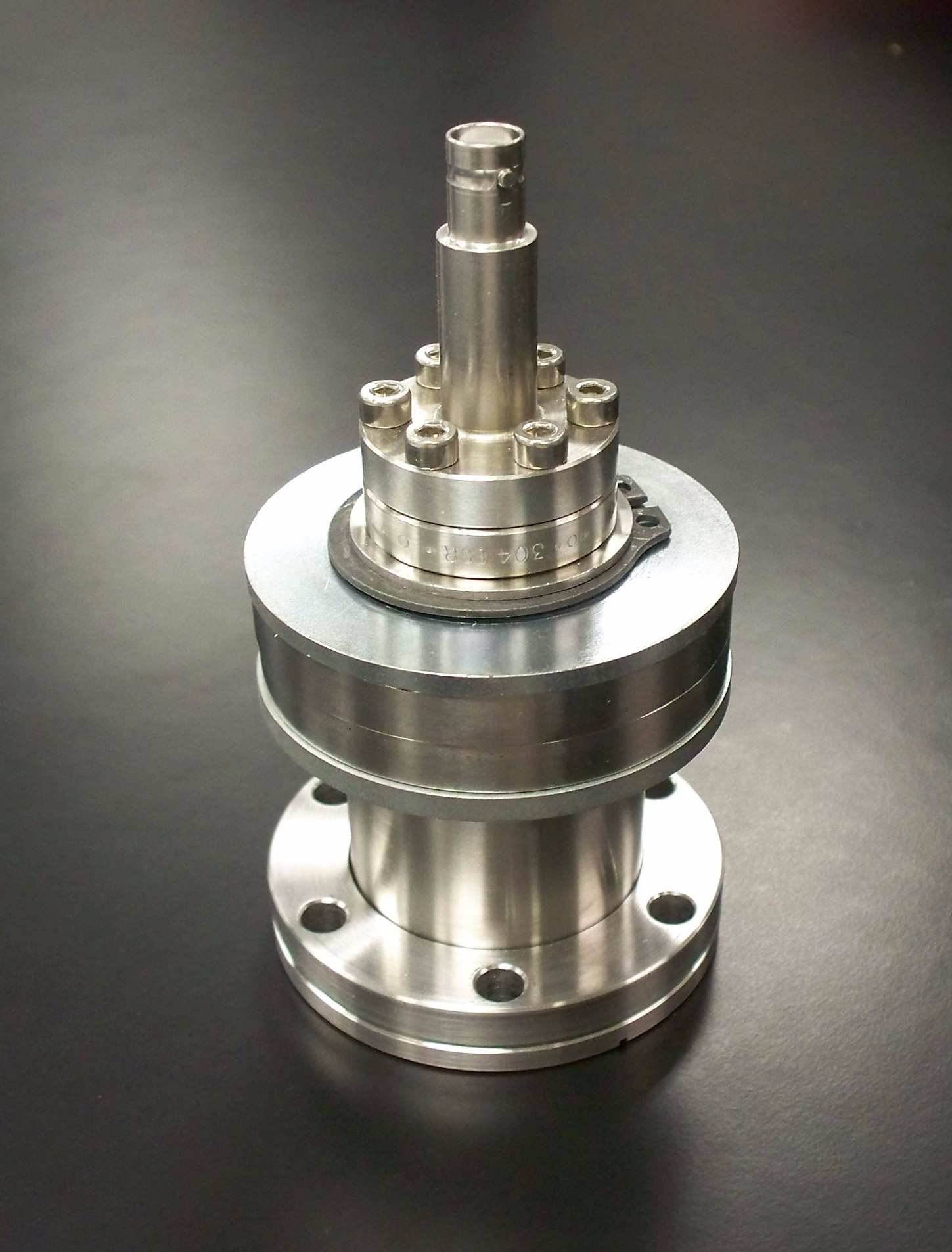
Agilent Technologies IMG 300 Inverted Magnetron Gauge
Agilent Technologies IMG 300 Inverted Magnetron Gauge — Vacuum gauges.
The IMG-300 is a 1.6-inch inverted magnetron cold cathode ionization gauge with an all-welded 304L stainless steel shell, ceramic-brazed feedthrough, and ConFlat flange, covering 10⁻³ to 10⁻¹¹ Torr. Its 3 kV DC high-voltage discharge, 2.5 A/Torr sensitivity, and <10 ms response suit fast UHV measurement where no hot filament is acceptable. It is intended for rugged UHV service and environments where stray electrons and photons disturb hot-filament gauges.
Full specifications
| Measurement range | -3...10 Torr |
| Sensitivity | 2.5 A/Torr |
| Response Time | 10 milliseconds |
| Feedthrough/UHV mfr | Ceramic brazed brazed |
| Ignition Time mfr | 5 Torr |
| Operating voltage (HV range) mfr | 3 DC |
| Operating Voltage mfr | 3 DC |
| Electrical Connector mfr | 5 rated |
| Material Exposed to the Vacuum mfr | 304 ceramic |
| Bakeout Temperature | 250 °C |
| Operating temperature | 250 °C |
Description
Construction and series positioning
- Cold cathode inverted magnetron design with no hot filament; all-welded stainless steel shell and ceramic-brazed feedthrough; no elastomers in the vacuum path.
- Materials exposed to vacuum: 304L stainless steel, nickel, 2% thoriated tungsten, and ceramic.
- 1.6-inch diameter body with ConFlat flange (part R0343301, IMG-300 2.75 CFF); a separate maintenance kit is listed as R0342301.
- No sibling models are listed for this series, so the IMG-300 is the single configuration described in the manual.
Behavior and measurement characteristics
- Measurement range 10⁻³ to 10⁻¹¹ Torr (10⁻³ to 10⁻¹¹ mbar); sensitivity 2.5 A/Torr (+100%, −5% at 5×10⁻⁶ Torr), used to convert ion current to pressure.
- Response time <10 ms for increasing pressure, making the gauge suitable for transients and fast control loops.
- Ignition time <5 s at pressures above 1×10⁻⁶ Torr, but typically 20 minutes at 1×10⁻¹⁰ Torr; no special starting accessory is normally required.
- The manual notes the gauge is generally not as stable or linear as a well-maintained Bayard-Alpert gauge; it is chosen for ruggedness and fast response rather than for the highest linearity.
Installation, connection, and operation
- High-voltage operating range is 3 kV DC; the electrical connector is a standard SHV style rated 5 kV, so the mating connector and coaxial cable must be rated for at least 5 kV.
- The gauge connects to a Multi-Gauge controller; the controller and vacuum system must be separately connected to a common ground, and the system ground must support at least 10 A.
- Do not place a ground wire between the vacuum chamber and the controller chassis; large continuous currents could flow through it.
- Bakeout up to 250 °C is permitted with the ConFlat metal gasket and magnet, provided the cable is unplugged during bakeout.
- The magnet's external field requires mounting at least a few inches from any magnetic material; if no magnetic force is felt, the distance is sufficient. Avoid contact with steel tools and rough handling, which can reduce magnet strength and shift calibration.
Integration & Operating Notes
The inverted magnetron's external field interacts with nearby magnetic parts. Mount the gauge so that no magnetic force is felt at the chosen distance; contact with steel tools and rough handling can weaken the magnet and change calibration, so plan the flange location and tool access accordingly.
The gauge operates at 3 kV DC on the high-voltage range and terminates in a standard SHV connector rated 5 kV. The mating cable and connector must carry that rating; a lower-rated assembly is not a safe substitute for the high-voltage discharge path.
The cold cathode high-voltage discharge can act as an ignition source, and the device is not intrinsically safe. The gauge must be disconnected from the controller and never turned on when combustible gases or mixtures are present in the system.
Ignition is faster than 5 seconds above 1×10⁻⁶ Torr, but at 1×10⁻¹⁰ Torr it typically takes about 20 minutes. Control logic and operator procedures should tolerate this startup delay at very high vacuum rather than treating a slow start as a fault.
With the ConFlat metal gasket and magnet, the gauge may be baked to 250 °C, but the cable must be unplugged during bakeout. Plan the bakeout cycle and cable routing so the connector can be disconnected without disturbing the flange or the gauge alignment.
Silicone oil or grease must not be used on the gauge or vacuum surfaces. If grease is necessary, apply Apiezon L grease (Agilent part number 695400004) sparingly. Do not clean aluminum parts with Alconox, and wear powder-free butyl or polycarbonate gloves when handling vacuum surfaces.
Periodic service and calibration are available from Agilent under the STARRS service program. Because mechanical shock or prolonged contact with the metal surface can change magnet strength and shift calibration, a recalibration path should be planned for after any rough handling.
Selection & Integration Q&A
Choose the IMG-300 for rugged UHV service, fast response (<10 ms), and where stray electrons or photons disturb hot-filament gauges. The manual notes it is generally not as stable or linear as a well-maintained Bayard-Alpert gauge, so prefer the Bayard-Alpert when linearity and stability dominate over ruggedness.
It connects to a Multi-Gauge controller via a standard SHV connector rated 5 kV, and the operating high-voltage range is 3 kV DC. The mating coaxial cable and connector must be rated for at least 5 kV. The controller and vacuum system must be separately grounded to a common ground tested for at least 10 A.
Mount at least a few inches from any magnetic material; if no magnetic force is felt, the distance is sufficient. Avoid steel tools and rough handling, which can weaken the magnet and shift calibration. Bakeout is allowed to 250 °C with the ConFlat metal gasket and magnet, with the cable unplugged. The gauge is Class A and may cause radio interference in domestic environments.
The base gauge is part R0343301 (IMG-300 2.75 CFF); a maintenance kit is listed separately as R0342301. Calibration can be maintained under the STARRS service program. Use Apiezon L grease (part 695400004) sparingly if grease is needed, never silicone oil or grease, and wear powder-free butyl or polycarbonate gloves when handling vacuum surfaces.