
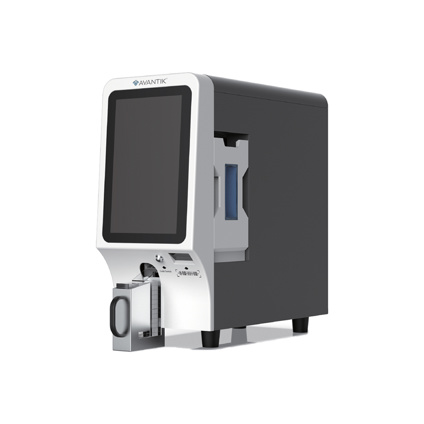
Avantik S100
Avantik S100 — Slide printers.
The Avantik S100 is a UV laser slide printer that marks slides at 2500 dpi with a throughput of 4 seconds or less per slide. It is the base model in the UV laser slide printer line, distinguished from the S200 by its specific configuration and performance envelope. It is used for permanent, high-resolution labeling of microscope slides directly in laboratory workflows.
Full specifications
| Print resolution | 2500 dpi |
| Print technology | UV laser |
| Throughput | 4 seconds or less |
| Weight | 52.9 lbs |
Description
Construction and positioning
- The S100 is a UV laser slide printer, using a UV laser marking engine rather than thermal transfer or CO2 laser technology. - The unit weighs approximately 24 kg (52.9 lbs), indicating a benchtop or floor-standing laboratory instrument. ### Performance and operation
- Print resolution is 2500 dpi, suitable for durable, high-contrast slide labels. - Throughput is 4 seconds or less per slide, enabling rapid batch processing. ### Installation and integration
- The brochure digest does not contain actionable engineering facts regarding installation, connection, control, or operation specifics. Refer to the full instruction manual for electrical requirements, interface details, and environmental limits.
Integration & Operating Notes
The brochure digest does not specify voltage, current, or frequency for the S100. Consult the instrument nameplate and instruction manual to confirm compatibility with local power before installation.
Selection & Integration Q&A
The available brochure digest does not specify electrical or interface details. Refer to the S100 instruction manual for voltage, current, and communication protocols. Ensure facility power matches the nameplate rating before connection.
No environmental or duty-cycle limits are provided in the brochure digest. The S100 is a laboratory instrument; typical operating conditions (e.g., ambient temperature, humidity) should be confirmed in the instruction manual. Continuous operation at the rated 4-second cycle may require adequate ventilation.