
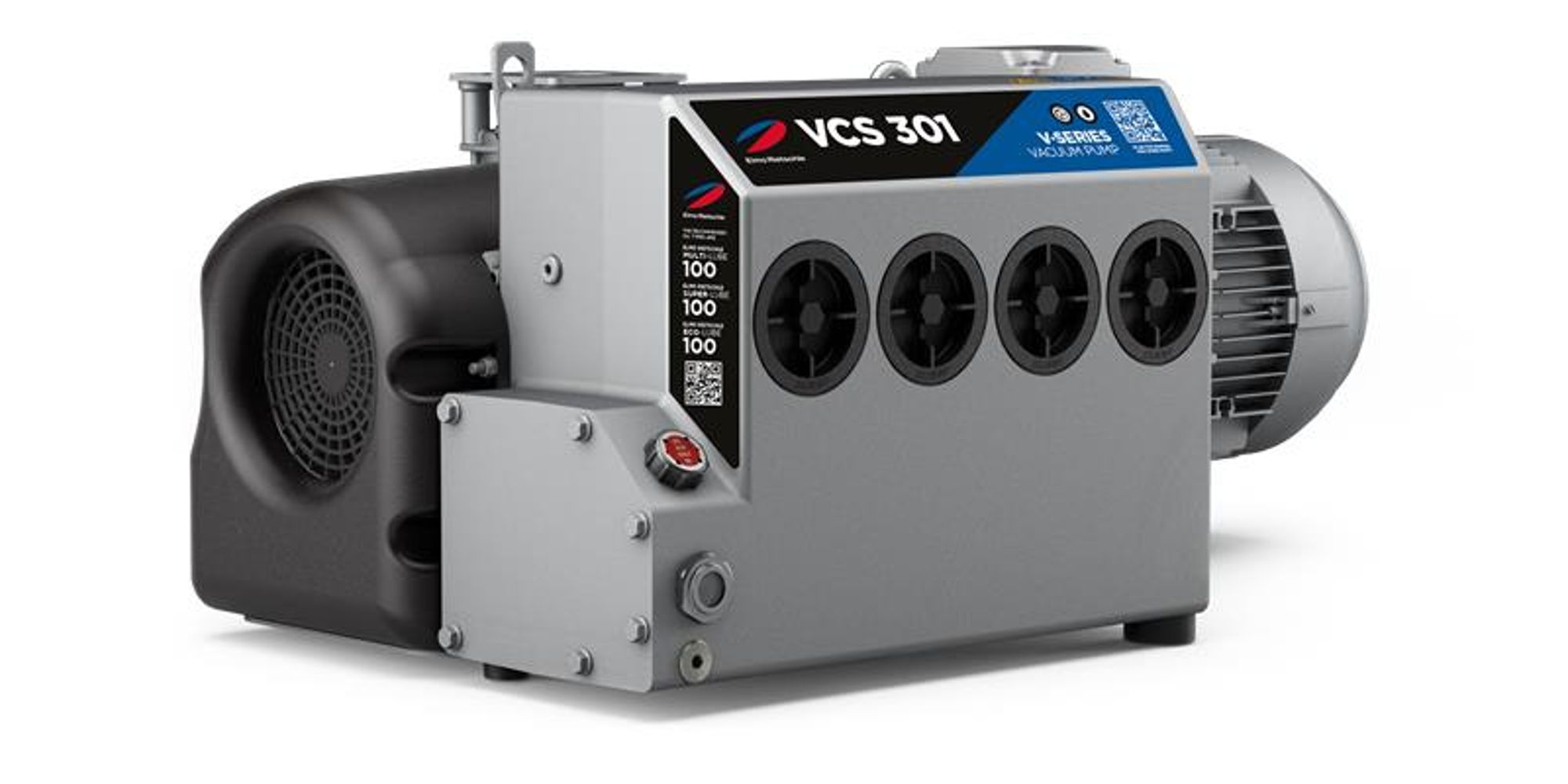
Elmo Rietschle V-VCS 200
Elmo Rietschle V-VCS 200 — Central Industrial & Medical Vacuum Systems.
The V-VCS 200 is a single-stage, oil-flooded rotary vane vacuum pump with a nominal suction capacity of 200 m³/h at 50 Hz, configured for continuous intake pressures from 0.5 to 500 mbar (abs.). Within the V-VCS series, it sits between the V-VCS 100 and V-VCS 400, using the same standard (non-VCX) design without enhanced water-vapour resistance. It serves as the vacuum-generating unit in central industrial vacuum systems, where its 200 m³/h displacement matches the required pumping speed at process pressure.
Elmo Rietschle V-VCS Series — Model Comparison & Selection
| Model | Motor power, kW | Noise level, dB | Pumping speed, m³/h | Ultimate pressure, mbar | Weight, kg | Current, A |
|---|---|---|---|---|---|---|
| V-VCS 200 Current | — | — | — | — | — | — |
| V-VCS 100 | — | — | — | — | — | — |
| V-VCS 1100 | 25 | 81 | 26 | 1 | 807 | 42.9–74.5 |
| V-VCS 40 | 1.1 | 63 | 48 | 0.5 | 39 | 2.34–4.07 |
| V-VCS 400 | 9 | 73 | 400 | 0.5 | 357 | 10.5–18.1 |
Full specifications
| Model mfr | V-VCS 200 |
| Series mfr | V Series |
| Design mfr | Rotary Vane |
| Document type mfr | Operating Instructions (Translation of the origi |
| Edition mfr | 1.7 |
| Date mfr | 28/06/2022 |
| Document number mfr | BA 236-EN |
| Max inclination mfr | 1 ° |
| Maintenance clearance mfr | 50 cm |
| Max. inclination mfr | 1 ° (in all directions) |
| Maintenance clearance around machine mfr | 50 cm (minimum) |
| Ambient temperature limit | 12 degC (min.) max.: 40 degC |
| Cooling type | Air-cooled (cooling air inlets/outlets, min. 30 cm from walls) |
| Cooling air clearance to walls mfr | 30 cm |
Description
Construction and series positioning
- Single-stage oil-flooded rotary vane principle with inlet flange, integrated non-return valve, oil separator element, gas ballast valve, and oil sight glass.
- The V-VCS 200 is the standard-design variant; the V-VCX 200 shares the same 200 m³/h displacement but adds water-steam/solvent-resistant internals, glass-fibre reinforced epoxy resin slide gates, increased gas ballast quantity, and an adjustable gas ballast valve with ball valve.
- Sibling models V-VCS 40, 100, 400, and 1100 cover the same series at different displacements; the 200 is selected when the required pumping speed at 50 Hz falls near 200 m³/h.
Behaviour under load and media
- Continuous intake pressure range for the V-VCS 200 is 0.5 to 500 mbar (abs.); operation outside this range risks oil leakage through the outlet.
- For continuous operation above 100 mbar (abs.), the next higher motor output must be selected to avoid overheating.
- When evacuating closed systems, the volume to be evacuated must not exceed 2% of the nominal pumping capacity (i.e., 4 m³ for this model).
- Permissible back pressure on the exhaust side is up to +100 mbar; no filters may be fitted on the exhaust side.
- Frequent switching at approximately 10 times per hour or higher ambient/inlet temperatures may exceed motor winding and bearing temperature limits; consult the manufacturer for such duty.
Installation, connection and operation
- The machine must be set up horizontally with a maximum inclination of 1° in all directions; cooling air inlets/outlets require at least 30 cm clearance from adjacent walls, and at least 50 cm free space is needed around the machine for maintenance.
- Ambient and inlet temperatures must remain between 12 and 40 °C; output reduction is noticeable above 1000 m above sea level.
- Motor protection class IP 55, insulation class F; permissible voltage deviation ±5% and frequency deviation ±2%.
- For parallel operation of multiple pumps, an external non-return valve must be installed in the suction line upstream of each pump.
- For standstill times longer than two minutes, vent the connected suction line to atmospheric pressure (e.g., via a ball valve).
- Lubricating oil must comply with ISO VG 100 (DIN ISO 3448); storage is limited to 6 months at -10 to +60 °C and max. 80% relative humidity, with preservation oil required for storage beyond 3 months.
Integration & Operating Notes
Operating the V-VCS 200 outside its continuous intake pressure range risks oil being carried through the outlet opening. Processes that periodically drop below 0.5 mbar or rise above 500 mbar require a different pump size or the V-VCX variant, and the suction line must be vented to atmosphere for standstill periods longer than two minutes.
When evacuating a closed system, the volume to be evacuated must not exceed 2% of the nominal pumping capacity — approximately 4 m³ for the 200 m³/h V-VCS 200. Larger volumes require either a larger pump from the series or staged evacuation, otherwise evacuation time and oil carry-over behaviour become unpredictable.
For continuous operation at intake pressures above 100 mbar (abs.), the next higher motor output must be used to prevent motor overheating. System designers should confirm the actual duty-point pressure before ordering, because the standard motor supplied with the V-VCS 200 is intended for lower continuous intake pressures.
The permissible back pressure on the exhaust air side is up to +100 mbar, and no filters may be installed on the exhaust side. Exhaust piping must be sized so that this limit is never exceeded during operation, since higher back pressure can damage the pump and distort vacuum performance.
When several pumps operate in parallel, an external non-return valve must be installed in the suction line upstream of each pump. This prevents a switched-off V-VCS 200 from being driven backwards by the operating pumps, which would damage the pump and contaminate the oil.
For standstill times longer than two minutes, the connected suction line must be vented to atmospheric pressure. Provide an air-release position such as a ball valve in the suction line so that the pump does not start against vacuum and oil is not drawn into the suction line during idle periods.
Lubricating oil must comply with ISO VG 100 as per DIN ISO 3448; incorrect viscosity can cause overheating or insufficient vacuum. Storage is limited to 6 months at -10 to +60 °C and max. 80% relative humidity, and storage beyond 3 months requires preservation oil instead of operating oil.
Both ambient temperature and inlet temperature must remain within 12 to 40 °C; the manufacturer must be contacted for operation outside this range. Output reduction is noticeable above 1000 m above sea level, so high-altitude installations require consultation before selection.
Selection & Integration Q&A
Pick the V-VCS 200 when the duty point is near 200 m³/h at 50 Hz and the process is dry or only mildly humid, with intake pressure between 0.5 and 500 mbar (abs.). Choose the V-VCX 200 if the gas stream carries water vapour or solvents, since it adds resistant internals and an adjustable gas ballast. Move to V-VCS 100 or 400 only if the required pumping speed falls clearly below or above 200 m³/h.
The suction line needs an air-release valve for standstill venting and, in parallel-pump installations, an external non-return valve upstream of each pump. The exhaust line must be sized so back pressure never exceeds +100 mbar and must not carry filters. The evacuated closed volume should not exceed 2% of the 200 m³/h capacity (about 4 m³).
Mount horizontally with max. 1° inclination on a plane, even surface, keeping 30 cm clearance around cooling air inlets/outlets and 50 cm free space for maintenance. Ambient and inlet temperatures must stay between 12 and 40 °C. Avoid switching frequencies around 10 times per hour or higher temperatures without consulting the manufacturer, as motor winding and bearing limits may be exceeded.
The base pump does not include lubricating oil, suction-line vent valve, external non-return valves, or exhaust piping. Maintenance requires ISO VG 100 oil per DIN ISO 3448, oil separator element replacement, filter cleaning, and oil cooler/fan checks per the maintenance table. For storage beyond 3 months, preservation oil must be used instead of operating oil.