
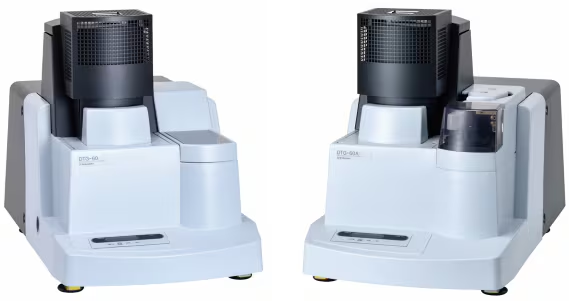
Shimadzu DTG 60 Series
Shimadzu DTG 60 Series — Thermal analyzers.
The Shimadzu DTG-60 Series is a thermogravimetric analyzer that measures mass changes in samples as a function of temperature. It is used for material characterization, including decomposition, oxidation, and moisture content analysis. The series includes multiple models with different temperature ranges and balance capacities.
Full specifications
Description
Construction and Architecture
The DTG-60 Series is a thermogravimetric analyzer (TGA) designed for precise measurement of mass changes in samples under controlled temperature programs. The instrument typically consists of a high-sensitivity balance, a furnace, and a sample holder. The series includes models such as DTG-60, DTG-60H, and DTG-60A, which differ in maximum temperature and balance capacity. The DTG-60 is the standard model, while the DTG-60H offers a higher temperature range, and the DTG-60A provides a larger balance capacity for larger samples.
Behavior Under Load and in Different Modes
The DTG-60 Series operates by heating a sample in a controlled atmosphere and continuously measuring its mass. The balance mechanism is designed to minimize drift and noise, ensuring accurate weight measurements even at high temperatures. The furnace can be programmed with various heating rates and isothermal holds. The instrument can operate in different atmospheres, such as nitrogen, air, or argon, to study oxidation or decomposition behaviors. The DTG-60H extends the temperature range to 1500°C, making it suitable for high-temperature applications like ceramics and metals.
Installation, Connection, Control, and Operation
Installation requires a stable power supply and a suitable environment with controlled temperature and humidity. The instrument is typically connected to a computer via RS-232C or USB for data acquisition and control using Shimadzu's software. The sample is placed in a platinum or alumina pan, and the furnace is closed before starting the measurement. Proper gas flow and purge times must be observed to ensure accurate results. Regular calibration of the balance and temperature sensors is necessary for reliable performance.
Integration & Operating Notes
The DTG-60 Series uses a sensitive balance that can be affected by vibrations. Install the instrument on a sturdy bench free from vibrations and drafts. Avoid placing it near equipment that generates vibrations, such as centrifuges or pumps. Ensure the instrument is level to prevent mechanical stress on the balance.
Connect the instrument to a power source that is free from voltage fluctuations and electrical noise. Use a dedicated circuit if possible. Avoid sharing the outlet with high-power equipment that may cause interference. The power supply must match the voltage and frequency specified on the instrument's nameplate.
The furnace must be fully closed and locked before initiating a temperature program. Starting a run with the furnace open can cause inaccurate results and may damage the instrument. The software typically includes an interlock that prevents operation if the furnace is not properly closed.
Select a purge gas that is compatible with the sample and the desired atmosphere. Typical gases include nitrogen, air, and argon. Set the flow rate according to the recommended range, usually between 20 and 100 mL/min. Insufficient flow can lead to incomplete purging and erroneous results, while excessive flow may cause turbulence and affect the balance.
Calibrate the balance using standard weights and the temperature sensor using reference materials at recommended intervals. Shimadzu recommends calibration every six months or after major repairs. Failure to calibrate can result in inaccurate measurements. Refer to the service manual for detailed procedures.
Selection & Integration Q&A
Choose the DTG-60H if your applications require temperatures up to 1500°C, such as for ceramics or metals. The standard DTG-60 is limited to 1000°C. The DTG-60H also offers a higher heating rate capability, making it suitable for high-temperature studies.
The DTG-60 can be connected via RS-232C or USB. Ensure your computer meets the software's system requirements. Use a shielded cable to minimize noise. Install the Shimadzu thermal analysis software and configure the communication port accordingly.
Regularly clean the furnace and sample holder. Replace the sample pans (platinum or alumina) as needed. Calibrate the balance and temperature sensor every six months. Check gas filters and replace if necessary. Refer to the maintenance schedule in the manual for details.
Dimensional Drawings & Technical Documentation
Dimensional drawings
Click drawing to inspect vector dimensions