
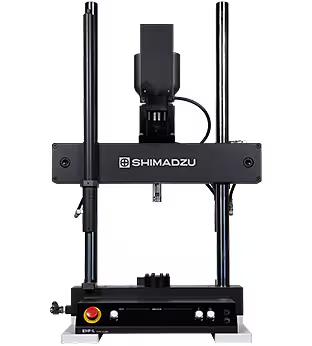
Shimadzu EHF L Series
Shimadzu EHF L Series — Testing machines.
The Shimadzu EHF L Series is a servo-hydraulic fatigue and fracture mechanics testing system configured as a floor-standing frame with a hydraulic power supply and digital controller. It is distinguished within the EHF series by its extended column height and large actuator stroke, accommodating long specimens and high-displacement tests. The system is used for static and dynamic testing of materials and components under controlled load or displacement.
Full specifications
Description
Construction and positioning
- Floor-standing, dual-column load frame with a hydraulic actuator mounted in the base; the L Series variant provides increased daylight and stroke compared to standard EHF models.
- Integrated hydraulic power unit and digital servo controller are supplied as part of the system, enabling closed-loop control in load, displacement, or strain.
- Designed for high-force static and dynamic testing, with a rigid frame to minimize compliance effects.
Behavior under load and media
- The servo-hydraulic actuator delivers smooth, high-force motion with precise control; load capacity and stroke are sized for fatigue and fracture tests on metallic and composite specimens.
- Hydraulic fluid temperature and cleanliness are critical to stable performance; the system includes filtration and cooling provisions.
- Dynamic performance depends on the hydraulic supply and controller tuning; the system supports sinusoidal, triangular, and arbitrary waveform generation.
Installation, connection, and control
- Requires a stable, vibration-isolated foundation and adequate clearance for specimen loading; the hydraulic power unit should be located away from the test frame to reduce noise and heat transfer.
- Electrical supply must match the motor rating of the hydraulic pump; control signals are routed via the digital controller with standard interfaces for external command and data acquisition.
- Operation is managed through dedicated software that provides test sequencing, data logging, and safety interlocks.
Integration & Operating Notes
The load frame must be bolted to a concrete floor or seismic block with flatness within 0.2 mm/m; uneven support induces bending stresses in the columns and misaligns the actuator, leading to seal wear and inaccurate load readings.
A clogged filter reduces flow and can cause cavitation in the pump, leading to damage. The filter element is not included in the base delivery and must be ordered separately; maintenance logs should record replacement dates.
Selection & Integration Q&A
Choose the L Series when testing long specimens or requiring large actuator strokes, such as full-size components or fracture mechanics specimens with high displacement. Standard EHF models have shorter columns and are better for compact, high-force tests where space is limited.
The hydraulic power unit must be located within 5 m of the frame to minimize pressure drop; use only the supplied high-pressure hoses. The power unit requires a dedicated electrical supply matching its motor rating and a clean, ventilated environment.
Ambient temperature must be 10–40°C with humidity below 80% RH. Continuous operation at maximum load is limited to 80% duty cycle; exceeding this may overheat the hydraulic oil and require additional cooling.
The base package excludes hydraulic oil, filter elements, specimen grips, and load cells other than the standard one. These must be ordered separately; refer to the accessories list for compatible grips and load cells.