
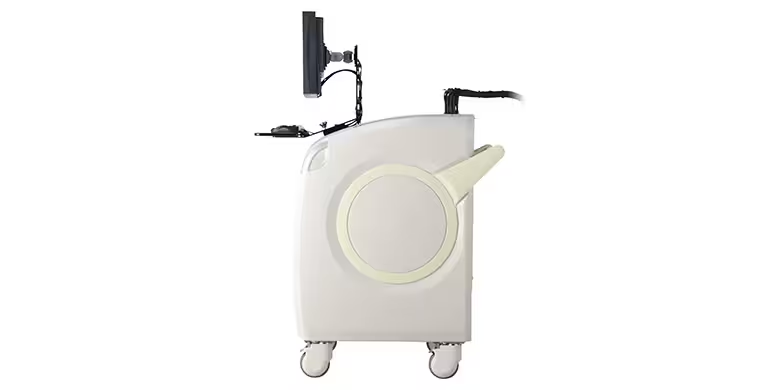
Shimadzu Labnirs
Shimadzu Labnirs — Life science instruments.
The Shimadzu Labnirs is a near-infrared spectroscopy (NIRS) system using photomultiplier tube detectors to measure hemoglobin concentration changes in biological tissue. It supports configurations from 4 sets (10 channels) up to 40 sets (142 channels), enabling scalable cortical mapping. The system is used for non-invasive monitoring of brain activity via Oxy-Hb, Deoxy-Hb, and Total-Hb variations.
Full specifications
| Detector types | photomultiplier tube |
| Wavelength | 650, 750, 850, 950 nm |
| Number of wavelengths mfr | 3 |
| Number of measurement channels mfr | 10, 24, 38, 52, 67, 82, 97, 112 ch |
| Main unit sets mfr | 4, 8, 12, 16 sets |
| Maximum optical fibers (in 40 sets) mfr | 80 fibers (in 40 sets) |
| Sampling mfr | high-speed |
| Fiber holder type mfr | FLASH (Flexible Adjustable Surface Holder) |
| Fiber placement mfr | Normal Placement, High-Density Placement |
| Fiber shape mfr | L-Shaped Fiber, Straight-Type Fiber |
| Infant fiber holder mfr | Type A, Type B, Whole-head Fiber Holder for infa |
| Simultaneous measurement mfr | NIRS + EEG |
| Software mfr | MRI Fusion Software |
| Position measurement mfr | 3D position measurement system |
| Intended use mfr | For Research Use only. Not for use in diagnostic |
| Number of subjects (ANA employees) mfr | 12 male pilots (ANA employees) |
| Expert captains (48 ± 4 years of age) mfr | 6 subjects (48 ± 4 years of age) |
| Expert captains total flying time mfr | 10,490 ± 1,260 hours |
| Young trainees (24 ± 2 years of age) mfr | 6 subjects (24 ± 2 years of age) |
| Young trainees total flying time mfr | 120 ± 72 hours |
| Measurement positions (prefrontal area) mfr | 22 channels (prefrontal area) |
| Relaxation time mfr | 2 min |
| Number of landings (2 easy tasks and 3 difficult tasks) mfr | 5 landings (2 easy tasks and 3 difficult tasks) |
| Left DLPFC activity difference (expert captains) (average of 5 landings, easy and difficult tasks) mfr | p<0.001 (average of 5 landings, easy and difficult tasks) |
| Channels (LABNIRS main unit, type L optic fibers) mfr | 97 channels (LABNIRS main unit, type L optic fibers) |
| Main unit quantity (LABNIRS full system configuration) mfr | 28 sets (LABNIRS full system configuration) |
| Channels (LIGHTNIRS two-unit system) mfr | 52 channels (LIGHTNIRS two-unit system) |
| Main unit quantity (LIGHTNIRS two-unit system) mfr | 2 units (LIGHTNIRS two-unit system) |
| Optic fiber cable sets (LIGHTNIRS dedicated optic fiber cables, per unit) mfr | 8 sets (LIGHTNIRS dedicated optic fiber cables, per unit) |
| Number of subjects (feasibility study) mfr | 10 subjects (feasibility study) |
| Optic fiber cable length (LIGHTNIRS dedicated optic fiber cables) mfr | 2 m (LIGHTNIRS dedicated optic fiber cables) |
| Rest period (measurement task protocol) mfr | 30 sec (measurement task protocol) |
| Task period (measurement task protocol) mfr | 15 sec (measurement task protocol) |
| Flight altitude (flight simulator) mfr | 2000 ft (flight simulator) |
Description
Construction and Architecture
The Labnirs is a modular NIRS instrument built around photomultiplier tube (PMT) detectors. Its channel count is determined by the number of detector sets: 4 sets yield 10 channels, while 40 sets yield 142 channels. This modularity allows the system to be scaled from basic to high-density mapping. ### Measurement Principle and Behavior
The system measures relative changes in oxygenated hemoglobin (Oxy-Hb), deoxygenated hemoglobin (Deoxy-Hb), and total hemoglobin (Total-Hb) from initial values. It does not provide absolute concentrations. PMT detectors offer high sensitivity, but their performance may be affected by ambient light; measurements should be conducted in controlled lighting. Users should refer to the official Shimadzu manual for electrical requirements, interface protocols, and operating procedures.
Integration & Operating Notes
Proper fixation of optical fibers or probes is essential to minimize motion artifacts. The system does not include subject interface accessories by default; these must be specified separately.
The Labnirs reports variations from initial values, not absolute concentrations. Baseline drift and systemic physiological interference (e.g., heart rate, respiration) must be accounted for during analysis.
Photomultiplier tubes may drift over time; regular calibration and performance verification are recommended. Consult the service manual for intervals and procedures.
Selection & Integration Q&A
Choose 40 sets (142 channels) for high-density cortical mapping requiring broad spatial coverage. Lower channel counts (e.g., 4 sets, 10 channels) suffice for localized or preliminary measurements, offering lower cost and simpler setup.
The Labnirs outputs analog or digital signals via its interface; specific connector types and protocols are detailed in the manual. Ensure the receiving system supports the channel count and sampling rate. Optical fibers must be compatible with the PMT inputs.
Operate in a stable, low-vibration environment away from strong electromagnetic interference. Ambient light should be minimized to prevent PMT saturation. Temperature and humidity ranges are specified in the manual; typical laboratory conditions are acceptable.
Regular calibration of PMTs and cleaning of optical connectors are required. Accessories such as optical fibers, probes, and subject interface kits are not included in the base delivery and must be ordered separately. Refer to the manual for maintenance intervals.