
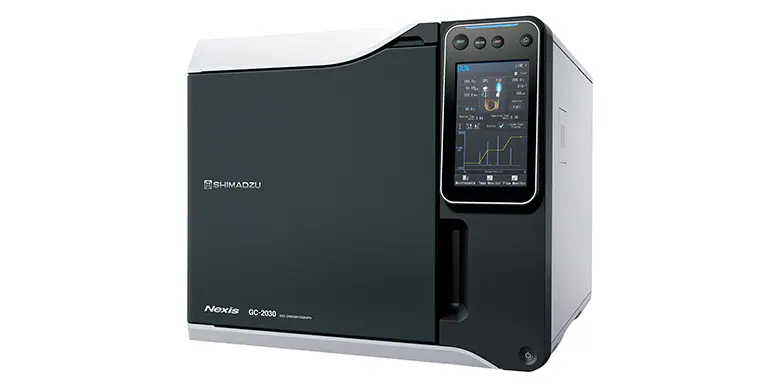
Shimadzu Nexis GC 2030
Shimadzu Nexis GC 2030 — Chromatographs.
The Nexis GC 2030 is a gas chromatograph with a split/splitless, direct, on-column, or programmable temperature vaporizer injector and a column oven reaching 450°C. It supports constant linear velocity, constant flow, or constant pressure carrier gas control up to 970 kPa and 1300 mL/min, accommodating seven detector types. It serves as the separation and detection core in analytical GC systems for volatile and semi-volatile compounds.
Direct drop-in replacements
Full specifications
Description
Construction and positioning
The Nexis GC 2030 is a single-channel gas chromatograph built around a 450°C column oven and a versatile sample injector that accepts split/splitless, direct, on-column, and programmable temperature vaporizer (PTV) techniques. Carrier gas control is electronic, offering constant linear velocity, constant flow, or constant pressure modes within a maximum pressure of 970 kPa and a maximum flow rate of 1300 mL/min. The system supports up to seven detector types—FID, TCD, BID, FTD, FPD, ECD, and SCD—making it adaptable to a wide range of detection needs. A color-touch panel provides local operation and status display. ### Behavior under load and in different modes
The 450°C oven ceiling enables analysis of high-boiling compounds and fast temperature programs. The three carrier gas control modes let the method developer prioritize retention time stability (constant flow or pressure) or linear velocity for speed. The injector's PTV capability allows large-volume injection and thermal modulation, while on-column injection suits thermally labile analytes. Detector selection determines sensitivity and selectivity: FID for hydrocarbons, ECD for halogenated compounds, FPD for sulfur/phosphorus, and so on. The system's maximum pressure and flow define the practical column dimensions and carrier gas choice. ### Installation, connection, and operation
Installation requires laboratory bench space, carrier gas supply (typically nitrogen, helium, or hydrogen) regulated to the system's inlet pressure, and detector-specific gases (e.g., hydrogen and air for FID). Electrical supply and data system connection are necessary; the color-touch panel allows standalone control. The system should be installed in a well-ventilated area, with exhaust for detector gases if required. Routine operation involves setting oven temperature programs, injector parameters, and detector settings via the panel or chromatography data system.
Integration & Operating Notes
Exceeding the maximum pressure can damage the electronic pressure control module and compromise safety. Ensure the gas supply regulator is set below this limit and that column and injector restrictions are compatible with the available pressure.
Operating the oven above 450°C may degrade the column and damage oven components. Set the method's upper temperature limit with a safety margin, and verify that the column's maximum temperature is not exceeded.
Connect the instrument to a dedicated, grounded electrical outlet as specified in the manual. Avoid sharing circuits with high-power equipment to prevent noise and ensure reliable operation of the electronic controls and detectors.
Detectors such as FID require hydrogen and air, while ECD may require a makeup gas. Use high-purity gases and appropriate traps to prevent contamination and baseline noise. Verify that gas pressures meet detector requirements before ignition or operation.
Septa and liners degrade with use, causing leaks, ghost peaks, and poor reproducibility. Follow the maintenance schedule in the manual, typically replacing septa every 100–200 injections and liners as needed based on sample cleanliness.
Selection & Integration Q&A
Choose the GC 2030 when you need a 450°C oven, multiple injector modes including PTV, and support for up to seven detectors. If you require higher pressure or additional automation, consider other models in the series.
The carrier gas must be supplied at a pressure not exceeding 970 kPa and a flow capacity of at least 1300 mL/min. Use high-purity gas and a two-stage regulator to maintain stable pressure.
Install in a laboratory with ambient temperature within the manual's specified range, away from direct sunlight and strong drafts. Ensure adequate ventilation for detector gases and avoid continuous operation at maximum oven temperature to extend component life.
The base delivery typically excludes columns, injector liners, septa, gas filters, and detector-specific gases. Plan to purchase these consumables separately and follow the manual's maintenance schedule for replacement.