
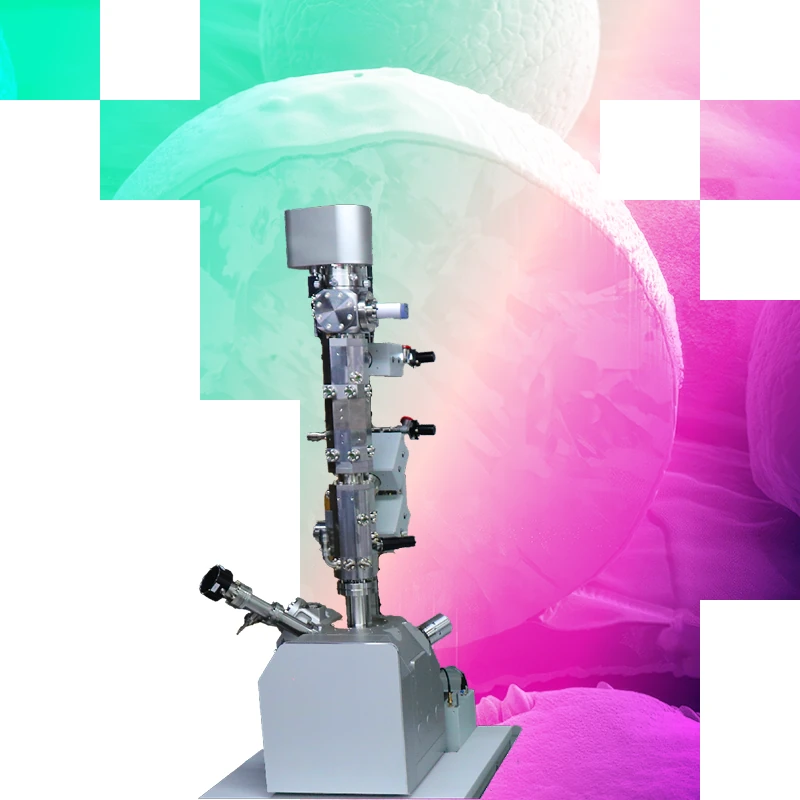
Shimadzu Tescan Quiin
Shimadzu Tescan Quiin — Microscopes.
The Tescan Quiin is a focused ion beam (FIB) system with a SEM column in coincidence point, using a Wien filter for isotope selection and YAP scintillator detectors. It operates with gas ions (N, Ar, O, He, Xe or mixtures) and metal ions (Au, Ge, Si) at 3–30 keV, and integrates an in-situ heating stage (FurnaSEM 1000) for annealing above 950 °C. It is intended for advanced nanofabrication, isotope-selective implantation, and high-temperature material studies within a single vacuum platform.
Full specifications
Description
Construction and positioning
- The Quiin combines a FIB column and a SEM column in a coincidence point configuration, enabling simultaneous or sequential ion and electron beam operations on the same sample area. - A Wien filter provides isotope selection, allowing specific ion species to be chosen from the available gas and metal sources. - Detection is via YAP scintillators, and the system is controlled through the Pegasus GUI. ### Behavior under load and in different media
- The acceleration voltage/energy range of 3–30 keV covers both low-energy surface-sensitive and higher-energy implantation or milling regimes. - Gas ion species (N, Ar, O, He, Xe or mixtures) and metal ions (Au, Ge, Si) can be selected, each with different sputter yields and interaction volumes; the Wien filter ensures isotopic purity where required. - The ultra-sensitive current measurement system provides dose control, critical for reproducible implantation or patterning. - The integrated FurnaSEM 1000 heating stage enables in-situ annealing above 950 °C, allowing observation of dynamic processes such as recrystallization or dopant activation without transferring the sample. ### Installation, connection, and operation
- The system requires vacuum-compatible mounting and connection to gas supplies for the specified ion species; metal ion sources require appropriate source materials. - Control is via the Pegasus GUI, which manages beam parameters, isotope selection, dose, and heating stage operation.
Selection & Integration Q&A
Choose the Quiin when you need isotope-selective ion beams (via Wien filter) and in-situ heating above 950 °C. It is ideal for studies requiring precise dose control and multi-species ion implantation. Other models may lack these specialized features.
The Quiin requires a high-vacuum environment compatible with FIB and SEM operation. Gas delivery lines for N, Ar, O, He, Xe or mixtures must be of high purity and materials compatible with the reactive species. Metal ion sources require dedicated ports and power supplies.
Continuous operation at high beam currents or elevated temperatures may require cooling breaks. The heating stage should not be operated above 950 °C for extended periods without verifying sample stability. Ambient temperature and humidity must be within laboratory standards to ensure electronics reliability.
The base delivery does not include gas cylinders, metal ion source materials, sample holders for the heating stage, or calibration standards. Regular replacement of YAP scintillators and Wien filter components may be required. A service contract for software updates and preventive maintenance is recommended.