
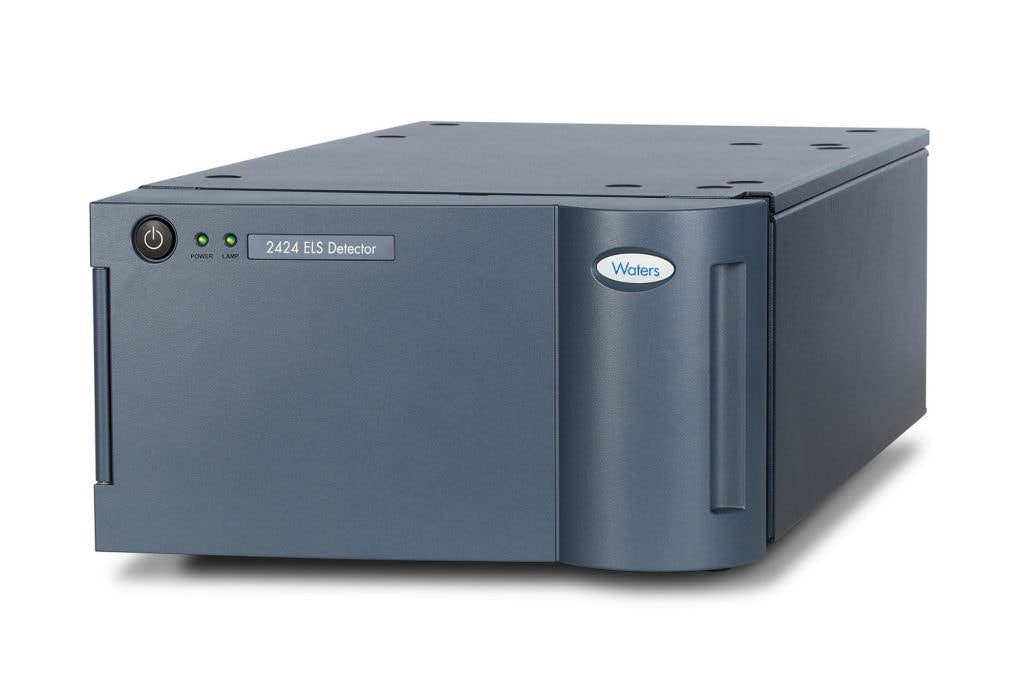
Waters 2424 Evaporative Light Scattering Detector
Waters 2424 Evaporative Light Scattering Detector — Chromatography detectors.
The Waters 2424 is an evaporative light scattering detector (ELSD) with a high-flow nebulizer (300–3000 µL/min) and a drift tube controllable from ambient +5.0 to 100.0 °C in 0.1 °C increments. Its heated optics bench held at a constant 50 °C and 60° scattering angle distinguish it as a dedicated LC detector for non-volatile analytes lacking UV chromophores. It serves as a universal, gradient-compatible detector in chromatography systems where analyte volatility is low and nebulization into a nitrogen stream is feasible.
Full specifications
| Detector type | Evaporative Light Scattering Detector |
| Nebulizers (high-flow rate) mfr | 300 to 3000 μL/min, (gas flow at 1.80 L/min at 2 |
| Nebulizers (optional low-flow rate) mfr | 50 to 500 μL/min, (gas flow at 0.77 L/min at 25 |
| Nebulizer heater power mfr | 0% to 100% |
| Nebulizer cooler mfr | On/off |
| Drift tube mfr | Ambient +5.0 to 100.0 °C; 0.1 °C increments |
| Optional external column heater mfr | Ambient +5.0 to 150.0 °C; 1.0 °C increments |
| Gas supply mfr | Nitrogen, to be supplied at least 65 psi |
| Gain setting mfr | 0 to 1000 |
| Filter time constant mfr | Hamming, 0.0 to 5.0 s |
| Sampling rate mfr | Up to 80 points/s |
| Measurement range mfr | 0.1 to 2000.0 LSU |
| Optics mfr | Heated optics bench (constant 50 °C) |
| Light source mfr | Tungsten halogen polychromatic front mounted, pr |
| Scattering angle mfr | 60 degrees |
| Wetted materials mfr | 316 stainless-steel, aluminum, viton, PTFE, FEP, |
| Light source warranty mfr | 2000 hours or 1 year warranty (whichever comes f |
Description
Construction and positioning
- The 2424 is a standalone ELSD module: sample enters a nebulizer, is mixed with nitrogen at ≥65 psi, and the resulting aerosol passes through a temperature-controlled drift tube where solvent evaporates; residual particles scatter light from a tungsten-halogen source, detected by a photomultiplier at 60°. - The standard high-flow nebulizer covers 300–3000 µL/min at 1.80 L/min gas flow (25 psi); an optional low-flow nebulizer (50–500 µL/min, 0.77 L/min at 25 psi) is available for narrow-bore or capillary-scale work. - Wetted materials include 316 stainless steel, PTFE, FEP, Viton, silicone rubber, polyethylene, and polyurethane, supporting common reversed-phase and normal-phase solvents. ### Behavior under load and in different modes
- The drift tube operates from ambient +5.0 to 100.0 °C in 0.1 °C steps; the nebulizer heater is adjustable 0–100% and the nebulizer cooler is on/off. These controls let the user balance evaporation efficiency against analyte loss for semi-volatile compounds. - Gain is adjustable from 0 to 1000, filter time constant (Hamming) from 0.0 to 5.0 s, and sampling rate up to 80 points/s, allowing trade-offs between sensitivity, noise, and peak resolution. - Measurement range is 0.1 to 2000.0 LSU. The heated optics bench at a constant 50 °C reduces condensation and baseline drift. ### Installation, connection, and operation
- Gas supply must be nitrogen at ≥65 psi; the instrument does not include a gas generator or regulator. The light source is a front-mounted, pre-aligned tungsten-halogen lamp, user-installable, with a 2000-hour or 1-year warranty (whichever comes first). - An optional external column heater (ambient +5.0 to 150.0 °C, 1.0 °C increments) can be added for temperature control upstream of the detector.
Integration & Operating Notes
The nebulizer requires nitrogen at ≥65 psi to generate the aerosol; lower pressure will degrade nebulization efficiency and may prevent the instrument from reaching the specified gas flow rates (1.80 L/min for high-flow, 0.77 L/min for low-flow). Verify the supply can sustain this pressure at the required flow before installation.
Operating the drift tube outside this range risks incomplete solvent evaporation (too low) or analyte loss/thermal degradation (too high). The 0.1 °C increment allows fine adjustment, but the setpoint must be validated against the boiling point of the mobile phase and the thermal stability of the analyte.
Selection & Integration Q&A
Choose the standard high-flow nebulizer (300–3000 µL/min) for conventional analytical LC columns at typical flow rates. The optional low-flow nebulizer (50–500 µL/min) is for narrow-bore or capillary-scale separations where the standard unit would be outside its range.
Provide nitrogen at ≥65 psi with sufficient flow capacity to sustain 1.80 L/min (high-flow nebulizer) or 0.77 L/min (low-flow) at 25 psi. A regulator, filter, and suitable tubing are not included and must be sourced separately.
The base delivery does not include the nitrogen supply/regulator, the optional low-flow nebulizer, or the optional external column heater. The tungsten-halogen lamp is user-installable and warranted for 2000 hours or 1 year; spare lamps should be planned as consumables.