
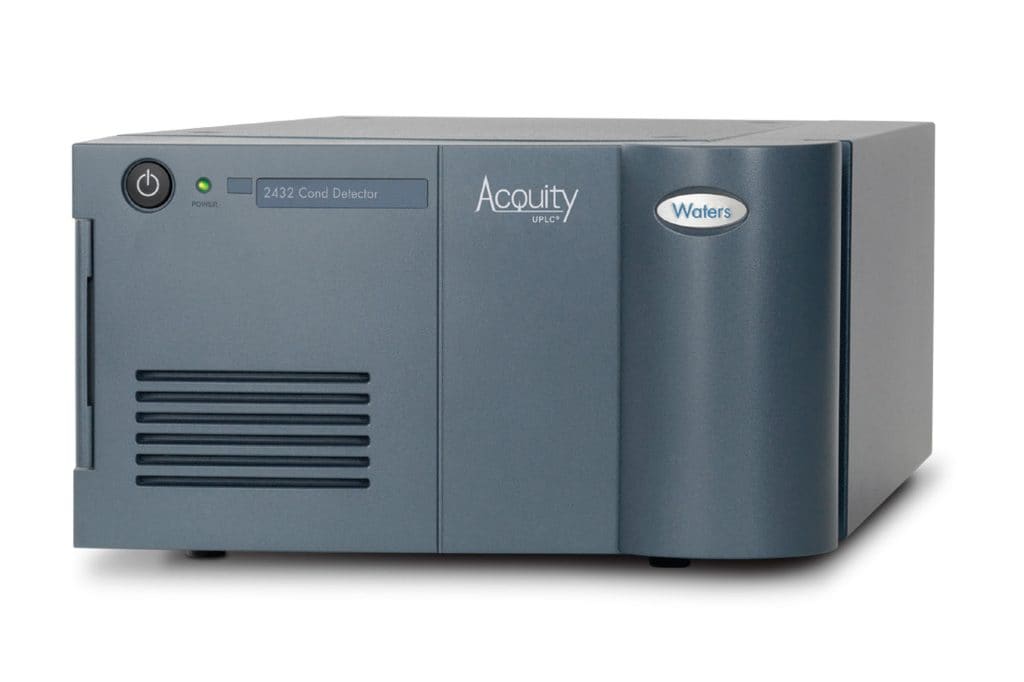
Waters 2432 Conductivity Detector for HPLC Systems
Waters 2432 Conductivity Detector for HPLC Systems — Chromatography detectors.
The Waters 2432 Conductivity Detector is a HPLC detector using ring-shaped stainless-steel electrodes in a 0.8 µL flow cell, with chemically inert PCTFE and stainless-steel wetted parts. It covers 0 to 10,000 µS/cm without range switching and provides active temperature control from 20 °C to 50 °C in 5 °C steps. It is intended for continuous conductivity monitoring in HPLC systems, delivering low noise (≤0.005 µS/cm) and drift below 0.5%/hr.
Full specifications
| Detector type | Conductivity Detector |
| Measuring range mfr | 0 to 10,000 μS/cm without range switching |
| Drift mfr | <0.5%/hr |
| Sampling rate mfr | 10 points/s |
| Electrodes mfr | Ring-shaped electrodes, made from stainless stee |
| Cell volume mfr | 0.8 μL |
| Pressure limit mfr | 4999 kPa (49,989 mbar, 725 psi) |
| Wetted materials mfr | Chemically inert polychlorotrifluoroethylene (PC |
| Moisture protection mfr | Normal (IPX0) |
| Line voltages, nominal mfr | Grounded ac |
| Measurement range mfr | 0 to 10,000 μS/cm (without range switching) |
| Drift (alt var) mfr | <0.5 %/hr |
| Maximum backpressure mfr | 5000 kPa (50 mbar, 725 psi) |
| Weight | 12.3 kg |
| Width mfr | 34.3 cm |
| Height mfr | 20.8 cm |
| Depth mfr | 61.0 cm |
| Minimum pulse width mfr | 100 ms |
| Power consumption | 160 VA (nominal) |
| Line frequency mfr | 50 to 60 Hz |
| Line voltages, nominal mfr | 100 to 240 Vac (grounded ac) |
| Power requirements mfr | 100 to 240 Vac |
| Fuse ratings mfr | 3.15 A, 250 V (fast-blow), 5 x 20 mm |
| Inject-start trigger V max mfr | +5 Vdc |
| Inject-start trigger V min mfr | +0 Vdc |
| Inject-start trigger VIH mfr | +2.0 Vdc |
| Inject-start trigger VIL mfr | +0.8 Vdc |
| Noise | ≤0.005 μS/cm |
| Audible noise (instrument generated) (alt var) mfr | <58 dBA |
| Operating humidity range mfr | 20 to 80 % non-condensing |
| Shipping and storage humidity range mfr | 20 to 85 % non-condensing |
| Protection class mfr | Class I |
| Overvoltage category mfr | II |
| Pollution degree mfr | 2 |
| Noise (alt var) mfr | ≤0.005 μS/cm |
Description
Construction and positioning
- The 2432 is a conductivity detector specifically configured for HPLC integration, featuring a low-volume (0.8 µL) flow cell with ring-shaped stainless-steel electrodes. - Wetted materials are limited to PCTFE and stainless steel, ensuring chemical compatibility with typical HPLC eluents. - Unlike fixed-range detectors, it provides a wide dynamic range (0–10,000 µS/cm) without manual range switching, simplifying method development. - Active temperature control (20–50 °C, 5 °C increments, or off) with ±0.1 °C stability supports reproducible measurements. ### Behavior under load and in different media
- The detector maintains low noise (≤0.005 µS/cm) and drift (<0.5%/hr) across its full range, enabling trace-level conductivity detection. - The 10 points/s sampling rate captures fast eluting peaks. - The pressure limit of 725 psi defines the maximum operating pressure; exceeding it risks cell damage. - Temperature control can be disabled (Off) for ambient operation, but stability then depends on laboratory conditions. ### Installation, connection, and operation
- The 2432 integrates into HPLC systems via standard fluidic connections; ensure compatibility with the 0.8 µL cell volume to avoid extra-column band broadening. - The detector requires a stable environment to achieve specified noise and drift; temperature fluctuations should be minimized when temperature control is off.
Integration & Operating Notes
The flow cell is rated to a maximum pressure of 725 psi. Operating above this limit can cause cell rupture or leakage, leading to inaccurate readings and potential safety hazards. Install appropriate pressure relief or monitoring upstream.
The detector can actively control temperature only within 20 °C to 50 °C, selectable in 5 °C increments, or turned off. Ensure your method's required temperature falls within this range and set it accordingly; otherwise, rely on ambient stability.
The flow cell may accumulate deposits from eluents, affecting noise and drift. Flush with appropriate solvents and follow the manual's cleaning procedure at recommended intervals to maintain performance.
The detector must be connected to a suitable power source and integrated with the HPLC system's data acquisition unit. Refer to the manual for specific voltage and interface requirements to avoid damage.
Selection & Integration Q&A
Choose the 2432 when your analytes are ionic and require conductivity detection with a wide dynamic range (0–10,000 µS/cm) and active temperature control. For UV-absorbing compounds, a UV/Vis detector is more appropriate; for trace-level ion analysis, the 2432's low noise and drift are advantageous.
Ensure the system pressure does not exceed 725 psi and that wetted materials (PCTFE, stainless steel) are compatible with your mobile phase. Use low-volume tubing to preserve the 0.8 µL cell volume and minimize band broadening.
Operate within 20–50 °C if using active temperature control; otherwise, ambient fluctuations may affect stability. The detector is designed for continuous operation but should not exceed 725 psi. Avoid corrosive atmospheres and ensure adequate ventilation.
Regularly flush the flow cell to prevent fouling. Replacement parts such as ferrules, tubing, and cleaning solutions are not included and must be ordered separately. Refer to the manual for the recommended maintenance schedule and spare parts list.