
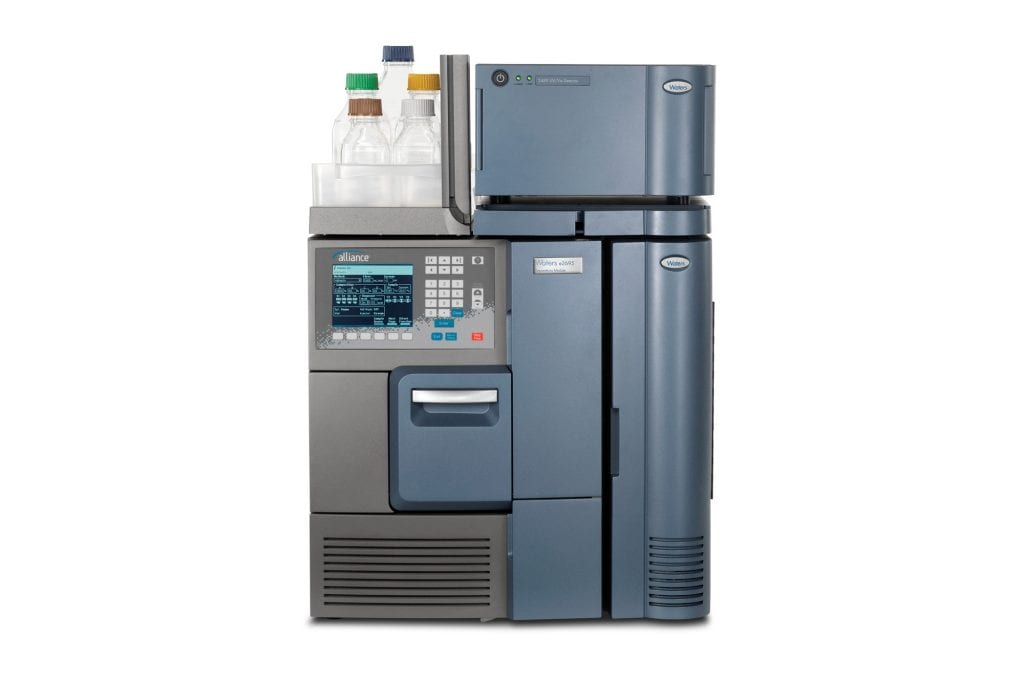
Waters 2489 UV/Vis Detector for UV Detection in HPLC & UHPLC
Waters 2489 UV/Vis Detector for UV Detection in HPLC & UHPLC — Chromatography detectors.
The Waters 2489 UV/Vis Detector is a dual-wavelength absorbance detector with a patented TaperSlit flow cell (10 mm path, 16.3 µL volume) for HPLC and UHPLC. It covers 190 nm upward with ≤5 nm bandwidth and ±1 nm accuracy via an internal erbium filter, distinguishing it from fixed-wavelength or single-beam variants. It serves as the concentration-sensitive detector in analytical and bio-inert chromatographic systems.
Full specifications
| Detector type | UV/Vis Detector |
| Wavelength range | 190 nm |
| Bandwidth mfr | ≤5 nm |
| Wavelength accuracy mfr | ±1 nm (via patented Erbium filter) |
| Wavelength repeatability mfr | ±0.1 nm |
| Linearity mfr | ≤5% at 2.5 AU, propylparaben, 257 nm, analytical |
| Drift mfr | ≤1 x 10 -4 AU/hour, 239 nm, 2 points/s, 1.0 s, 3 |
| Measurement range mfr | 0.0001 to 4.0000 AU |
| Sampling rate mfr | Up to 80 points/s |
| Light source mfr | Deuterium arc lamp |
| Flow cell design mfr | Patented TaperSlit |
| Cell volume mfr | 16.3 μL (analytical cell) |
| Pressure limit mfr | 1000 psi (analytical cell) |
| Wetted materials mfr | Alliance HPLC/ACQUITY Arc: 316 stainless-steel, |
| Path length mfr | 10 mm (analytical cell) |
| Noise | ≤5 x 10 -6 AU peak to peak, 230 nm, 10 points/s, 1.0 s, 30 s segments, dry analytical flow cell |
| Baseline noise, dual wavelength mfr | ≤35 x 10 -6 AU peak to peak, 230 nm, 280 nm, 1 p |
Description
Construction and positioning
- The 2489 is a variable-wavelength UV/Vis detector using a deuterium arc lamp and a TaperSlit flow cell design that shapes the light beam to match the cell geometry, reducing refractive index effects. - The analytical flow cell has a 10 mm path length and 16.3 µL volume, with a pressure limit of 1000 psi. Wetted materials for standard Alliance HPLC/ACQUITY Arc systems are 316 stainless steel, fused silica, PEEK, and fluoropolymer; a bio-inert variant uses fluoropolymer, fused silica, MP35N, PEEK, and titanium. ### Optical and detection behavior
- Wavelength range spans 190 nm to the upper limit (not specified in facts), with ≤5 nm bandwidth and ±1 nm accuracy maintained by a patented erbium filter; repeatability is ±0.1 nm. - Baseline noise is ≤5 × 10⁻⁶ AU peak-to-peak at 230 nm (10 points/s, 1.0 s, 30 s segments, dry analytical cell). Dual-wavelength noise is ≤35 × 10⁻⁶ AU under comparable conditions. Drift is ≤1 × 10⁻⁴ AU/hour at 239 nm. - Linearity is ≤5% at 2.5 AU (propylparaben, 257 nm). The measurement range is 0.0001 to 4.0000 AU, and sampling rate reaches up to 80 points/s. - The flow cell must be plumbed with appropriate fittings (not specified) and operated within the 1000 psi pressure limit. The deuterium lamp requires warm-up for stable baseline; no warm-up time is given in the facts.
Integration & Operating Notes
Exceeding the 1000 psi limit of the analytical flow cell can rupture the cell or distort the TaperSlit geometry, leading to leaks, baseline noise, or permanent damage. Install a backpressure regulator or ensure system pressure is monitored and limited upstream.
The standard analytical cell uses 316 stainless steel, fused silica, PEEK, and fluoropolymer; the bio-inert variant uses MP35N, titanium, PEEK, and fluoropolymer. Avoid solvents that attack these materials (e.g., strong acids, halide salts with stainless steel) to prevent corrosion and contamination.
The deuterium arc lamp has a finite lifetime; when lamp energy falls below the system's acceptable level, intensity noise increases and sensitivity degrades. Replace the lamp following the manufacturer's procedure and allow warm-up before acquiring data.
The detector requires a stable AC power source with protective earth. Ensure the outlet is properly grounded and the power cord is rated for the local voltage. Do not operate with damaged cords or in wet environments.
Selection & Integration Q&A
Choose the 2489 when method development or multi-analyte detection requires variable wavelength selection (190 nm upward) with dual-wavelength capability and ≤5 nm bandwidth. Fixed-wavelength detectors are simpler but lack spectral flexibility and dual-wavelength monitoring.
The analytical flow cell (10 mm path, 16.3 µL) connects via standard 1/16" fittings; ensure tubing and fittings are compatible with the wetted materials (316 SS, PEEK, etc.). The cell pressure limit is 1000 psi, so verify system backpressure does not exceed this.
Operate within the laboratory temperature range specified in the manual (typically 4–40 °C) and avoid direct sunlight, vibration, and corrosive vapors. Continuous operation is supported, but allow warm-up for stable baselines. The deuterium lamp has a limited lifetime; track hours for replacement.
The base delivery typically includes the detector and analytical flow cell, but not the deuterium lamp (spare), tubing, fittings, or control software. Plan for periodic lamp replacement and spare flow cell parts. A bio-inert flow cell is a separate option for bio-compatible systems.