
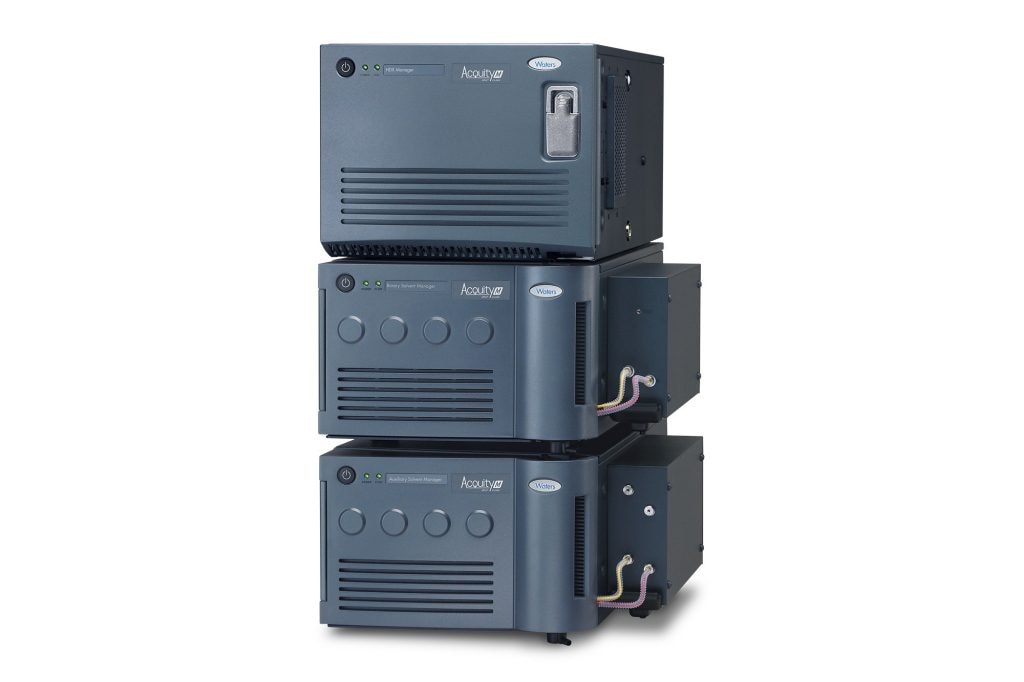
Waters ACQUITY UPLC M-Class System with HDX Technology
Waters ACQUITY UPLC M-Class System with HDX Technology — Chromatographs with Flow rate 2×10⁻⁷ milliliter/minute, Max pressure 103.4 megapascal.
The ACQUITY UPLC M-Class System with HDX Technology is a binary, non-ferrous flow-path chromatograph configured for hydrogen-deuterium exchange workflows, operating from 0.2 nL/min to 50 µL injections at up to 15,000 psi. Its 0–25 °C sample compartment and PDA/mass spectrometer detector options distinguish it within the M-Class line for HDX-MS applications requiring precise low-flow control and inert sample handling.
Full specifications
| Flow rate | 0.2 nL/min |
| Max pressure | 15000 psi |
| Injection volume | 50 µL |
| Sample flow path mfr | Non-ferrous |
| Sample compartment mfr | 0–25 °C |
| Pump options mfr | Binary |
| Detector options mfr | PDA Detector, Mass Spectrometers |
| External control mfr | MassLynx Software |
| Height | 76 cm |
| Width | 34 cm |
| Depth mfr | 71 cm (28.0 in.) |
| pH range mfr | 2 to 10 |
Description
Construction and positioning
- Binary pump architecture with a non-ferrous sample flow path, sized for capillary/nano-scale UPLC separations. - Integrated sample compartment held at 0–25 °C, supporting temperature-sensitive HDX experiments. - Detector flexibility: PDA or mass spectrometer, controlled externally via MassLynx software. - Physical envelope: 76 cm height × 34 cm width × 71 cm depth. ### Behavior under load and media
- Flow range extends down to 0.2 nL/min, enabling ultra-low-flow separations; maximum pressure 15,000 psi (≈103.4 MPa). - Injection volume up to 50 µL accommodates both analytical and semi-preparative scale injections. - pH compatibility 2–10 across the non-ferrous flow path, suitable for typical reversed-phase and HDX-compatible mobile phases. ### Installation, control and operation
- External control exclusively through MassLynx software; no standalone control panel described. - Binary pump configuration simplifies gradient formation for HDX workflows. - Sample compartment temperature control (0–25 °C) is integral, not an add-on.
Integration & Operating Notes
Operating above the rated maximum pressure risks seal failure, column damage, and invalid chromatographic results. Ensure pressure relief and monitoring are configured in MassLynx to alarm before the limit is reached.
The non-ferrous flow path tolerates pH 2–10; outside this range, corrosion or leaching may occur, compromising both hardware integrity and analytical results. Verify buffer pH before each HDX run.
The system has no standalone control interface; all method execution, gradient programming, and data acquisition depend on a MassLynx-connected workstation. Plan for network and software licensing as part of installation.
HDX experiments are temperature-sensitive; the sample compartment's 0–25 °C range must be actively controlled and monitored. Exceeding 25 °C or failing to stabilize temperature will invalidate exchange-rate measurements.
Selection & Integration Q&A
Choose this version when the workflow is hydrogen-deuterium exchange coupled to MS: the 0–25 °C sample compartment and non-ferrous flow path are configured for HDX. For routine peptide mapping without HDX, a standard M-Class avoids the HDX-specific configuration.
The supplied facts list only the system with binary pump, non-ferrous flow path, and 0–25 °C sample compartment. Detectors (PDA or MS), MassLynx software, columns, and consumables are not confirmed as included; verify the delivery scope with Waters.
Dimensional Drawings & Technical Documentation
Dimensional drawings
Click drawing to inspect vector dimensions