
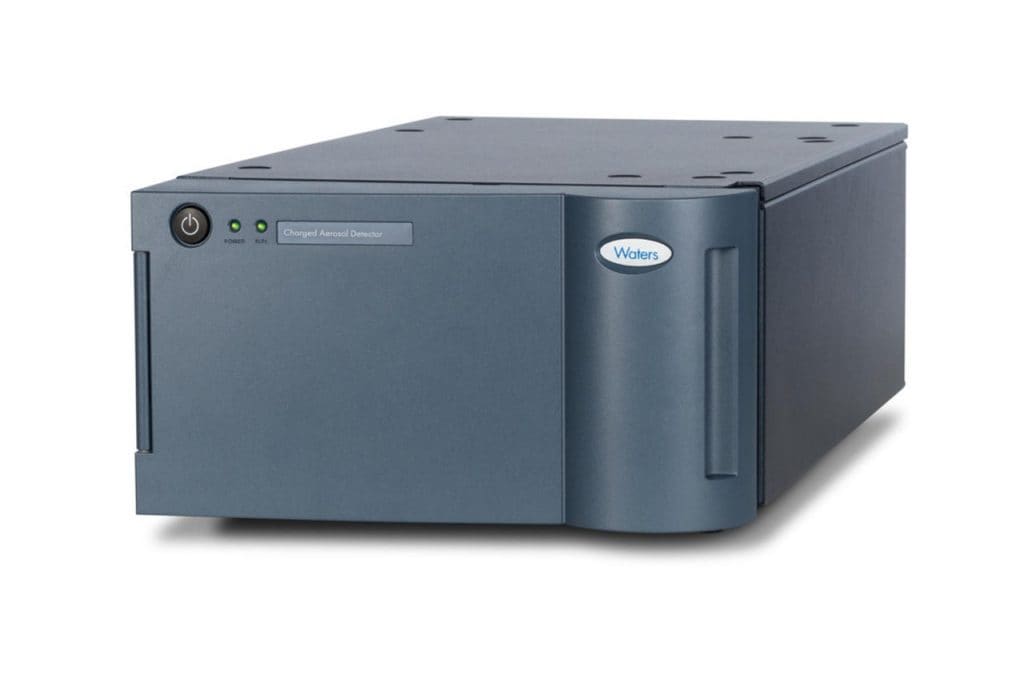
Waters Charged Aerosol Detector
Waters Charged Aerosol Detector — Chromatography detectors.
The Waters Charged Aerosol Detector is a universal HPLC detector that nebulizes the column effluent, evaporates the mobile phase, and measures the charge imparted to analyte particles. It supports flow rates down to 0.01 mL/min and evaporation temperatures from ambient to 100 °C, with four independent channels for parallel detection. It is used for sensitive, gradient-compatible detection of non-volatile and semi-volatile compounds lacking chromophores.
Full specifications
| Detector type | Charged Aerosol Detector |
| Flow rate | 0.01 mL/min |
| Evaporation temperature mfr | Ambient (off) or settable controlled range: 10 ° |
| Sampling rate mfr | Up to 200 Hz |
| Biocompatible mfr | No |
| Inert gas supply mfr | Nitrogen (recommended) or compressed air |
| Inlet pressure mfr | 4.83–5.52 bar (483–552 kPa, 70.0–80.0 psi) |
| Gas consumption mfr | Typically ≤ 5 L/min |
| Diagnostic channels mfr | Nebulizer: Factory-optimized gas flow gas pressu |
| Dynamic range mfr | Four individual power value |
| Power requirements mfr | 100 to 240 VAC |
| Dimensions mfr | Width: 34.3 cm (13.5 in); Height: 20.8 cm (8.2 i |
| Number of channels mfr | Four (4) supported by four (4) independent backg |
Description
Construction and positioning
- The detector is a stand-alone benchtop unit (34.3 cm W × 20.8 cm H × 61.0 cm D) with an integrated nebulizer, evaporation chamber, ion trap, charger, and mixing chamber. - It is not a variant of a multi-model series; it is the sole charged aerosol detector model in the Waters lineup, distinguished by its four independent background current channels and wide flow-rate compatibility. - Unlike UV or fluorescence detectors, it responds to essentially all non-volatile analytes, making it complementary to optical detectors in multi-detector setups. ### Behavior under load and in different modes
- The detector operates with either nitrogen (recommended) or compressed air at an inlet pressure of 4.83–5.52 bar (70–80 psi) and a typical gas consumption of ≤5 L/min. - Evaporation temperature can be set from 10 °C to 100 °C in 0.1 °C increments, but must be at least 5 °C above ambient; ambient (off) operation is also possible. - Sampling rates up to 200 Hz support fast LC and UHPLC applications, while the four channels allow simultaneous acquisition of signal and diagnostic data. - Diagnostic channels monitor nebulizer gas pressure, evaporator temperature, ion trap voltage, charger current, and mixing chamber temperature, enabling real-time performance verification. ### Installation, connection, and control
- The unit requires a 100–240 VAC power supply and a regulated gas source (nitrogen or compressed air) delivered at 70–80 psi. - It is controlled via external chromatography data software (e.g., Empower) through a standard interface; no dedicated front-panel controller is described. - The detector is not biocompatible, so it is unsuitable for applications requiring inert wetted paths (e.g., certain biopharmaceutical analyses). - Installation should account for the need to vent the evaporated mobile phase and to provide adequate laboratory ventilation.
Integration & Operating Notes
Setting the evaporator below ambient+5 °C risks incomplete evaporation, leading to baseline noise and contamination. Always verify ambient temperature and set the evaporator accordingly, or use the ambient (off) mode if the mobile phase is sufficiently volatile.
The nebulizer requires a stable inlet pressure of 4.83–5.52 bar (70–80 psi). Exceeding this range can damage the nebulizer; falling below it causes poor aerosol formation and unreliable results. Use a two-stage regulator and ensure the gas is dry and oil-free.
The nebulizer and evaporation chamber are prone to buildup from non-volatile residues. Periodic cleaning (frequency depends on usage) prevents clogging and baseline drift. Refer to the operator's manual for cleaning procedures and recommended intervals.
Selection & Integration Q&A
Choose the charged aerosol detector for analytes lacking chromophores or fluorophores, or for universal detection across a wide polarity range. UV/fluorescence detectors offer higher sensitivity for specific compound classes but require appropriate functional groups.
The base unit does not include gas regulators, tubing, or filters; these must be sourced separately. A preventive maintenance kit (nebulizer, filters, seals) is recommended but not included. Refer to the manual for the full list of consumables.