
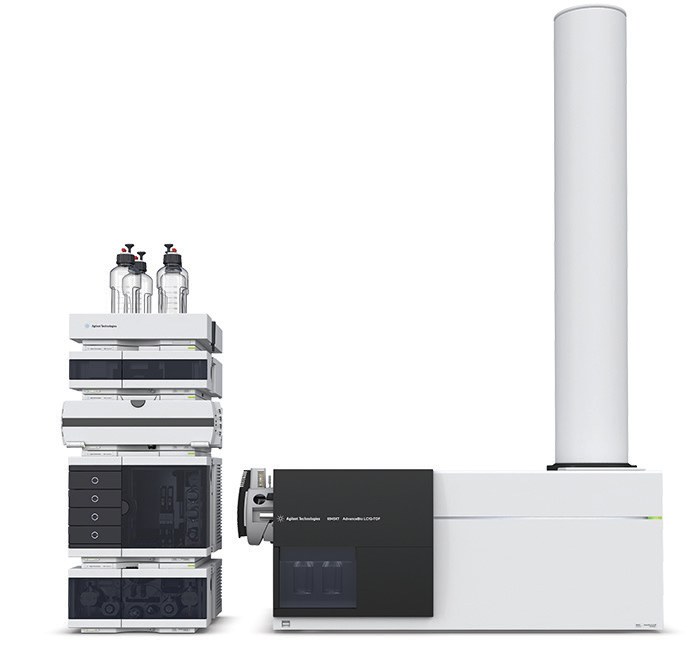
Agilent Technologies 6545XT AdvanceBio UHPLC QTOF, biopharmaceutical analysis
Agilent Technologies 6545XT AdvanceBio UHPLC QTOF, biopharmaceutical analysis — Liquid chromatography mass spectrometry lc ms with Pumping speed 3×10⁻⁵ m³/h.
The 6545XT AdvanceBio is a UHPLC quadrupole time-of-flight LC/MS configured for biopharmaceutical characterization, spanning a 100–10,000 m/z mass range with a Dual Agilent Jet Stream source. It is the AdvanceBio modification of the 6545 QTOF platform, paired with 1290 Infinity II/III LC modules, and is used for intact-protein, peptide-mapping and food-authenticity workflows.
Agilent Technologies Quadrupole Time Of Flight LC MS Series — Model Comparison & Selection
| Model | Pumping speed, m³/h | Mass range | Acquisition rate, Hz | Autosampler temperature, °C | Column temperature, °C | Sample volume, milliliter |
|---|---|---|---|---|---|---|
| 6545XT AdvanceBio UHPLC QTOF, biopharmaceutical analysis Current | 3×10⁻⁵ | 100...10,000 | 1.0 | 4 | 60 | 5×10⁻⁴ |
| 6560 Ion Mobility QTOF LC/MS, Collision Cross Section | 1.6×10⁻⁸ | 100...1,700 | 10 | 4 | 45 | — |
| Electron capture dissociation for QTOF LCMS of proteins | 0.024 | — | 1 | 5 | 60 | 0.01 |
Full specifications
| Pumping speed | 0.5 mL/min |
| Acquisition Rate | 1.0 spectra/s |
| Column temperature | 60 °C |
| Gas Flow | 12 L/min |
| Ion source | Dual Agilent Jet Stream |
| Sample Loading Amount | 0.6 µg |
| Sample volume | 0.5 µL |
| Sheath Gas Flow | 11 L/min |
| Solvent A mfr | 0.1 water |
| Solvent B mfr | 0.1 % acetonitrile |
| Nebulizer mfr | 60 psig |
| Quad AMU mfr | 500 m/z |
| Acquisition mode mfr | Positive, Extended Mass Range Range |
| Sample concentration mfr | 1.0 μg/μL |
| Analytical column mfr | 2.1 μm |
| False discovery rate mfr | 0.1 |
| LC pump module mfr | 1290 Speed |
| Autosampler module mfr | 1290 Multisampler |
| Needle wash mfr | 3 sec |
| Nebulizer pressure mfr | 35 psig |
| Data acquisition rate mfr | 8 spectra/s |
| Enzyme-to-substrate ratio mfr | 1 w/w |
| Average MS/MS spectra mfr | 78683 |
| Average spectra submitted to database matches mfr | 8753 |
| Average unique peptides mfr | 1084 |
| Average % ID mfr | 11.1 |
| Mass range | 100...10,000 m/z |
| Reference mass mfr | 922.0098 |
| Deconvoluted mass range mfr | 140000...160,000 Daltons |
| MS1 mass tolerance mfr | 10 ppm |
| MS2 mass tolerance mfr | 30 ppm |
| Peptide length limit mfr | 5...60 acids |
| Isolation width mfr | Medium Medium |
| Capillary Voltage | 5500 V |
| Nozzle Voltage | 2000 V |
| Fragmentor mfr | 380 V |
| Skimmer mfr | 140 V |
| Autosampler Temperature | 4 °C |
| Gas Temperature | 350 °C |
| Sheath Gas Temperature | 400 °C |
Description
Architecture and series positioning
- The 6545XT AdvanceBio is a QTOF LC/MS detector built around a Dual Agilent Jet Stream ion source, specified over a 100–10,000 m/z mass range and operated with 1290 Infinity II or III UHPLC front ends (1290 pump and 1290 multisampler modules appear in the application workflows).
- Within the QTOF series it is the biopharmaceutical-focused modification: the 6530 is the general accurate-mass QTOF, the 6546 targets wide dynamic range, and the 6560 adds ion mobility with a 100–1,700 m/z range. The 6545XT's distinguishing feature is its extended mass range reaching 10,000 m/z, which supports intact and deconvoluted protein work rather than small-molecule or ion-mobility applications.
Behavior in biopharmaceutical workflows
- Intact monoclonal antibody characterization is run with a PLRP-S column on the 1290 Infinity II UHPLC, covering NIST mAb RM 8671, trastuzumab and a T-DM1 ADC. Deconvoluted mass ranges of 140,000–160,000 Da are reported for this class of work.
- Peptide mapping of a CHO-cultured human IgG1 mAb uses Iterative MS/MS with MassHunter BioConfirm, at 15-minute and 30-minute gradients and 0.6 µg or 2 µg sample loading; the documented workflow reports MS1 and MS2 mass tolerances of 10 ppm and 30 ppm respectively, with a 0.1 false discovery rate and peptide lengths of 5–60 amino acids.
- Source settings in the documented methods include capillary 5500 V, nozzle 2000 V, fragmentor 380 V, skimmer 140 V, sheath gas 11 L/min at 400 °C, drying gas 12 L/min at 350 °C, and nebulizer pressures of 35–60 psig depending on the method.
LC and autosampler conditions
- The LC train is specified at 0.5 mL/min pumping speed with 0.5 µL sample volume; the autosampler thermostat is set to 4 °C and the column compartment to 60 °C. Solvent compositions in the documented methods are 0.1 % (water/A and acetonitrile/B) with a 3-second needle wash.
- Acquisition is run in positive, extended mass range mode with a 500 m/z quad AMU setting and a 922.0098 reference mass for lock-mass correction.
Integration & Operating Notes
The documented source and LC settings differ between the intact-mAb and peptide-mapping workflows (for example nebulizer 60 psig vs 35 psig, and 0.6 µg vs 2 µg loading). Treat every value as tied to its method and re-optimize source and gradient conditions when transferring a workflow to a new sample type.
The documented peptide-mapping workflow relies on Iterative MS/MS acquisition and MassHunter BioConfirm B.09.00 for processing, with database matching at a 0.1 false discovery rate. Plan the acquisition method and the processing software version together, since the reported identification statistics assume this combination.
The workflows are evaluated at 10 ppm MS1 and 30 ppm MS2 tolerance with a 922.0098 reference mass. Exceeding these tolerances invalidates database-match statistics, so lock-mass stability and calibration must be verified before committing to a peptide-mapping run.
The documented methods specify a 3-second needle wash and a PLRP-S column for intact-mAb work. These consumables and wash settings are method components rather than base-instrument items, and must be provisioned and configured before the workflow can be reproduced.
Selection & Integration Q&A
Pick the 6545XT for biopharmaceutical work needing the 100–10,000 m/z range, such as intact mAb and ADC characterization with deconvoluted masses of 140,000–160,000 Da. The 6546 targets wide dynamic range, and the 6560 adds ion mobility but is specified only to 1,700 m/z.
The application notes pair the 6545XT with a 1290 Infinity II UHPLC (1290 pump and multisampler) and a PLRP-S column for intact-mAb work, at 0.5 mL/min and 0.5 µL injection with the autosampler at 4 °C and column at 60 °C. The LC modules are separate from the QTOF.
The documented peptide-mapping method uses Iterative MS/MS in positive extended mass range, capillary 5500 V, nozzle 2000 V, fragmentor 380 V, skimmer 140 V, sheath gas 11 L/min at 400 °C, drying gas 12 L/min at 350 °C, nebulizer 35 psig, and 15- or 30-minute gradients.
The workflows assume 1290 Infinity II/III LC modules, a PLRP-S column, MassHunter BioConfirm B.09.00, and the AssayMAP Bravo for sample preparation in the peptide-mapping note. These are separate items and must be provisioned alongside the QTOF.