
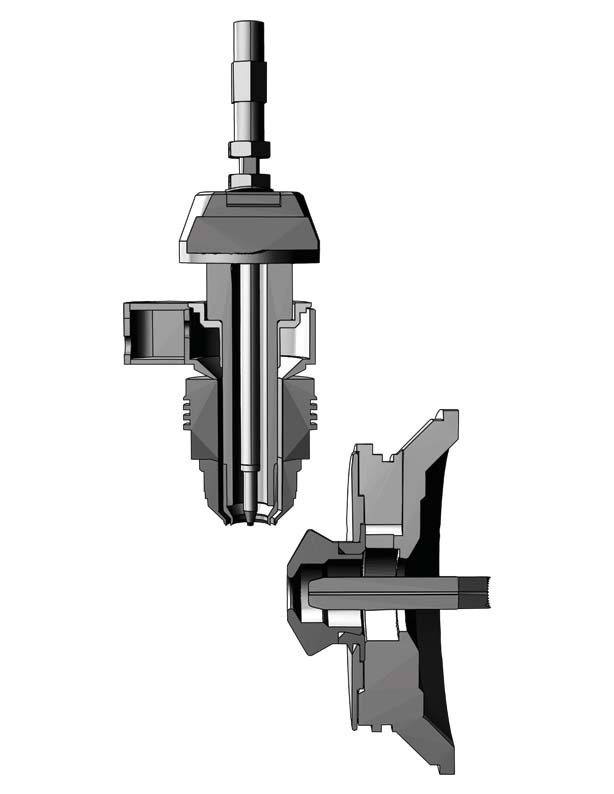
Agilent Technologies High sensitivity MS, high sensitivity ion source, Jet Stream
Agilent Technologies High sensitivity MS, high sensitivity ion source, Jet Stream — Liquid chromatography mass spectrometry lc ms.
The Agilent Jet Stream ion source is an electrospray-based high-sensitivity LC/MS interface that uses thermal-gradient focusing of the spray. It operates with a 600 V nozzle, 350 °C sheath gas at 11 mL/min, and 30 psi nebulizer pressure, delivering up to 5× sensitivity gain over conventional ESI. It is intended for LC/MS systems requiring trace-level detection across 50 µL/min to 2.5 mL/min flow rates.
Agilent Technologies LC MS Ion Sources Series — Model Comparison & Selection
| Model | Pumping speed, m³/h | Sample volume, milliliter | Column temperature, °C | Drying gas temperature, °C | Sheath gas flow, liter/minute | Sheath gas temperature, °C |
|---|---|---|---|---|---|---|
| High sensitivity MS, high sensitivity ion source, Jet Stream Current | — | — | — | — | 0.011 | 350 |
| Atmospheric Pressure Chemical Ionization Source, APCI | 2.4×10⁻⁵ | 0.004 | 55 | 350 | — | — |
| Electrospray ion Source, ESI | 2.4×10⁻⁵ | 0.001 | 80 | 290 | 12 | 400 |
Full specifications
| Sheath Gas Flow | 11 mL/min |
| Nebulizer pressure mfr | 30 psi |
| Sensitivity gain mfr | 5 x |
| Nozzle Voltage | 600 V |
| Chamber voltage mfr | 4 kV |
| Sheath Gas Temperature | 350 °C |
Description
Construction and series positioning
- The Jet Stream source is an electrospray ionization (ESI) variant within Agilent's LC/MS ion source series, distinguished by its thermal-gradient focusing technology.
- Unlike the APCI sibling (7000 m/z mass range, 0.4 mL/min) and the standard ESI source (0.4 mL/min), the Jet Stream is optimized for high-sensitivity applications across a broader flow range (50 µL/min to 2.5 mL/min, optimal 0.25–2.0 mL/min).
- It is not a low-flow nanospray source; that sibling is dedicated to highest-sensitivity nanospray applications.
Behavior under load and in different media
- The source employs a heated sheath gas (350 °C at 11 mL/min) to focus the electrospray plume, improving ion transmission and reducing matrix effects.
- Nozzle voltage is set to 600 V, and chamber voltage to 4 kV, establishing the electrostatic field for ion generation.
- Nebulizer pressure is 30 psi, supporting stable spray formation across the specified flow range.
- Sensitivity gain of 5× is reported relative to conventional ESI, as demonstrated on an Agilent 6530 Q-TOF LC/MS system.
- Spray start temperature is 25 °C and spray stop temperature is 350 °C, indicating a controlled thermal ramp for source operation.
Installation, connection, control and operation
- The source is designed for integration with Agilent LC/MS systems; specific mounting and connection details are not provided in the available documents.
- Operation requires sheath gas supply and temperature control; the technical note describes recommended operating parameters but does not include installation procedures.
- No certificates or applications are listed; the source is intended for analytical LC/MS use.
Integration & Operating Notes
The thermal gradient focusing is optimized for 0.25–2.0 mL/min; operating outside the broader 50 µL/min to 2.5 mL/min range may reduce sensitivity gain and spray stability. Ensure LC flow is within this window before initiating spray.
The source requires sheath gas at 350 °C and 11 mL/min to achieve the reported 5× sensitivity gain. Insufficient temperature or flow will degrade focusing and may cause signal instability. Verify gas supply capacity and heater performance before use.
The supplied technical note and specification sheet do not include maintenance intervals, consumables, or service procedures. Consult the instrument's user manual for nozzle cleaning, gas filter replacement, and calibration schedules.
Selection & Integration Q&A
Choose Jet Stream for high-sensitivity work across 50 µL/min to 2.5 mL/min, where its thermal focusing gives up to 5× gain. Standard ESI suits conventional flows up to 0.4 mL/min; APCI is for low-polarity compounds with 7000 m/z range.
Provide sheath gas at 11 mL/min and capable of 350 °C. LC flow must be within 50 µL/min to 2.5 mL/min, optimally 0.25–2.0 mL/min. Nebulizer pressure should be set to 30 psi. Ensure gas plumbing and heater can sustain these conditions.
Mounting and environmental limits are not specified in the available documents. The source is designed for integration with Agilent LC/MS systems; refer to the instrument manual for installation clearances and laboratory environment requirements.
No maintenance schedule or included accessories are listed in the provided documents. Typically, sheath gas supply, nebulizer gas, and LC connections are required. Consult the Agilent system manual for nozzle cleaning kits, gas filters, and calibration standards.
Dimensional Drawings & Technical Documentation
Dimensional drawings
Click drawing to inspect vector dimensions