
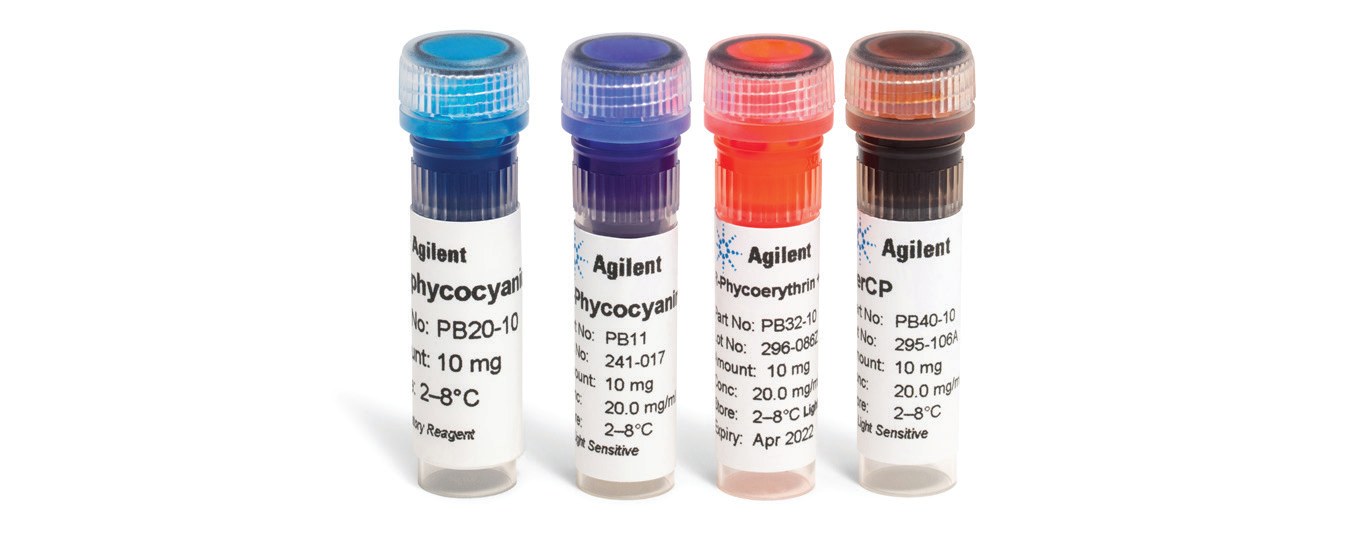
Agilent Technologies Streptavidin
Agilent Technologies Streptavidin — Biomolecules conjugation synthesis purification.
Native streptavidin tetramer (52 kDa) supplied at 50 mg/mL, with a specific activity of 14.0 U/mg by HABA dye assay. Excitation/emission maxima at 566/575 nm and an extinction coefficient of 240 are the reagent's own optical reference values. Used as the capture/bridge protein in biotinylated assay and purification systems.
Full specifications
| Emission Maximum | 575 nm |
| Excitation Maximum | 566 nm |
| Solubility Concentration | 50 mg/mL |
| Specific Activity (haba Dye) | 14.0 U/mg |
| Extinction coefficient mfr | 240 |
| PJRS301*; PJRS20; PJRS34 mfr | Large Large |
| PJRS25**; PJRS27 mfr | Medium Medium |
| PJ39S mfr | Small Small |
| Streptavidin-Agarose bead size distribution mfr | 75...300 microns |
| Streptavidin-Agarose pH stability range mfr | 4...11 |
| Streptavidin-Agarose streptavidin content mfr | 1 beads |
| HRP conjugate stabilizer dilution mfr | 1000 fold |
| AP conjugate stabilizer dilution mfr | 1000 fold |
| RPE conjugation kit antibody capacity mfr | 1 mg |
| RPE conjugation kit minimum scale mfr | 50 antibody |
| RPE conjugation time mfr | as little as two hours hours |
| Molecular Weight (tetramer Size) | 52 kDa |
Description
Construction and series positioning
- This is the native streptavidin reagent (SA10 family), a 52 kDa tetramer, not a recombinant streptavidin-plus variant and not an enzyme or phycobiliprotein conjugate.
- Within the Agilent streptavidin/phycobiliprotein line, it is the unconjugated building block: the SA26 recombinant streptavidin-plus, streptavidin-HRP/AP conjugates, and streptavidin-RPE/APC conjugates are separate products with their own performance.
- Supplied as a 50 mg/mL solution; the series lists 10, 100 and 1000 mg pack sizes for the native grade.
Behavior and measurement basis
- Specific activity is stated as 14.0 U/mg by the HABA dye displacement assay, which is the lot-release measure of free biotin-binding capacity.
- Optical constants: excitation maximum 566 nm, emission maximum 575 nm, extinction coefficient 240. These are the reagent's own fluorescence/absorbance reference values, not a detection limit.
- No load curves or dynamic binding data are provided; binding performance must be established by the user's own assay.
Handling and use
- The attached product digest covers the streptavidin and phycobiliprotein portfolio but contains no procedural sections for this reagent; no conjugation, dilution or storage protocol is asserted here.
- Because the product is a concentrated protein solution, dilution and buffer exchange are user-defined steps ahead of coupling or capture use.
Integration & Operating Notes
Excitation maximum 566 nm and emission maximum 575 nm with extinction coefficient 240 define the instrument settings for detecting this reagent directly; detectors configured for RPE or APC conjugates use different channels and are not interchangeable with the unconjugated reagent.
Selection & Integration Q&A
Pick the native grade when you need the unconjugated 52 kDa tetramer at 50 mg/mL and will attach your own label or surface. Choose streptavidin-plus for the recombinant variant, or the HRP/AP and RPE/APC conjugates when a detection enzyme or fluorophore is already required.
The detection channel must be set for 566 nm excitation and 575 nm emission with extinction coefficient 240. Any biotinylated capture partner and buffer must be free of competing free biotin, since the reagent's function is biotin binding as measured by the HABA assay at 14.0 U/mg.
It is supplied at 50 mg/mL, so working dilutions and buffer exchange are user-defined; the product digest gives no storage temperature, freeze-thaw or shelf-life figures for this grade, so those conditions must be taken from the lot documentation rather than assumed.
The base delivery is the native streptavidin solution itself; the series lists separate items for streptavidin-plus, HRP/AP conjugates, stabilizers, phycobiliproteins and conjugation kits. No buffers, conjugation reagents or detection conjugates are part of this item.
Dimensional Drawings & Technical Documentation
Dimensional drawings

Click drawing to inspect vector dimensions