
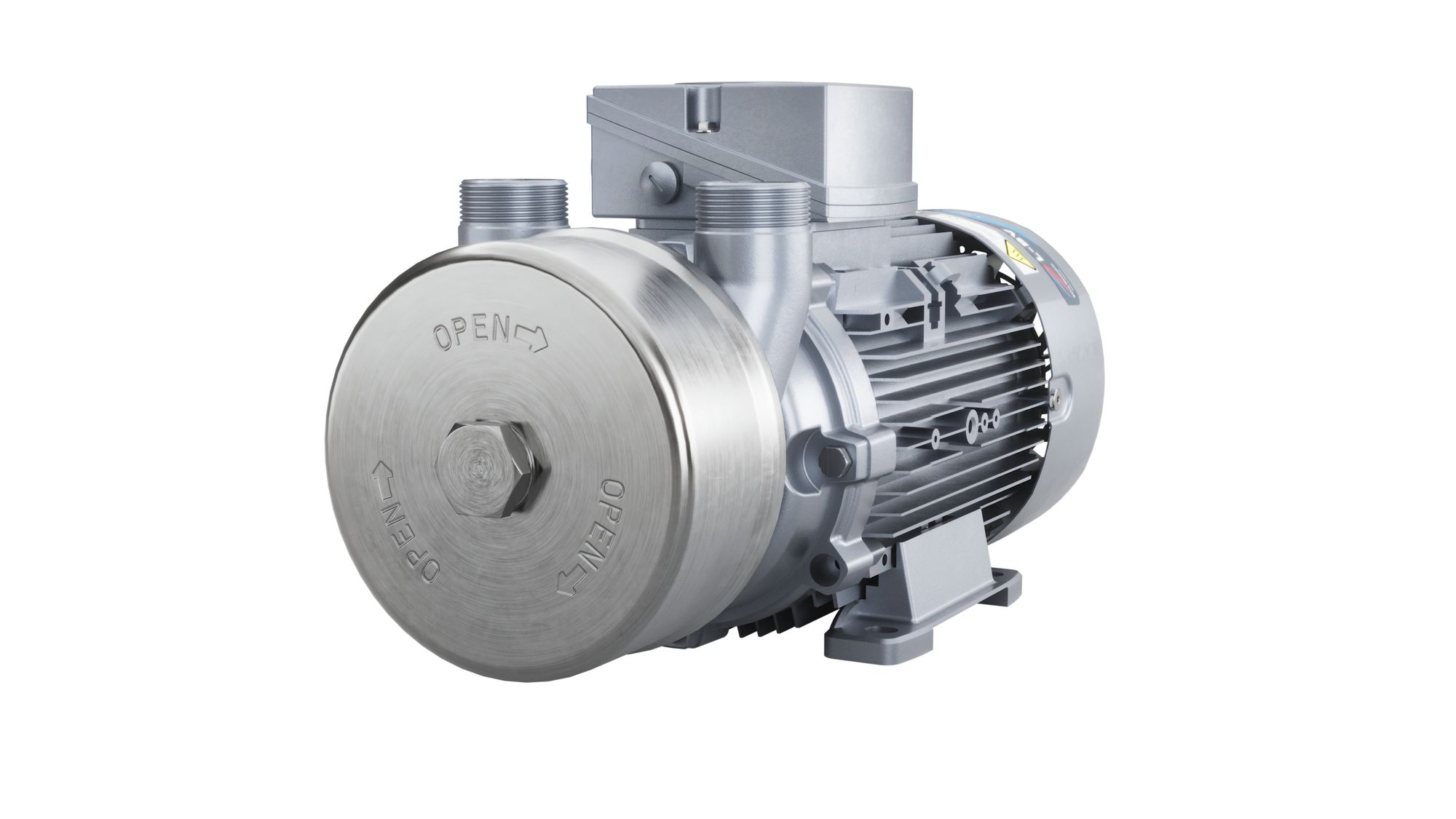
Elmo Rietschle 2BV7070
Elmo Rietschle 2BV7070 — Liquid Ring Vacuum Pumps with Pumping speed 500 m³/h.
The 2BV7070 is a liquid-ring vacuum pump/compressor with an eccentrically mounted impeller in a cylindrical casing, using an operating-liquid ring for gas handling. It delivers 500 m³/h at 50 Hz (575 m³/h at 60 Hz) and accepts inlet pressures up to 8 bar abs., distinguishing it from smaller siblings 2BV7060/7061. It serves as a robust vacuum source or low-pressure compressor in systems requiring moderate flow and high inlet pressure tolerance.
Elmo Rietschle L-BV7 Series — Model Comparison & Selection
Full specifications
| Max inlet pressure | 8 bar abs. |
| Operating principle | Liquid ring |
| Pumping speed | 500 m³/h (50 Hz) 60 Hz: 575 m³/h |
| Suction capacity (alt 60 Hz) mfr | 660-725 m3/h (60 Hz) |
| Max. discharge pressure during vacuum-pump operation (alt var) mfr | 1.3 bar abs. |
| Weight | 39 kg (2BV7070-2) 2BV7070-3: 53 kg |
| Power supply | 200 VΔ |
| Voltage (alt var) mfr | 550-600 VΔ |
| Noise level | 72 dB(A) (50 Hz) |
| Operating temperature | +80 °C |
| Ambient temperature limit | +40 °C |
Description
Construction and series positioning
- The 2BV7070 is a liquid-ring machine with a cast-iron or stainless-steel casing, bronze impeller (stainless variant), and cast-iron lantern; it is available in -2 and -3 variants differing in weight (39 kg vs 53 kg) and motor configuration.
- Within the L-BV7N series, it sits between the 2BV7060/7061 (lower inlet pressure limits, 2.0/1.9 bar abs.) and the 2BV7071 (same 8 bar abs. limit but higher motor power 6.3 kW). The 2BV7070 is the mid-size option for high-pressure vacuum duty.
- It is designed for both vacuum-pump and compressor operation; maximum discharge pressure in compressor mode at 1 bar abs. inlet is 3.0 bar abs. at 50 Hz and 2.5 bar abs. at 60 Hz.
Behavior under load and media
- Pumping speed is 500 m³/h at 50 Hz and 575 m³/h at 60 Hz; suction capacity at 60 Hz is listed as 660–725 m³/h in alternate data, reflecting operating-liquid and inlet conditions.
- Maximum permissible pressure in the pump-motor unit is 8 bar abs.; in vacuum operation, discharge pressure must not exceed 1.3 bar abs. When pumped gases are passed on, discharge pressure is limited to 1.1 bar abs.
- Maximum temperature of pumped gases/vapors is +80 °C; operating-liquid temperature range is +5 to +80 °C (nominal +15 °C). Ambient temperature must remain between +5 and +40 °C.
- Nominal operating-liquid flow rate for dry air extraction with water at 15 °C is 0.28 m³/h at 50 Hz and 0.34 m³/h at 60 Hz. Priming filling amount is 0.80 l.
Installation, connection and operation
- The unit requires a minimum clearance of 53 mm from the fan guard to adjacent surfaces for heat dissipation. Maximum permissible vibration velocity is 4.5 mm/s; feet are bolted with 4 x M10-6.8.
- Electrical connection: terminal plate torques M4 = 0.8–1.2 Nm, M5 = 1.8–2.5 Nm; maintain at least 5.5 mm clearance between bare live parts and ground. Supply tolerance is ±5 % voltage and ±2 % frequency.
- Pipe connections on intake and discharge must not be tightened beyond 100 Nm. Two operating modes exist: self-priming (requires ≥900 mbar abs. in inlet pipe at switch-on and liquid level at shaft center) and operation with operating-liquid feed (pre-pressure pA approx. 1 bar above inlet pressure pB).
- Installation height is limited to 1000 m above sea level; higher altitudes require consultation.
Integration & Operating Notes
In vacuum-pump operation, the system back-pressure on the discharge side must remain below 1.3 bar abs. Exceeding this limit can overload the pump and damage the liquid-ring mechanism. When pumped gases are passed on, the limit is further reduced to 1.1 bar abs. Ensure downstream components and piping do not create excessive restriction.
For dry air extraction with water at 15 °C, the nominal operating-liquid flow rate is 0.28 m³/h at 50 Hz (0.34 m³/h at 60 Hz). The operating-liquid temperature must stay between +5 and +80 °C, with +15 °C nominal. Deviating from these conditions affects minimum inlet pressure and pump performance; adjust the feed system accordingly.
In self-priming mode, before switch-on the inlet pipe must be evacuated to at least 900 mbar abs. and the liquid level in the feed pipe or reservoir must be at the same level as the center of the unit shaft. During operation, the reservoir level must not drop more than 1 m below the shaft center. These conditions must be verified by the control sequence to prevent dry running or cavitation.
Electrical connections in the terminal box require M4 screws tightened to 0.8–1.2 Nm and M5 screws to 1.8–2.5 Nm. Maintain at least 5.5 mm clearance between bare live parts and between live parts and ground. The supply must be within ±5 % voltage and ±2 % frequency of the motor rating plate to avoid performance loss or overheating.
The operating liquid must be maintained within temperature limits and free of excessive contaminants. During self-priming operation, monitor the reservoir level to ensure it does not fall below approximately 1 m under the shaft center. Refer to the fault table in Chapter 9 for troubleshooting symptoms such as reduced performance or unusual noise.
Selection & Integration Q&A
Choose 2BV7070 for 500 m³/h at 50 Hz and inlet pressures up to 8 bar abs. The 2BV7060/7061 are limited to ~2 bar abs. and lower flow; the 2BV7071 offers same pressure but higher power (6.3 kW) and flow. Select 2BV7070 for mid-range high-pressure vacuum duty.
Provide operating liquid at 0.28 m³/h (50 Hz) with temperature +5 to +80 °C (nominal +15 °C). For feed mode, set pre-pressure pA about 1 bar above inlet pressure pB. Ensure piping can withstand 100 Nm tightening torque and maintain discharge pressure below 1.3 bar abs. in vacuum duty.
The base unit does not include operating liquid, piping, valves, or control devices for feed systems. Self-priming operation requires an external reservoir and inlet piping capable of 900 mbar abs. vacuum. Electrical cables and terminal lugs are not supplied; use M4/M5 terminals torqued to 0.8–1.2/1.8–2.5 Nm.