Pfeiffer Vacuum ASM 310
Pfeiffer Vacuum ASM 310 — Leak detectors with Min detectable leak rate 1×10⁻¹² mbar·l/s, Motor power 0.3 kW.
The Pfeiffer Vacuum ASM 310 is a portable 21 kg helium/hydrogen mass-spectrometer leak detector with built-in 1.7 m³/h diaphragm backing pump, 1.1 l/s He pumping speed and 300 W universal 90–240 V supply. Detecting leaks down to 1·10⁻¹³ Pa·m³/s in vacuum mode, it is the compact service/maintenance variant of the ASM series, ready in under 2 minutes.
Full specifications
| Min detectable leak rate | 1*10^(-13) Pa m3/s |
| Motor power | 300.0 W |
| Test method mfr | Spraying and sniffing tests |
| Detectable gases mfr | 4.0 He; 3He; H2 |
| Pumping speed for Helium mfr | 1.1 l/s (Helium) |
| Max. test inlet pressure mfr | 15.0 mbar |
| Start-up time (20 °C) mfr | <2 min |
| Response time mfr | <1 s |
| Backing pump mfr | Diaphragm vacuum pump |
| Roughing capacity mfr | 1.7 m3/h |
| Communication interfaces mfr | Standard 15 pins I/O, RS-232 |
| Weight | 21.0 kg |
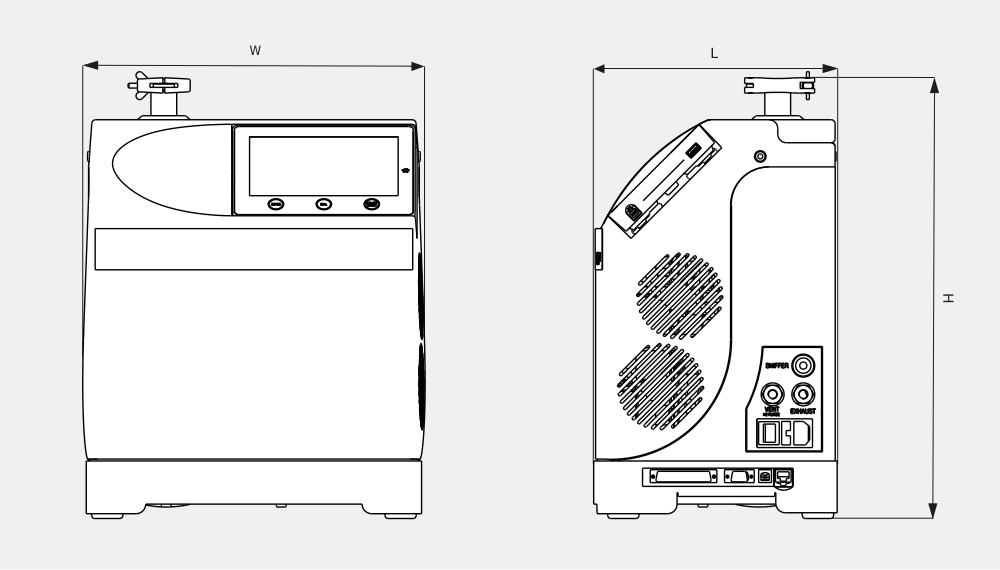
| Dimensions (L x W x H) mfr | 350.0 x 254 x 414 mm |
| Power supply | 90-240 V |
| Inlet port mfr | DN 25 ISO-KF |
| Noise level | <45 dB(A) dB |
| Operating temperature | 10-40 °C |
Description
Positioning within the ASM series
The ASM 310 is the lightest, most compact mass-spec leak detector in the series, designed as a single-person portable with retractable handle and detachable control panel. It matches the top sensitivity of the ASM 340 / 340D (1·10⁻¹³ Pa·m³/s) but at 300 W consumption versus 850 W (ASM 340) and 600 W (ASM 340D), trading pump-down speed and gross capacity for mobility. The ASM 306S (1·10⁻⁸ Pa·m³/s) covers less demanding EOL testing; the ASM 2000 (3750 W) serves stationary high-throughput installations.
Behavior in vacuum and sniffer modes
- Vacuum (spraying/bombing) mode: minimum detectable leak rate 1·10⁻¹² mbar·l/s (1·10⁻¹³ Pa·m³/s) with He, with ³He and H₂ also detectable; max test inlet pressure 15 mbar.
- Sniffer mode: sensitivity is five orders of magnitude lower (1·10⁻⁷ mbar·l/s), suited to pressure/external tests only.
- Response time <1 s enables rapid spray-gun pinpointing; start-up to standby in <2 min at 20 °C.
- The oil-free diaphragm backing pump (1.7 m³/h roughing) removes oil management, but the modest He pumping speed (1.1 l/s) means larger chambers require external pre-pumping before inlet connection.
Installation, control and operation
The unit installs on a flat surface with ≥10 cm clearance, ventilated and free of tracer gas. Test parts connect via DN 25 ISO-KF using metal vacuum pipework only; inlet pressure must never exceed atmospheric. Purge gas (N₂) is regulated to 0–0.3 bar relative at 5 sccm with a manual lockout valve within 3 m. Operation runs from the touchscreen with START/STOP, CAL and ZERO keys; two test methods (Hard Vacuum, Sniffer) are configured in the Test menu. Calibration uses the internal temperature-compensated ⁴He leak (≈10⁻⁷ mbar·l/s), prompted 20 min after switch-on and recommended daily or each 8-hour shift. Remote integration is via 15-pin D-Sub I/O and RS-232 (details in manual 130417); after mains failure the detector auto-restarts when power returns.
Integration & Operating Notes
Connecting a pressurized or poorly evacuated part can contaminate the mass spectrometer cell and invalidate readings; bomb-tested parts must be vented to a test chamber, never directly to the detector inlet. External pre-pumping is required for volumes exceeding what the internal diaphragm pump can rough down.
Parts connected to the DN 25 ISO-KF inlet must be supported externally; the detector inlet tolerates maximum 5 kg of weight and 3 N·m of torque, and connected parts must withstand −1·10³ hPa relative pressure. Exceeding these risks flange and turbo-pump damage. Plastic compressed-air style tubing is forbidden as it permeates and corrupts readings.
Excessive purge pressure keeps the inlet vent valve closed and the purge fails to reduce helium background. Use a range of 0–0.3 bar relative (1–1.3 bar absolute) with 5 sccm flow at 1 bar abs inlet, and fit a manual lockout valve in the purge circuit within 3 m of the unit for pressurized-gas safety.
The detector restarts automatically once power is restored, so downstream safety logic must assume unattended return to standby. The unit is Class I equipment and must be earthed with original manufacturer mains cables; after power-off, wait 5 minutes before service or cover removal due to live parts.
The detector prompts calibration 20 minutes after switch-on; the internal calibrated leak is ⁴He at ≈10⁻⁷ mbar·l/s. Applications with H₂ or Mass-3 ³He tracer require an external calibrated leak of that gas, which Pfeiffer does not supply. Critical error E244 mandates contacting Pfeiffer service — field action is limited to warnings/errors via [i Next].
No USB or Ethernet is available on this model; remote triggering, status and data logging must be implemented over the 15-pin D-Sub I/O and 9-pin RS-232 interfaces (dedicated manual 130417). Use shielded cables in EMC-critical production environments.
The installation surface must be flat and horizontal, the area ventilated and free of tracer gas, and ventilation grids kept unobstructed and cleaned regularly to prevent overheating. Nothing may be stored under the detector. Floor inclines above 3° (6%) during transport require alternative handling; the cart load limit is 26 kg.
Only tracer gas with hydrogen concentration up to 5% is permitted — the recommended mixture is 95% N₂ / 5% H₂ (hydrogenated nitrogen). Richer H₂ mixtures constitute misuse, voiding warranty and safety protection; ⁴He, ³He and this forming gas are the only valid tracer options.
Selection & Integration Q&A
Pick the ASM 310 for portable service/maintenance call-outs needing top sensitivity (1·10⁻¹³ Pa·m³/s) at only 300 W and 21 kg. Choose the ASM 340 (850 W) when faster pump-down/gross capacity matters in stationary use; the ASM 306S suffices for coarse EOL tests at 1·10⁻⁸ Pa·m³/s.
Use DN 25 ISO-KF clamps, centering rings and metal vacuum pipework only — plastic tubing is forbidden. Inlet pressure must be ≤15 mbar (never atmospheric); the internal 1.7 m³/h diaphragm pump handles small volumes, so larger chambers need external pre-pumping to rough them below the inlet limit.
Operate only at 10–40 °C with ≥10 cm clearance and unobstructed ventilation grids; calibrate at least daily or at the start of each 8-hour shift (prompt appears 20 min after switch-on). Exhaust backpressure must stay ≤200 hPa relative with the exhaust filter in place; size any ducting accordingly.
Sniffer probe (121780, 5 or 10 m hose), helium spray gun (121781), RC 10 remote control (124628), transport case/cart, inlet filter, ISO-KF calibration adaptors, spare internal calibrated leak, external calibrated leaks for H₂/Mass-3, and country-specific mains cables are all sold separately.
Markets & Applications
- 3D printing
- Leak Detection and EoL Testing
- Leak Detection and EoL Testing (Master)
- circulation
- Upgrading Membrane
- Upgrading Pressure Swing Adsorption
- Amine Scrubbing
- Direct Air Capture
- Membrane Capture
- Freeze Drying, Lyophilization
- Laboratory Vacuum
- leak detection
- Lab Vacuum
- Leak Testing Of Medical Devices
- Mass spectromer
- die casting
- Vacuum Sintering
- Condenser Air Extraction
- Green Energy Generation
- Transformer Drying
- Transformer Oil Purification