
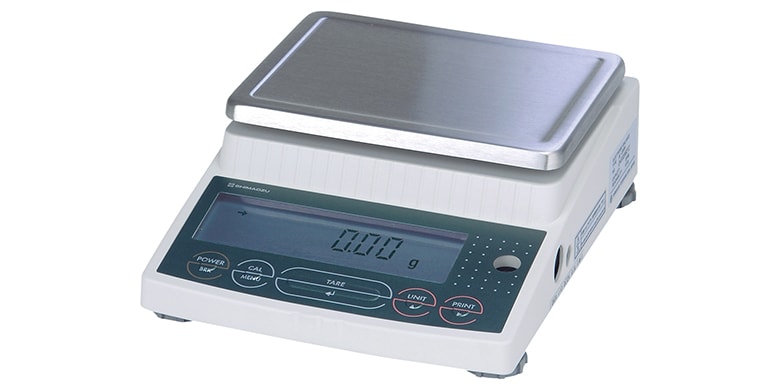
Shimadzu Bl Series
Shimadzu Bl Series — Laboratory balances.
The Shimadzu BL Series is a family of electronic balances spanning S-series (standard) and H-series (high-stability) models, with capacities from 320 g to 3200 g and readabilities from 0.001 g to 0.1 g. This card covers the series as a whole; individual model selection depends on required readability, pan size, and temperature stability. The balances are intended for general laboratory weighing, piece counting, and percent weighing, with optional RS-232C output for printer or PC integration.
Full specifications
Description
Construction and Series Positioning
The BL Series comprises two sub-families: the S series (BL-320S, BL-620S, BL-3200S) and the H series (BL-220H, BL-320H(L), BL-2200H, BL-3200H(L)). S-series models offer standard sensitivity stability (±10 ppm/°C), while H-series models provide improved stability (±3 ppm/°C for BL-220H and BL-2200H; ±5 ppm/°C for BL-320H(L) and BL-3200H(L)). The H series also includes a windbreak (supplied only with BL-220H and BL-320H(L)) for protection from drafts during high-resolution weighing. Pan sizes differ: 100×100 mm for BL-320S, BL-220H, and BL-320H(L); 159×126 mm for BL-620S, BL-3200S, BL-2200H, and BL-3200H(L). Body height is approximately 77 mm for S series (78 mm for BL-3200S) and 114 mm for H series (78 mm for BL-2200H and BL-3200H(L)). All models share a common 171×243 mm footprint.
Behavior Under Load and in Different Modes
Weighing performance is characterized by repeatability (standard deviation) and linearity, with eccentric error limits varying by model: 2 counts for S series, 4 counts for H series, and 7 counts for BL-320H(L) and BL-3200H(L). The balance offers three measurement modes: standard, sample pouring, and high stability, selectable via the menu. Zero tracking should be enabled for normal weighing but disabled when monitoring slow weight changes (e.g., liquid or powder addition). Stability detection is indicated by a mark when the display remains within ±1 unit for a fixed period in standard mode. Autoprint triggers when the display is within zero ±3 counts and a sample exceeding 20 counts of the g display is loaded and stable.
Installation, Connection, and Control
Installation requires leveling using the three level screws and level gauge, fitting the protection cover, and assembling the pan. Power is supplied via an optional AC adapter (DC12 V, 1.0 A; primary AC100–240 V, 400 mA, 50/60 Hz). A warm-up period of at least one hour is required before accurate measurement or calibration. The data I/O connector allows connection to printers or PCs; communication parameters (baud rate 300–9600, parity, stop bits, delimiter) must match the peripheral. Up to three units can be registered from 14 available units, but % and pcs cannot be registered simultaneously. Calibration requires setting a weight value within the model-specific range (e.g., >150 g and <capacity for BL-320S) and performing span calibration after warm-up and leveling.
Integration & Operating Notes
Exceeding these environmental limits can cause drift, condensation, or damage. The balance is rated Pollution Degree 2, Overvoltage Category II, and altitude up to 2000 m. Avoid direct sunlight, vibration, and drafts; use the windbreak (if supplied) in drafty locations.
The balance requires DC12 V, 1.0 A. The AC adapter accepts AC100–240 V, 400 mA, 50/60 Hz. Using an unauthorized adapter may cause malfunction or safety hazard. Check the supply voltage before connecting.
Baud rate (300–9600), parity (even/odd/none), stop bits (1 or 2), and delimiter (C/R, L/F, C/R+L/F, comma) must be set to match the peripheral. Autoprint requires the display to be within zero ±3 counts and a stable sample over 20 counts of the g display.
Zero tracking should be ON for normal weighing but OFF when monitoring weight changes over time or slowly adding liquid/powder. Otherwise, the balance may mask small incremental changes by re-zeroing.
Repeatability: standard deviation must be less than 1.5 times the specified value after 10 load/unload cycles near capacity. Eccentric error limits: 2 counts (S series), 4 counts (H series), 7 counts (BL-320H(L), BL-3200H(L)). Clean the balance and pan as instructed; avoid solvents.
Selection & Integration Q&A
Choose S series for general weighing where ±10 ppm/°C stability suffices and a windbreak is not needed. Choose H series for better temperature stability (±3 or ±5 ppm/°C) and, for BL-220H/BL-320H(L), an included windbreak for high-resolution work.
Use the data I/O connector and set communication parameters (baud rate 300–9600, parity, stop bits, delimiter) to match the peripheral. Autoprint triggers when the display is within zero ±3 counts and a stable sample over 20 counts of the g display is loaded.
Operate indoors at 5–40 °C, 20–85% RH non-condensing, altitude ≤2000 m, Pollution Degree 2, Overvoltage Category II. Allow ≥1 hour warm-up before critical weighing. The design standard period of usage is ten years.
Periodically check repeatability (SD <1.5× spec after 10 cycles) and eccentricity (2/4/7 counts by model). Clean the balance and pan. The AC adapter is optional; windbreak is supplied only with BL-220H and BL-320H(L). Calibration weights and cables are listed in the parts list and must be ordered separately.