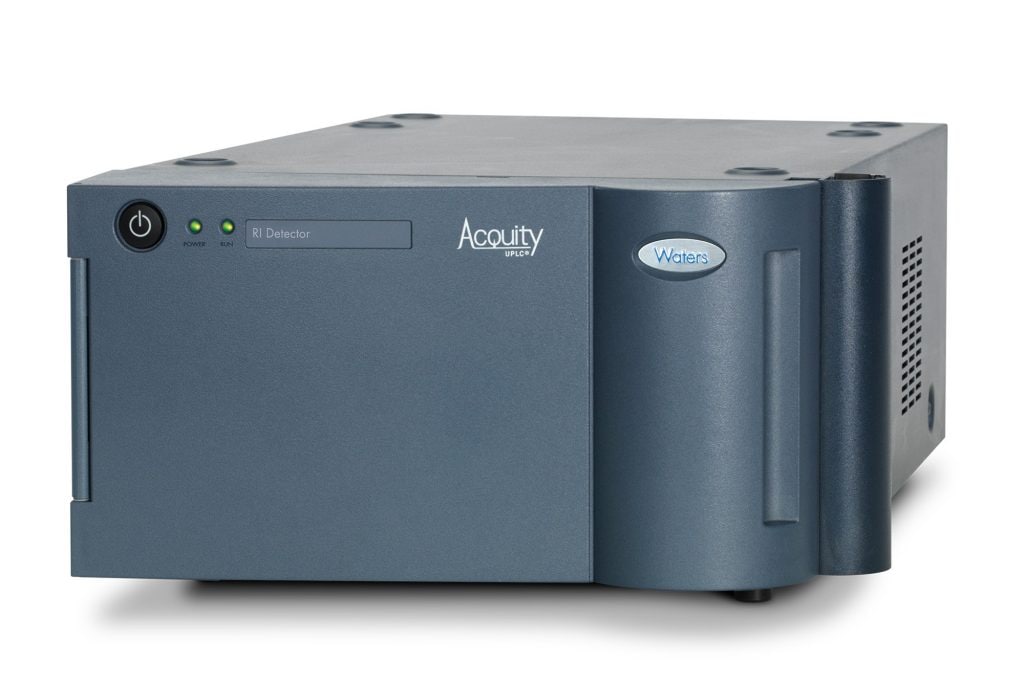
Waters ACQUITY UPLC Refractive Index Detector (RID)
Waters ACQUITY UPLC Refractive Index Detector (RID) — Chromatography detectors.
The ACQUITY UPLC Refractive Index Detector is an LED-based RID with a 1.3 µL fused-quartz flow cell and <15 µL internal fluidic volume, optimized for UPLC flow rates up to 2.0 mL/min. It delivers low-noise detection (≤±1.5 × 10⁻⁹ RIU) across an RI range of 1.00–1.75, making it suitable for analytes lacking UV chromophores. This detector integrates into ACQUITY UPLC systems for sensitive, low-dispersion refractive index measurements.
Full specifications
| Detector type | Refractive Index Detector (RID) |
| Flow rate | 2.0 mL/min |
| Refractive index range mfr | 1.00 to 1.75 |
| Measurement range mfr | 7.0 x 10 -9 RIU to 5.0 x 10 -4 RIU |
| Linear dynamic range mfr | ≤5.0% over ±5.0 x 10 -4 RIU |
| Drift mfr | ≤2.0 x 10 -7 RIU/h (2 points/s, 1 s filter time |
| Sampling rates mfr | 1 to 80 points/s |
| Filter time constant mfr | 0.0 to 5.0 s (Independently optimized) |
| Compatible flow rate range mfr | 0.05 to 2.00 mL/min |
| RIU full scale settings mfr | 1 to 500 x 10 -6 RIU |
| Flow cell design mfr | Fused quartz |
| Light source mfr | LED 870 nm |
| Flow cell volume mfr | 1.3 μL |
| Internal fluidic volume mfr | <15 μL |
| Wetted materials mfr | 316 stainless-steel, fluoroelastomer, fluoropoly |
| Pressure limit mfr | ≤145 psi |
| Weight | 15.4 kg |
| Width mfr | 34.3 cm (13.5 inches) |
| Height mfr | 20.8 cm (8.2 inches) |
| Depth mfr | 61.0 cm (24.0 inches) |
| Noise | ≤±1.5 x 10 -9 RIU (2 points/s, 1 s filter time constant 0.5 mL/min, 100% H2O) |
Description
Construction and Architecture
The ACQUITY UPLC RID is a dedicated refractive index detector featuring an 870 nm LED light source and a fused-quartz flow cell with a 1.3 µL volume. The internal fluidic path is minimized to <15 µL, reducing peak dispersion for UPLC separations. Wetted materials include 316 stainless steel, fluoroelastomer, fluoropolymer, natural PPS, fused silica, and PEEK (for non-APC systems), ensuring chemical compatibility with typical HPLC solvents. The detector's compact dimensions (34.3 cm W × 20.8 cm H × 61.0 cm D) allow integration into standard instrument stacks. ### Performance and Modes
- **Measurement range:** 7.0 × 10⁻⁹ RIU to 5.0 × 10⁻⁴ RIU, with a linear dynamic range of ≤5.0% over ±5.0 × 10⁻⁴ RIU. - **Noise and drift:** Noise ≤±1.5 × 10⁻⁹ RIU (2 points/s, 1 s filter, 0.5 mL/min, 100% H₂O) and drift ≤2.0 × 10⁻⁷ RIU/h under identical conditions. - **Adjustable parameters:** Sampling rates from 1 to 80 points/s, filter time constants from 0.0 to 5.0 s (independently optimized), and RIU full-scale settings from 1 to 500 × 10⁻⁶ RIU. - **Flow rate compatibility:** 0.05 to 2.00 mL/min, accommodating both analytical and narrow-bore applications. The low internal volume and pressure limit of ≤145 psi necessitate careful plumbing to avoid excessive backpressure. The LED source and fused-quartz cell require stable thermal conditions to achieve specified noise and drift performance. Users should refer to the ACQUITY UPLC RID operator's manual for detailed connection, control, and maintenance procedures.
Integration & Operating Notes
The flow cell and internal fluidics are rated to a maximum pressure of 145 psi. Operating above this limit risks cell rupture or seal damage, leading to leaks and potential sample loss. Ensure downstream tubing and connections do not introduce restrictive backpressure, especially when using narrow-bore tubing or small-particle columns.
The available documentation does not specify voltage, current, or frequency requirements. Before installation, consult the ACQUITY UPLC RID operator's manual for exact electrical specifications and ensure the supply is properly grounded and stable to prevent interference with the LED source and detection electronics.
To prevent clogging and maintain performance, flush the flow cell with a compatible solvent (e.g., HPLC-grade water or methanol) after each use, especially when switching between buffers and organic solvents. Avoid prolonged exposure to high-salt buffers that may precipitate and block the 1.3 µL cell. Refer to the manual for recommended flushing protocols and cleaning agents.
Selection & Integration Q&A
Choose this RID for UPLC applications requiring low dispersion and high sensitivity, with flow rates up to 2.0 mL/min and analytes lacking UV absorbance. Its 1.3 µL cell and <15 µL internal volume minimize peak broadening, making it ideal for narrow-bore columns. For higher flow rates or preparative scale, consider other detectors with larger cells.
The RID must be plumbed with tubing that withstands up to 145 psi and minimizes dead volume. Use compatible fittings (e.g., 1/16" or 1/8" PEEK) and ensure the flow path is free of restrictive elements. The detector's wetted materials (316 SS, PEEK, fluoroelastomer) are compatible with common HPLC solvents, but avoid chlorinated solvents if PEEK is present.
Regular maintenance includes flushing the flow cell with appropriate solvents and replacing seals as needed. The base delivery does not include solvent lines, fittings, or a computer/software for control; these must be ordered separately. A preventive maintenance kit (part number not specified) is recommended annually. Refer to the manual for detailed schedules.