
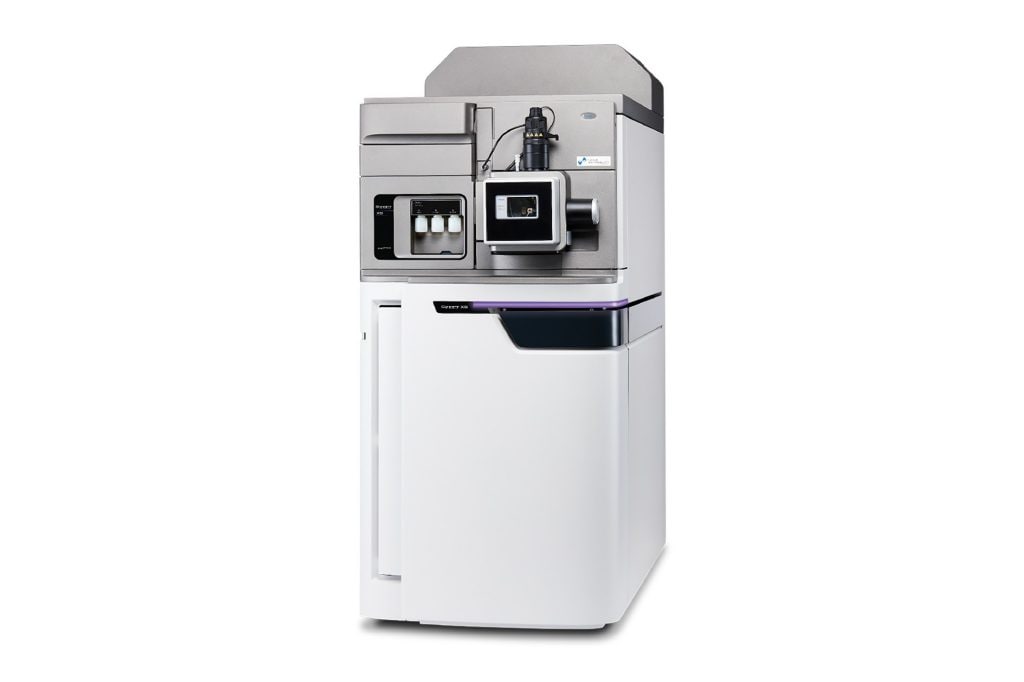
Waters SYNAPT XS
Waters SYNAPT XS — Mass spectrometers.
The Waters SYNAPT XS is a high-resolution mass spectrometer platform combining ion mobility spectrometry with time-of-flight mass analysis. It is positioned for advanced analytical laboratories requiring multidimensional separation and accurate mass measurement. The system serves as a primary detector in LC-MS workflows for complex mixture characterization.
Direct drop-in replacements
Full specifications
Description
Construction and Architecture
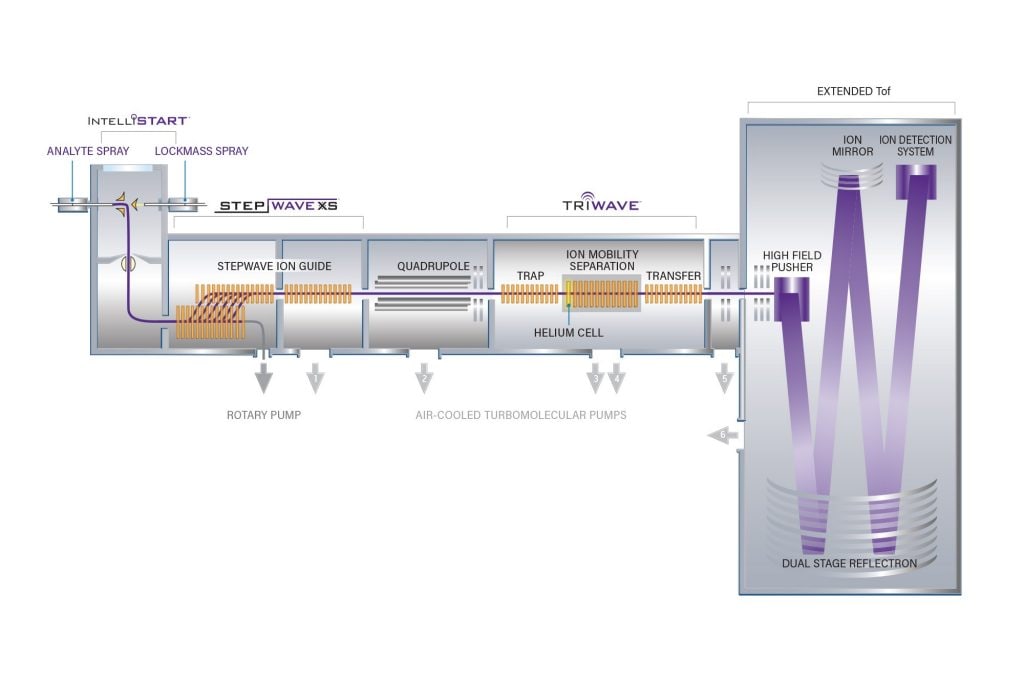
The SYNAPT XS is a benchtop mass spectrometer integrating ion mobility separation (IMS) with quadrupole time-of-flight (QTOF) mass analysis. The architecture typically includes an electrospray ionization source, a quadrupole mass filter, a traveling-wave ion mobility cell, and a reflectron TOF analyzer. This configuration enables acquisition of both mass-to-charge (m/z) and ion mobility (drift time) data, providing an additional dimension of separation for isobaric and isomeric species. ### Behavior Under Load and Modes
The instrument supports multiple acquisition modes, including MS, MS/MS, and ion mobility-enhanced MS. In IMS mode, ions are separated based on their collision cross section (CCS) as they travel through a gas-filled mobility cell under the influence of a traveling wave. This allows for the resolution of species that would otherwise overlap in m/z alone. The TOF analyzer provides high mass resolution and mass accuracy, typically in the low ppm range, which is essential for elemental composition assignment. ### Installation, Connection, and Control
The SYNAPT XS requires a stable laboratory environment with controlled temperature and humidity, and a supply of high-purity nitrogen for the source and mobility cell. It is controlled via Waters' MassLynx software, which manages acquisition, calibration, and data processing. The system interfaces with liquid chromatography systems, typically via an electrospray source, and requires a compatible LC gradient system for sample introduction. Electrical requirements include a dedicated power supply and proper grounding. The instrument should be installed on a vibration-isolated bench to prevent spectral artifacts.
Integration & Operating Notes
The TOF analyzer is sensitive to mechanical vibrations, which can degrade mass accuracy and resolution. The instrument must be placed on a rigid, level surface free from nearby sources of vibration such as pumps or centrifuges. Adequate clearance for ventilation and service access is also required.
The system draws significant current and is sensitive to voltage fluctuations. A dedicated circuit with a clean ground is necessary to prevent electrical noise from affecting detector performance. Uninterruptible power supply (UPS) is recommended to protect against power interruptions.
The source and ion mobility cell require high-purity nitrogen (≥99.999%) at a regulated pressure. Fluctuations or impurities can cause signal instability, reduced sensitivity, or contamination of the ion optics. A gas generator or Dewar supply with appropriate regulators and filters is essential.
Selection & Integration Q&A
Choose the SYNAPT XS when ion mobility separation is needed for resolving isobars/isomers or measuring collision cross sections. For routine accurate mass without IMS, a standard QTOF like the Xevo G2-XS may suffice.
The SYNAPT XS connects to an LC via an electrospray source. It requires a compatible LC system with flow rates typically in the 0.1–1.0 mL/min range, and the LC must be controlled by MassLynx for synchronized acquisition.
The instrument requires an air-conditioned laboratory with temperature stability (±2°C) and humidity control (40–60% RH). Avoid direct sunlight and drafts. A vibration-isolated bench is mandatory for optimal performance.
Regular maintenance includes source cleaning, ion optics cleaning, and replacement of the nitrogen filters. Consumables include ESI emitters, sample vials, and calibration solutions. A service contract is recommended for annual preventive maintenance.
Dimensional Drawings & Technical Documentation
Dimensional drawings
Click drawing to inspect vector dimensions