
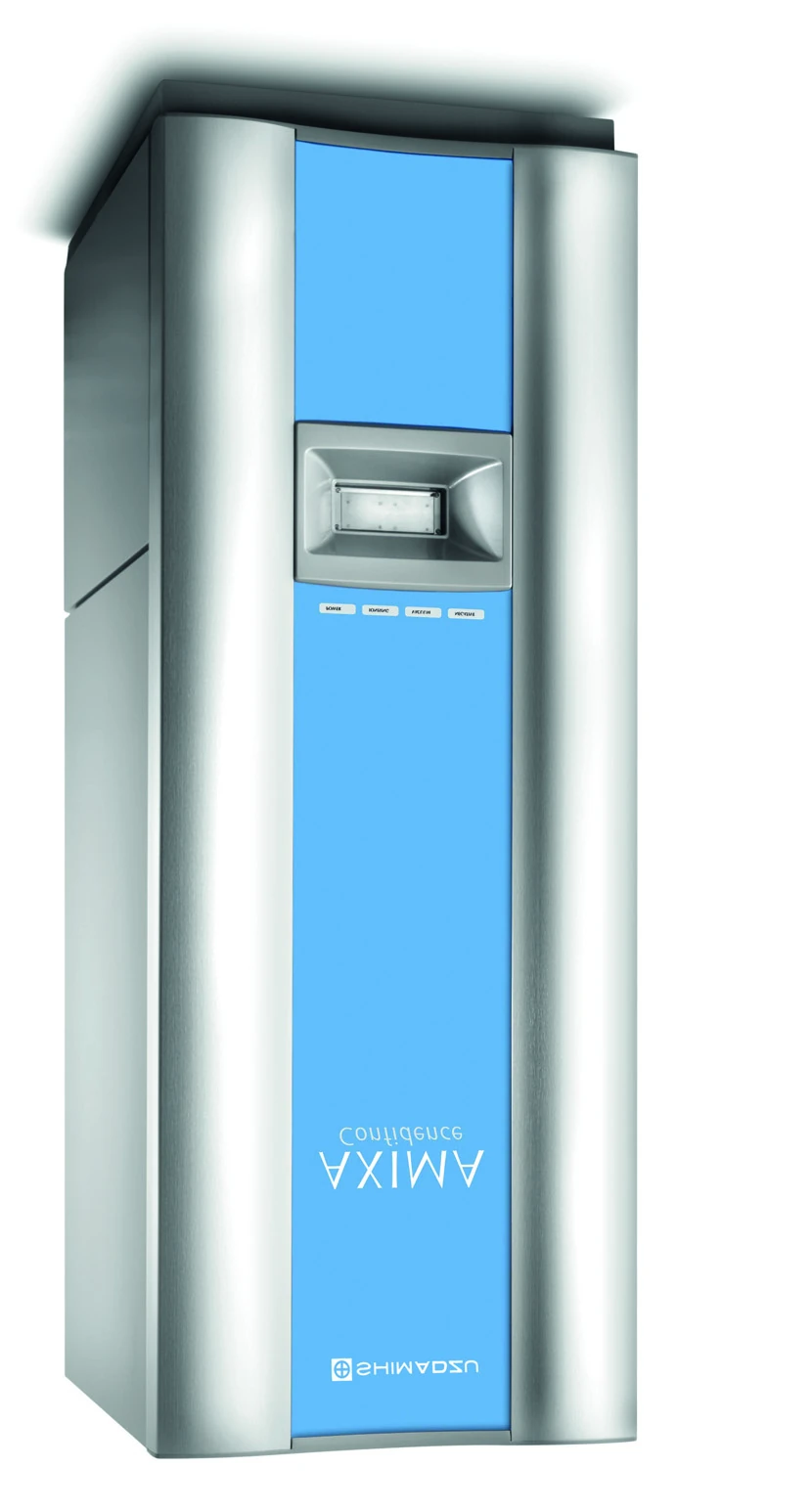
Shimadzu Axima Confidence
Shimadzu Axima Confidence — Mass spectrometers.
The Axima Confidence is a MALDI time-of-flight mass spectrometer with a fixed-focus 337 nm nitrogen laser (3 ns pulse, 100 µJ, 50 Hz) and near-normal on-axis irradiation. It covers linear mode from 1 Da to 500 kDa and reflectron mode with >15,000 FWHM resolution, using 96/384-well microtitre or FlexiMass slide-format targets. It serves as a benchtop workhorse for routine protein and peptide mass analysis in life-science laboratories.
Direct drop-in replacements
Full specifications
| Laser repetition rate (N2 laser) mfr | 50 Hz (N2 laser) |
| Laser type mfr | N2 |
| Resolution (ACTH fragment 7-38) mfr | >15,000 FWHM (ACTH fragment 7-38) |
| Ion source (near-normal (on-axis) laser irradiation) mfr | MALDI (near-normal (on-axis) laser irradiation) |
| Sample target format (FlexiMass microscope slide-format) mfr | plain or 48 well (FlexiMass microscope slide-format) |
| Sensitivity (linear mode, bovine serum albumin) mfr | 250 fmol (linear mode, bovine serum albumin) |
| Target thickness (plain, 96 and 384 sample targets) mfr | 2 mm (plain, 96 and 384 sample targets) |
| Maximum target thickness (with optional adaptor) mfr | 10 mm (with optional adaptor) |
| Turbomolecular pump pumping speed (nominal, sample introduction, rotary backing) mfr | 250 l/s (nominal, sample introduction, rotary backing) |
| Turbomolecular pump pumping speed (nominal, analyzer, two pumps with rotary backing) mfr | 250 l/s (nominal, analyzer, two pumps with rotary backing) |
| Camera magnification (monochrome CCD camera) mfr | 25 x (monochrome CCD camera) |
| Laser wavelength (nitrogen laser, fixed focus) mfr | 337 nm (nitrogen laser, fixed focus) |
| Laser energy (nominal, per laser shot) mfr | 100 μJ (nominal, per laser shot) |
| Maximum laser pulse rate (50 laser shots per second) mfr | 50 Hz (50 laser shots per second) |
| Transient recorder sampling rate (8 bit, 16 bit accumulator) mfr | 2 GHz (8 bit, 16 bit accumulator) |
| Second transient recorder sampling rate (neutral detection, 8 bit, 64 kB RAM) mfr | 125 MHz (neutral detection, 8 bit, 64 kB RAM) |
| RAM (control PC) mfr | 16 GB (control PC) |
| HDD storage (control PC) mfr | 256 GB (control PC) |
| SSD storage (control PC) mfr | 1 TB (control PC) |
| Monitor size (control PC) mfr | 24 in (control PC) |
| Operating system (control PC and LAUNCHPADTM) mfr | Microsoft® Windows® 10 64-bit (control PC and LAUNCHPADTM) |
| Mass range (linear mode, bovine serum albumin) mfr | 55000-80000 m/z (linear mode, bovine serum albumin) |
| Detector types (optional removal of unwanted low mass ions) mfr | patented beam blanker (optional removal of unwanted low mass ions) |
| Mass range (linear mode) mfr | 1 Da to 500 kDa (linear mode) |
| Mass accuracy (linear mode, with internal calibration) mfr | <30 ppm (linear mode, with internal calibration) |
| XY stage step (microtiter plate footprint MALDI target) mfr | 10 μm (microtiter plate footprint MALDI target) |
| XY stage repeatability (microtiter plate footprint MALDI target) mfr | 10 μm (microtiter plate footprint MALDI target) |
| Laser pulse width mfr | 3 ns |
| Linear flight tube drift length (linear mode) mfr | 1.2 m (linear mode) |
| Reflectron effective drift length (reflectron mode) mfr | 2.0 m (reflectron mode) |
| Ion extraction energy (linear mode, variable, software controlled) mfr | +25 kV/-20 kV kV (linear mode, variable, software controlled) |
| Ion extraction energy (reflectron mode, variable, software controlled) mfr | +20 kV/-20 kV kV (reflectron mode, variable, software controlled) |
| Sample target format (standard microtitre plate-format) mfr | 96 or 384 well (standard microtitre plate-format) |
Description
Construction and positioning
- MALDI ion source with near-normal (on-axis) laser irradiation and a fixed-focus nitrogen laser at 337 nm; no sibling variants are defined in the supplied facts, so this model stands as the single configured system.
- Dual-mode TOF analyzer: 1.2 m linear flight tube and 2.0 m effective reflectron path, selected in software.
- Sample introduction via a 96- or 384-well microtitre-format target (2 mm thick) or FlexiMass microscope-slide-format targets (plain or 48-well); an optional adaptor accepts targets up to 10 mm thick.
- Vacuum: 250 l/s turbomolecular pump on sample introduction with rotary backing; analyzer uses two 250 l/s turbomolecular pumps with rotary backing.
- Detection: patented beam blanker for optional removal of unwanted low-mass ions; monochrome CCD camera with 25× magnification for sample viewing.
Behavior under load and in different modes
- Linear mode spans 1 Da to 500 kDa; bovine serum albumin measured over m/z 55,000–80,000 with 250 fmol sensitivity and <30 ppm mass accuracy using internal calibration.
- Reflectron mode achieves >15,000 FWHM on the ACTH fragment 7–38.
- Ion extraction energy is software-controlled: +25 kV/−20 kV in linear mode and +20 kV/−20 kV in reflectron mode, supporting positive and negative ion detection.
- The XY stage on microtitre-footprint targets steps and repeats to 10 µm, enabling reproducible spot positioning.
- Data acquisition: 2 GHz transient recorder (8-bit, 16-bit accumulator) and a second 125 MHz recorder for neutral detection.
Installation, control and operation
- The system is controlled by LAUNCHPAD™ software running on a control PC with 16 GB RAM, 256 GB HDD and 1 TB SSD.
- Laser repetition is fixed at 50 Hz (50 shots/s); pulse width 3 ns and nominal energy 100 µJ per shot.
- Targets are loaded through the sample introduction vacuum lock; the standard microtitre-format target is 2 mm thick, and thicker or unconventional layouts require the optional adaptor.
- No certificates or application notes are supplied in the verified facts; performance figures above are the only quantified operating data.
Integration & Operating Notes
Standard 96- and 384-well microtitre-format targets are 2 mm thick; the sample introduction stage accepts only this thickness unless the optional adaptor is fitted, which raises the maximum to 10 mm. Loading an unadapted thick target risks jamming the vacuum lock and misaligning the laser focus.
The <30 ppm figure applies only with internal calibration in linear mode; without calibrant peaks in the same spectrum, mass accuracy will be worse. Include a calibrant spot or standard in the target layout for every batch where accurate masses are required.
The sample-introduction and analyzer turbomolecular pumps (250 l/s nominal) rely on rotary backing pumps; loss of backing vacuum or overdue pump service will degrade sensitivity and can trip the system. Schedule rotary-pump oil checks and turbopump service per the manual.
The fixed-focus 337 nm nitrogen laser operates at 50 Hz with 3 ns pulses and 100 µJ nominal energy; it requires a nitrogen supply and its gas fill has a limited lifetime, so plan laser service into long-term operating budgets.
Selection & Integration Q&A
No sibling variants are defined in the supplied facts, so the Axima Confidence is the only configured model here. Choose it when you need both linear mode to 500 kDa and reflectron resolution >15,000 FWHM with a fixed 337 nm N2 laser at 50 Hz.
Standard 96- or 384-well microtitre-format targets (2 mm thick) and FlexiMass microscope-slide-format targets (plain or 48-well) fit directly; the optional adaptor extends the maximum target thickness to 10 mm for unconventional layouts.
The nitrogen laser requires a nitrogen gas supply and periodic laser service due to finite gas-fill life; rotary backing pumps need oil checks and turbopumps need periodic service. Targets and the optional thick-target adaptor are ordered separately, and no cables or accessories are listed as included.