
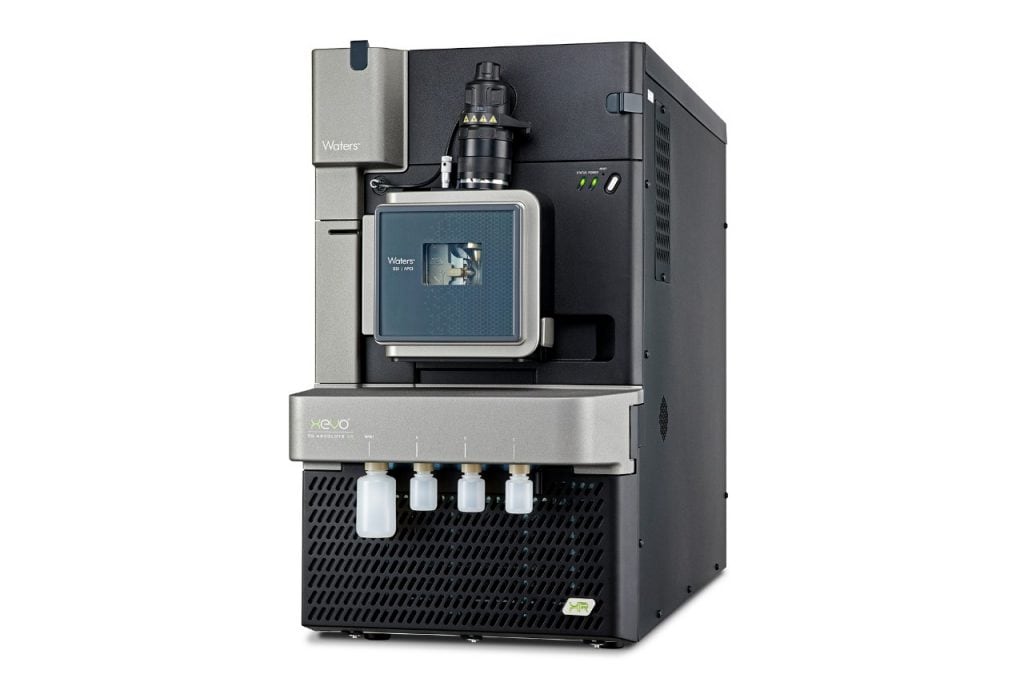
Waters Xevo TQ Absolute XR Triple Quadrupole Mass Spectrometer
Waters Xevo TQ Absolute XR Triple Quadrupole Mass Spectrometer — Mass spectrometers.
The Xevo TQ Absolute XR is a triple quadrupole mass spectrometer with two high-resolution quadrupole analyzers and a T-Wave collision cell, covering 2–2048 m/z. It distinguishes itself within the series by its StepWave XR ion transfer optics and XDR detector, enabling 500 MRM/sec. It serves as the primary quantitative detector in LC-MS/MS workflows for targeted analysis.
Direct drop-in replacements
Full specifications
| Detector types | Low-noise, off-axis, long-life photomultiplier XDR Detector |
| Ion source | High performance ZSpray dual-orthogonal API sources: Multi-mode ESI/APCI/ESCi (standard); UniSpray (optional); APCI probe (optional); nanoFlow ESI (optional); ASAP (optional); APGC (optional); ionKey (optional); DESI XS (optional) |
| Collision cell mfr | T-Wave enabled; software programmable gas contro |
| Vacuum system mfr | One splitflow turbomolecular pump; one vacuum ba |
| Regulatory approvals/marks mfr | CE, CB, NRTL (CAN/US), RCM |
| MRM speed mfr | 500 MRM/sec |
| Ion source transfer optics mfr | StepWave XR |
| Acquisition modes mfr | Full scan MS; Product ion scan; Precursor ion sc |
| Software mfr | waters_connect and MassLynx version 4.2 or later |
| Mass range | 2 to 2048 m/z |
| Height | 60 cm |
| Length | 93 cm |
| Width | 35.6 cm |
| Mass analyzer mfr | Two high-resolution, high-stability quadrupole a |
Description
Construction and architecture
- Dual quadrupole analyzers (MS1/MS2) with pre-filters, a T-Wave collision cell with software-programmable gas control, and a low-noise off-axis photomultiplier XDR detector. - Vacuum is maintained by one splitflow turbomolecular pump backed by one vacuum backing pump. - The standard ion source is a ZSpray dual-orthogonal API source in multi-mode ESI/APCI/ESCi; optional sources include UniSpray, APCI probe, nanoFlow ESI, ASAP, APGC, ionKey, and DESI XS. - Physical dimensions: 60 cm height, 93 cm length, 35.6 cm width. ### Behavior under load and in different modes
- The mass range spans 2 to 2048 m/z, suitable for low-mass fragments to larger molecules. - Acquisition modes include full scan MS, product ion scan, precursor ion scan, constant neutral loss scan, MRM, and simultaneous full scan and MRM (RADAR). - MRM speed is 500 MRM/sec, supporting high-throughput targeted quantitation. - The StepWave XR ion transfer optics and XDR detector are designed to maintain sensitivity and dynamic range. ### Installation, connection, and control
- The system is controlled by waters_connect or MassLynx version 4.2 or later. - Regulatory approvals include CE, CB, NRTL (CAN/US), and RCM.
Integration & Operating Notes
The vacuum system uses one splitflow turbomolecular pump and one backing pump. These pumps have high inrush currents; the electrical supply must be sized accordingly and may require a dedicated circuit. Refer to the site preparation guide for voltage and current ratings.
The system requires waters_connect or MassLynx version 4.2 or later. Using older software may prevent communication with the instrument or limit access to acquisition modes such as RADAR. Confirm software compatibility before installation.
Selection & Integration Q&A
Choose the XR when you need the highest MRM speed (500 MRM/sec) and the StepWave XR ion transfer optics for demanding high-throughput quantitation. For lower throughput or budget constraints, consider standard models without XR enhancements.
The system requires an LC system with compatible fittings and a PC running waters_connect or MassLynx v4.2+. Ensure the LC can communicate via the supported interface (e.g., Ethernet) and that the software is configured for the specific ion source in use.
The instrument is approved for indoor laboratory use (CE, CB, NRTL, RCM). Avoid high ambient temperatures and humidity; ensure adequate ventilation. Continuous operation at high MRM rates may require additional cooling; refer to the site prep guide for specifics.