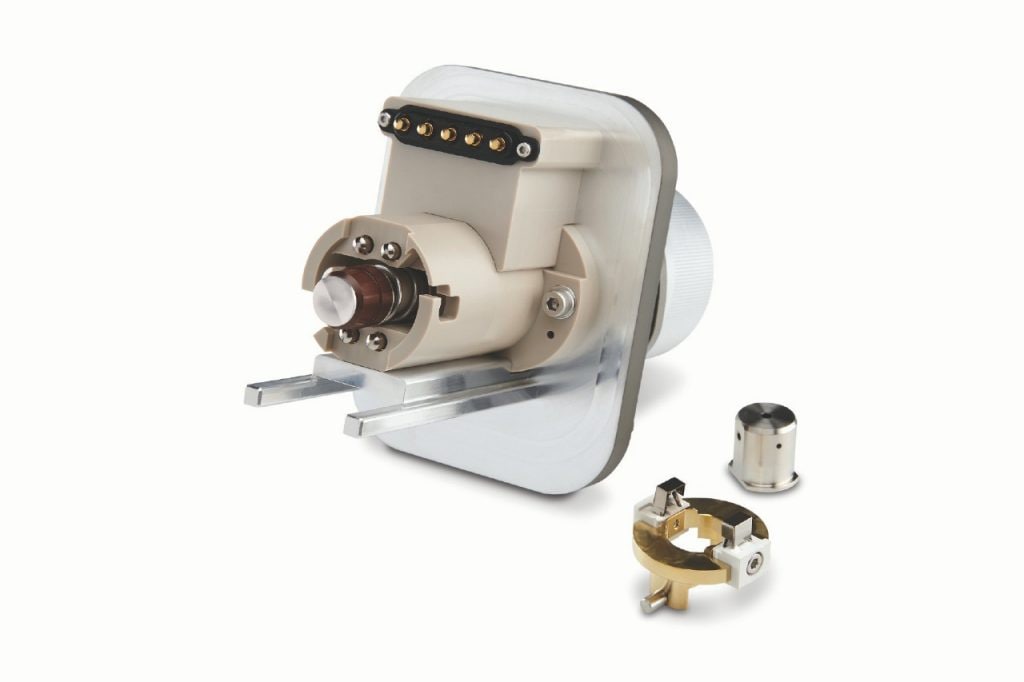
Waters Xevo TQ-GC Mass Spectrometer
Waters Xevo TQ-GC Mass Spectrometer — Mass spectrometers.
The Xevo TQ-GC is a tandem quadrupole mass spectrometer with dual high-resolution quadrupole analyzers (MS1/MS2), a curved T-Wave collision cell, and an off-axis photomultiplier detector. It covers a mass range of 2–1250 m/z and supports EI (standard) and CI (optional) ionization, with acquisition rates up to 500 MRM/sec. This model is intended for targeted quantitation and confirmation in GC-MS/MS workflows, offering multiple acquisition modes including MRM, SIR, and simultaneous full scan/MRM (RADAR).
Direct drop-in replacements
Full specifications
| Type | tandem quadrupole |
| Configuration | benchtop |
| Detector types | Low noise, off axis, long life photomultiplier detector |
| Ion source | EI standard, CI optional |
| Scan speed | 20000 Da/s (MS scanning mode) |
| EI filaments mfr | Dual EI Yttrium-coated long-lasting filaments |
| Electron energy mfr | Range 10–200 eV |
| Pump down time mfr | 15 minutes |
| Source temperature mfr | 250 °C |
| Transfer line temperature mfr | 350 °C |
| Collision cell mfr | Innovative curved T-Wave |
| Vacuum system mfr | One split-flow air-cooled vacuum turbomolecular |
| Regulatory approvals/marks mfr | CE and NRTL |
| Software mfr | MassLynx version 4.2; TargetLynx XS Application |
| Acquisition modes mfr | Full scan; MS Product ion scan; Precursor ion sc |
| Acquisition rate mfr | up to 500 MRM/sec |
| Ion source (alt var) mfr | electron impact (EI) or chemical ionization (CI) |
| Mass range | 2–1250 m/z |
| Height | 59.3 cm |
| Length | 1030 mm (40.6 inches) cm |
| Weight | < 135 kg (< 297.6 lbs) kg |
| Width | 97.0 cm |
| Depth mfr | 91.3 cm (36.0 in) |
| Mass analyzer mfr | Two high resolution, high stability quadrupole a |
| Width (instrument crate) (alt var) mfr | 770 mm (30.3 inches) cm |
| Height (instrument crate) (alt var) mfr | 880 mm (34.6 inches) cm |
Description
Construction and Architecture
- The Xevo TQ-GC is built around two high-resolution, high-stability quadrupole analyzers (MS1 and MS2) with pre-filters, ensuring high selectivity in MRM. A curved T-Wave collision cell provides efficient ion fragmentation and transmission. - Ionization is achieved via an EI source (standard) with dual Yttrium-coated long-life filaments; CI is available as an option. The detector is a low-noise, off-axis photomultiplier, extending lifetime and reducing neutral noise. - Vacuum is maintained by a split-flow air-cooled turbomolecular pump backed by a separate backing pump, achieving pump-down in approximately 15 minutes. - The system is controlled by MassLynx 4.2 software, with TargetLynx XS Application Manager included for data processing. ### Behavior Under Load and Modes
- The mass range of 2–1250 m/z covers small molecules and typical GC-amenable compounds. The electron energy is adjustable from 10 to 200 eV, allowing tuning of fragmentation. - Acquisition modes include full scan, product ion scan, precursor ion scan, SIR, MRM, RADAR (simultaneous full scan and MRM), and PIC. The system supports acquisition rates up to 500 MRM transitions per second, enabling high-throughput targeted analysis. - Source temperature is typically set to 250 °C, and the transfer line to 350 °C, ensuring efficient volatilization and transfer of analytes. ### Installation, Connection, and Operation
- The instrument requires a suitable GC system for sample introduction; the transfer line interfaces directly with the GC column. Ensure that the GC oven and transfer line temperatures are compatible with the maximum operating limits. - Electrical requirements: the system operates on standard laboratory power; consult the site preparation guide for detailed power and environmental specifications. The vacuum pump requires adequate ventilation and cooling. - The system is controlled via a PC running MassLynx 4.2 under Windows; a dedicated Ethernet connection is used for communication between the PC and the instrument. - Regulatory approvals include CE and NRTL marks, indicating compliance with European and North American safety standards.
Integration & Operating Notes
The system includes a split-flow turbomolecular pump and a backing pump, both of which have specific power requirements. Provide dedicated circuits with proper grounding and surge protection. Refer to the site preparation guide for voltage, current, and frequency ratings; do not share circuits with high-noise equipment.
Selection & Integration Q&A
Choose the Xevo TQ-GC when you need high-selectivity MRM quantitation at trace levels, confirmation via product ion scans, or simultaneous full-scan and MRM (RADAR). A single quad is adequate for simple full-scan screening but lacks the sensitivity and specificity of tandem MS for complex matrices.
The GC must provide a suitable column effluent interface to the transfer line, and its oven must be capable of reaching the transfer line temperature (up to 350 °C). The GC should have a compatible autosampler and be controllable via MassLynx or an independent controller; ensure synchronization of start signals.
The base system includes the instrument, MassLynx 4.2 with TargetLynx XS, and standard EI source. Not included: CI source (optional), additional filaments, source cleaning kits, backing pump oil, GC column and consumables, and a dedicated PC if not specified. Plan for a spare filament and regular source cleaning supplies.