
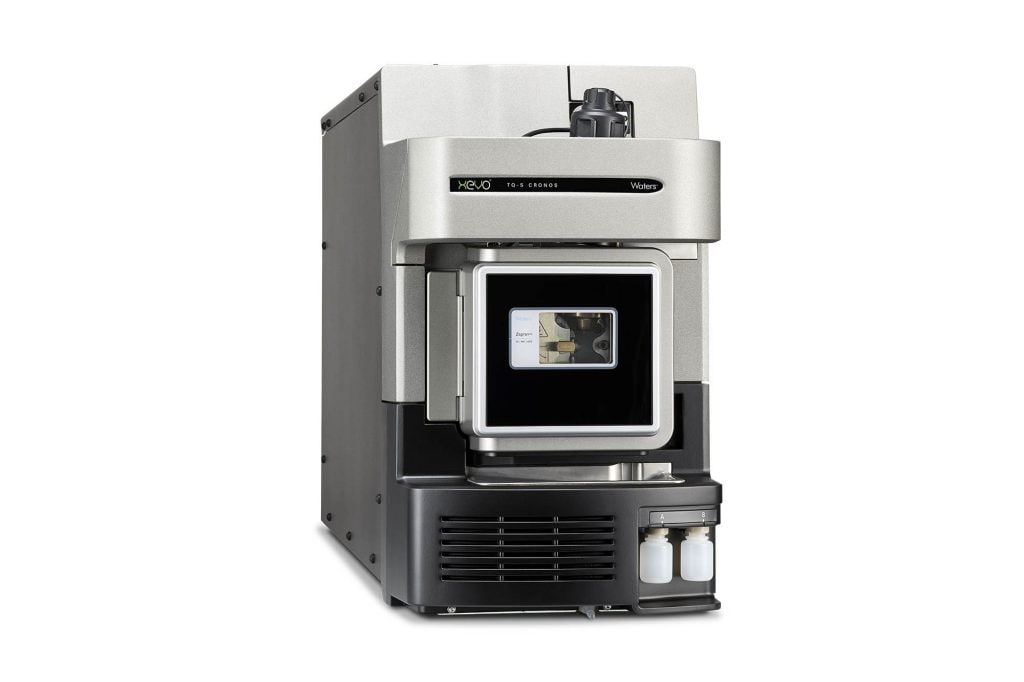
Waters Xevo TQ-S cronos
Waters Xevo TQ-S cronos — Mass spectrometers.
The Xevo TQ-S cronos is a tandem quadrupole mass spectrometer with two high-resolution quadrupole analyzers and a T-Wave collision cell, covering 2–2048 m/z. Its standard tool-free ESI/APCI/ESCi multi-mode source distinguishes it from single-source variants, while optional UniSpray and ASAP sources extend ionization flexibility. It serves targeted MRM quantitation and simultaneous full-scan/MRM (RADAR) in analytical laboratories.
Direct drop-in replacements
Full specifications
| Detector types | Low-noise, off-axis, long-life photomultiplier |
| Ion source | High performance ZSpray dual-orthogonal API sources: Multi-mode source – tool free ESI/APCI/ESCi (standard); UniSpray ion source (optional); Tool-free APCI probe (optional); ASAP (optional) |
| Collision cell mfr | T-Wave enabled |
| Vacuum system mfr | One split-flow air-cooled vacuum turbomolecular |
| Regulatory approvals/marks mfr | CE, CB, NRTL (CAN/US), RCM |
| MRM speed mfr | 555 MRM/sec |
| Acquisition modes mfr | Full scan MS; Product ion scan; Precursor ion sc |
| Mass range | 2 to 2048 m/z |
| Height | 60.0 cm |
| Width | 35.6 cm |
| Depth mfr | 93 cm (36.6 in) |
| Mass analyzer mfr | Two high-resolution, high-stability quadrupole a |
Description
Construction and series positioning
- Dual quadrupole architecture: MS1 and MS2 high-resolution, high-stability analyzers with pre-filters, plus a T-Wave-enabled collision cell for efficient ion transmission and fragmentation. - Standard high-performance ZSpray dual-orthogonal API source with tool-free ESI/APCI/ESCi multi-mode operation; UniSpray, tool-free APCI probe, and ASAP are optional and not part of the base configuration. - Vacuum is maintained by one split-flow air-cooled turbomolecular pump backed by one vacuum backing pump. - Detection uses a low-noise, off-axis, long-life photomultiplier. - Physical envelope: 60.0 cm high × 35.6 cm wide × 93 cm deep. ### Behavior and acquisition modes
- Mass range spans 2 to 2048 m/z, supporting small-molecule through peptide work. - Acquisition modes include full scan MS, product ion scan, precursor ion scan, constant neutral loss, MRM, and simultaneous full scan and MRM (RADAR). - MRM speed reaches 555 MRM/sec, enabling dense transition lists within short chromatographic windows. - No digitized response curves were supplied; behavior under load is therefore defined by the stated acquisition modes and MRM rate rather than empirical sensitivity curves. ### Installation, control and operation
- No PDF digests were provided, so connection, control, and operational specifics beyond the factory specification sheet cannot be detailed here. - Regulatory marks: CE, CB, NRTL (CAN/US), RCM. - The tool-free source design allows ESI/APCI/ESCi interchange without tools, reducing source-change downtime.
Integration & Operating Notes
The instrument is 60.0 cm high, 35.6 cm wide, and 93 cm deep, and the split-flow turbomolecular pump is air-cooled. The bench must provide the full footprint plus unobstructed air intake/exhaust space around the pump; enclosing the rear or sides will degrade vacuum performance and can trigger pump faults.
The standard multi-mode source supports ESI, APCI, and ESCI tool-free, but UniSpray and ASAP are optional and must be ordered separately. Method development must therefore be constrained to the installed source; switching to UniSpray or ASAP chemistry requires the corresponding optional hardware, not just a method change.
Selection & Integration Q&A
Choose this model when you need 2–2048 m/z coverage, 555 MRM/sec, and RADAR simultaneous full-scan/MRM with the standard tool-free ESI/APCI/ESCi source. If your workflow requires UniSpray or ASAP ionization, confirm those options are ordered, since they are not standard.
The available specification sheet lists no controller, software, or electrical interface details. Confirm bench space for the 60.0 × 35.6 × 93 cm envelope, air-cooling clearance for the turbomolecular pump, and the backing-pump location; obtain electrical and control requirements from the operating manual before site preparation.