
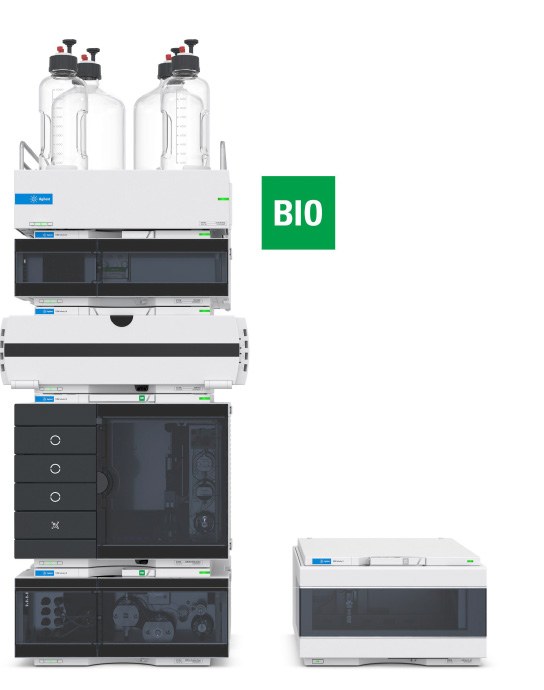
Agilent Technologies 1260 Infinity II Bio-SEC system | Biological polymer analysis
Agilent Technologies 1260 Infinity II Bio-SEC system | Biological polymer analysis — Liquid chromatography with Pumping speed 4.8×10⁻⁵ m³/h.
The 1260 Infinity II Bio-SEC system is a bio-inert LC configuration for size-exclusion chromatography of proteins and biological polymers, built around a quaternary bio-inert pump, multisampler, multicolumn thermostat and diode array detector. It is distinguished within the GPC/SEC series by its bio-inert flow path and 300 Å column pore size, and is used to separate and quantify aggregates and fragments in biomolecule samples.
Agilent Technologies GPC SEC Solutions Series — Model Comparison & Selection
| Model | Pumping speed, m³/h | Sample volume, milliliter | Column particle size, µm | Column temperature, °C | Column inner diameter, mm | Column length, m |
|---|---|---|---|---|---|---|
| 1260 Infinity II Bio-SEC system | Biological polymer analysis Current | 4.8×10⁻⁵ | 0.01 | 2.7 | 30 | — | — |
| 1260 Infinity II Bio-SEC System | 0.024 | — | 1.8 | — | 2.1 | 0.05 |
| 1260 Infinity II Multidetector GPC/SEC System | — | 5...500 | — | 220 | — | — |
| 1290 Infinity II GPC/SEC system | 3.6×10⁻⁶ | 0.02 | 3 | 35 | 4.6 | 0.25 |
Full specifications
| Pumping speed | 0.8 mL/min |
| Column Particle Size | 2.7 µm |
| Column Pore Size | 300 Å |
| Column temperature | 30 °C |
| Detection wavelength | 220, nm |
| Filter Pore Size | 0.22 µm |
| Pore size | 300 micrometer |
| Sample volume | 10 µL |
| Detection angle mfr | 90 ° |
| Column dimensions mfr | 7.8 mm |
| Water resistivity mfr | 18 |
| Chemical purity mfr | 99.7 |
| Needle wash mode mfr | Standard Wash Wash |
| Salt concentration tolerance mfr | 2 NaCl |
| Urea concentration tolerance mfr | 8 urea |
| NaOH concentration tolerance mfr | 0.5 NaOH |
| HCl concentration tolerance mfr | 0.5 HCl |
| Software version mfr | 2.8 |
| Stop time mfr | 30 min |
| MALS detection angle mfr | 90 ° |
| Number of simultaneous MALS angles mfr | 20 angles |
| Refractive index increment (dn/dc) mfr | 0.172 |
| Mobile phase pH mfr | 7 |
Description
Construction and series positioning
The Bio-SEC system is the biological-polymer variant of the 1260 Infinity II GPC/SEC line. Its flow path is bio-inert (pump G5654A, multisampler G5668A, thermostat G7116A with bio-inert heat exchanger, DAD G7115A with bio-inert flow cell), which distinguishes it from the general-purpose 1260 Infinity II GPC/SEC and Multidetector GPC/SEC systems and from the 1290 Infinity II GPC/SEC system. The sibling Bio-SEC Multi-detector System adds light-scattering detection; this model is the standard UV/DAD configuration.
Separation and detection behavior
- Columns are AdvanceBio SEC 300 Å, 7.8 mm internal diameter, 2.7 µm particle size, in 150 mm or 300 mm lengths (p/n PL1180-3301 or PL1180-5301).
- Typical operating conditions in the application notes: 0.8 mL/min mobile phase, 30 °C column temperature, 10 µL injection, UV detection at 220 nm or 260 nm, 30 min stop time.
- The 300 Å pore size is suited to protein aggregate and fragment separation; the mobile phase pH is 7 and the system tolerates salt, urea, NaOH and HCl in the mobile phase per the concentration tolerances listed in the specification table.
Installation and control
- The system is controlled by OpenLAB CDS; the application notes reference CDS 2.1 and the Advanced GPC/SEC Software for OpenLab CDS 2.8.
- Sample preparation requires filtration at 0.22 µm and water of 18 MΩ·cm resistivity.
- The multisampler supports a standard needle wash mode.
Integration & Operating Notes
The bio-inert flow path is specified for mobile phases containing up to 2 M NaCl, 8 M urea, 0.5 M NaOH and 0.5 M HCl. Exceeding these concentrations risks damage to the bio-inert components and invalid SEC results; verify the buffer composition against these limits before running the method.
The application notes specify 0.22 µm sample filtration and 18 MΩ·cm water. Particulate matter reaching the 2.7 µm column frit can raise backpressure and shorten column life, so filtration is a prerequisite for the 10 µL injections used in the method.
The system is driven by OpenLAB CDS; the application notes reference CDS 2.1 and the Advanced GPC/SEC Software for OpenLab CDS 2.8. Confirm the installed software version supports the column calibration and MALS data handling required by the method before commissioning.
Selection & Integration Q&A
Choose this UV/DAD Bio-SEC configuration for routine protein aggregate and fragment SEC with 300 Å columns. The Multi-detector sibling adds MALS for absolute molar mass; the standard GPC/SEC system lacks the bio-inert flow path needed for high-salt and urea mobile phases.
The base system requires AdvanceBio SEC 300 Å columns (7.8 × 150 mm p/n PL1180-3301 or 7.8 × 300 mm p/n PL1180-5301), 0.22 µm sample filters, 18 MΩ·cm water, and OpenLAB CDS with GPC/SEC software. The bio-inert heat exchanger and flow cell options are part of the bio-inert configuration.
Mobile phase must remain within 2 M NaCl, 8 M urea, 0.5 M NaOH and 0.5 M HCl; pH 7 is typical. Samples are filtered at 0.22 µm and injected at 10 µL, with the column held at 30 °C and a 30 min stop time per run.
SEC columns, 0.22 µm filters and mobile-phase reagents are consumables not part of the base system. Needle wash is set to standard mode; column replacement is driven by backpressure and peak-shape trends rather than a fixed interval.