
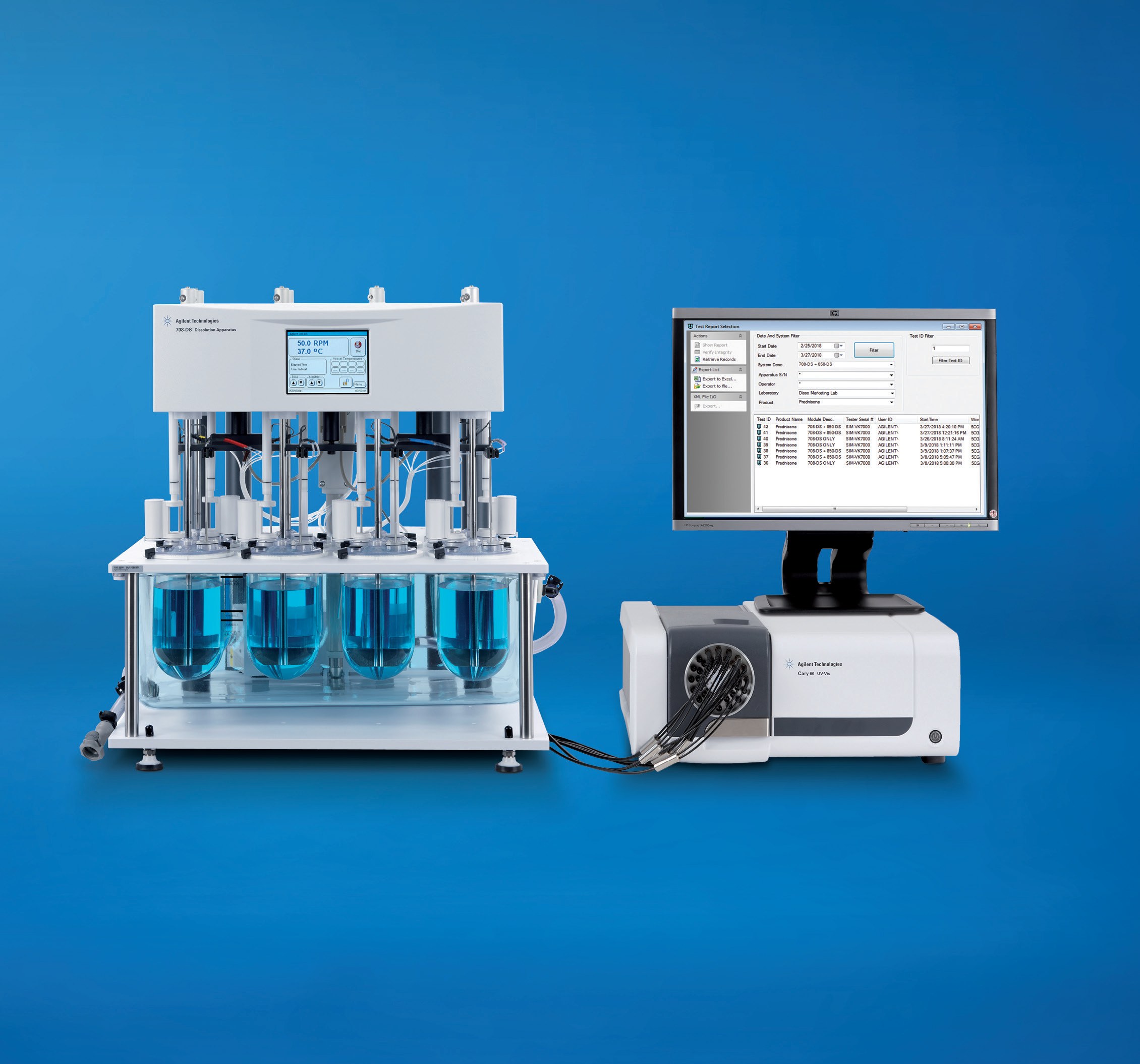
Agilent Technologies Cary 60 Multicell UV Dissolution System
Agilent Technologies Cary 60 Multicell UV Dissolution System — Dissolution testing.
The Cary 60 Multicell UV Dissolution System is an online scanning UV-Vis system built around the Cary 60 spectrophotometer, a multicell changer, and Cary WinUV software. It supports 1 to 2 dissolution apparatus and uses a xenon flash lamp with a 190 nm wavelength range. This modification is distinguished from the Fiber Optic sibling by its multicell changer and peristaltic pump or 850-DS Sampling Station, serving automated dissolution testing.
Agilent Technologies Cary Series — Model Comparison & Selection
| Model | Wavelength range | Baseline flatness | Photometric accuracy | Slit width, nm |
|---|---|---|---|---|
| Cary 60 Multicell UV Dissolution System Current | 190 | 1 | 0.005 | 1.5 |
| Cary 60 Fiber Optic UV Dissolution System | 190 | 1 | 0.005 | 1.5 |
Full specifications
| Wavelength range | 190 nm |
| Baseline Flatness | 0.001 Abs |
| Photometric accuracy | 0.005 Abs |
| Software package mfr | Cary WinUV WinUV |
| Number of apparatus mfr | 1...2 |
| Lamp type mfr | Xenon flash flash |
| Instrument design mfr | Scanning Scanning |
| Wavelength accuracy mfr | 0.5 nm |
| Wavelength reproducibility mfr | 0.1 nm |
| Stray light mfr | 1.0 |
| Path lengths mfr | 0.2 mm |
| Closed loop sampling mfr | Yes Yes |
| Path lengths (mm) mfr | 0.2 |
| Automated dosage delivery mfr | Yes Yes |
| Sampling mfr | Simultaneous Simultaneous |
| Sample filtration (min. pore size μm) mfr | 0.2 μm |
| Sample archival mfr | Yes Yes |
| minimum reading interval mfr | 45 seconds |
| lamp lifetime mfr | 10 years |
| photometric linear range mfr | 3.5 Abs |
| Slit Width | 1.5 nm |
| path length (multicell) mfr | 0.2...10 mm |
| path length (fiber optic tips) mfr | 1...20 mm |
| Photometric noise mfr | 0.0001 Abs |
Description
Construction and series positioning
The Cary 60 Multicell UV Dissolution System is one of two online configurations in the Agilent Cary 60 UV Dissolution series. It pairs the Cary 60 UV-Vis scanning spectrophotometer with a multicell changer and either a peristaltic pump or an 850-DS Sampling Station. The sibling Fiber Optic system instead uses a fiber optic multiplexer with in situ probes. Both configurations share the Cary 60 spectrophotometer and Cary WinUV software and support 1 to 2 dissolution apparatus. The Multicell version is therefore the choice when samples are to be transferred from vessels to a flow-through cell for measurement, rather than measured in situ.
Optical and measurement behavior
The spectrophotometer is a scanning instrument with a xenon flash lamp and a 1.5 nm slit width. Its specified wavelength range starts at 190 nm. Wavelength accuracy is 0.5 nm and wavelength reproducibility 0.1 nm. Photometric accuracy is 0.005 Abs, photometric noise 0.0001 Abs, and baseline flatness 0.001 Abs. Stray light is given as 1.0. These performance figures apply to the Cary 60 spectrophotometer common to both online configurations; no curve points or media-specific behavior are provided in the verified facts.
Installation, connection and control
The system is controlled through the Cary WinUV software package. The multicell configuration requires either a peristaltic pump or an 850-DS Sampling Station to move sample from the dissolution apparatus to the multicell changer. The verified facts do not include electrical ratings, interface details, or installation procedures; these must be taken from the instrument manuals rather than inferred here.
Integration & Operating Notes
The Multicell configuration requires either a peristaltic pump or an 850-DS Sampling Station to deliver sample from the dissolution vessel to the multicell changer. The choice determines tubing, pump control and sampling sequence, so it must be fixed at the system configuration stage rather than added later.
The system is driven by the Cary WinUV software package, which is common to both the Multicell and Fiber Optic online configurations. Method setup, scanning and result handling are performed in this environment; the verified facts do not list separate controller hardware or third-party software interfaces.
The online system is specified for 1 to 2 dissolution apparatus. Configurations requiring more than two vessels or apparatus must be split across additional systems; the verified facts give no provision for extending a single system beyond two apparatus.
The spectrophotometer uses a xenon flash lamp. The verified facts do not state a lamp replacement interval, warm-up requirement or lamp-life figure, so maintenance planning for the source should follow the Cary 60 spectrophotometer documentation rather than assumptions carried over from deuterium-lamp instruments.
Selection & Integration Q&A
Choose Multicell when sample is to be pumped from vessels to a multicell changer via a peristaltic pump or 850-DS Sampling Station. Choose the Fiber Optic sibling when in situ measurement with a fiber optic multiplexer and probes is preferred. Both share the Cary 60 spectrophotometer and WinUV software and support 1 to 2 apparatus.
The Multicell configuration requires either a peristaltic pump or an 850-DS Sampling Station to transfer sample to the multicell changer. This choice determines the tubing and sampling sequence and should be fixed when the system is configured, since the two options are not interchangeable after delivery.
The verified facts do not specify mounting clearances, environmental ranges or duty-cycle limits for the Multicell system. These must be taken from the Cary 60 spectrophotometer and multicell changer manuals. The only stated capacity limit is support for 1 to 2 dissolution apparatus per system.
The verified facts list no maintenance schedule, service intervals, cables or consumables in the base delivery. The xenon flash lamp is the source, but no replacement interval is stated. Pump tubing for the peristaltic pump or 850-DS Sampling Station and any probe or cell accessories should be confirmed against the order configuration.