
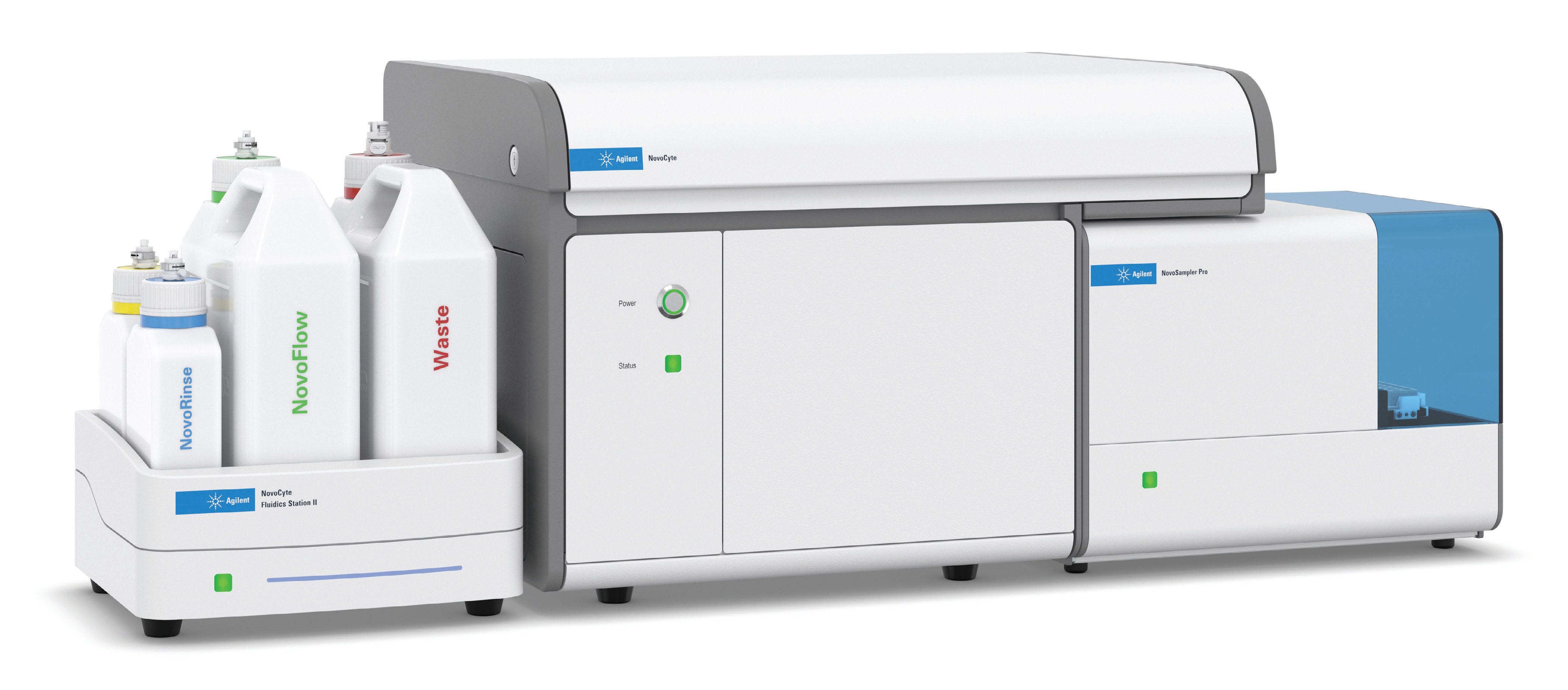
Agilent Technologies 1-3 laser benchtop flow cytometer, NovoCyte
Agilent Technologies 1-3 laser benchtop flow cytometer, NovoCyte — Research flow cytometry with Pumping speed 3×10⁻⁶ m³/h.
Benchtop flow cytometer with a fixed optical path and no operator alignment, configured with 1–3 lasers and 10 detection spots. It covers 0.2–50 µm cells at up to 35,000 events/s, with 5–120 µL/min sample flow against 6.5 mL/min sheath. Positioned below the 4- and 5-laser Quanteon/Penteon and the spectral Opteon for routine immunophenotyping and absolute counting.
Agilent Technologies Flow Cytometer Systems Series — Model Comparison & Selection
| Model | Pumping speed, m³/h | Sample flow rate, µL/min | Sheath flow rate, mL/min | Volumetric absolute count precision, % | Laser power, W | Print technology |
|---|---|---|---|---|---|---|
| 1-3 laser benchtop flow cytometer, NovoCyte Current | 3×10⁻⁶ | 5...120 | 6.5 | 5 | — | — |
| 1,2, or 3 Laser Benchtop Flow Cytometer, NovoCyte Advanteon | — | 5...120 | 6.5 | 5 | 0.405 | Solid state laser with o |
| 4 Laser Flow Cytometer, NovoCyte Quanteon | — | 5...120 | 6.5 | 5 | 0.405 | Solid state laser with o |
| 5 Laser Flow Cytometer, NovoCyte Penteon | — | 5...120 | 6.5 | 5 | 0.405 | Solid state laser with o |
Full specifications
| Pumping speed | 50 µL/minute |
| Carryover | 0.1 percent |
| Sample Flow Rate | 5...120 μL/min |
| Sheath Flow Rate | 6.5 mL/min |
| Volumetric Absolute Count Precision | 5 % |
| Laser configuration mfr | 10 spots |
| Optical alignment procedure mfr | Fixed, no operator alignment required required |
| Flow cell mfr | 170 cell |
| Scatter resolution mfr | 0.2 μm |
| Cell size mfr | 0.2...50 μm |
| Fluorescence threshold sensitivity mfr | 75 MESF |
| Fluorescence resolution mfr | 3 CEN |
| Filters mfr | User exchangeable exchangeable |
| Sample acquisition rate mfr | 35000 events/second |
| Sample aspiration volume mfr | 10 mL |
| Fluidics maintenance mfr | Automated startup, cleaning, decontamination, an |
| Parameters mfr | Height and area for FSC, SSC and all fluorescenc |
| Dynamic range mfr | 24 adjustment |
| Compensation mfr | Automatic compensation, manual compensation, vis |
| Output data files mfr | 3 |
| Power requirements mfr | 50...60 Hz |
| Blood dilution step 1 mfr | 20 PBS |
| Blood dilution step 2 mfr | 10 PBS |
| Final PBS concentration mfr | 55 % PBS |
| Baseline sample volume mfr | 20 μL |
| DI water spike volume mfr | 0.9 mL |
| Additional acquisition volume mfr | 100 μL |
| Acquisition segment duration mfr | 10 second |
| Normal donor residual red cells mfr | 65 % RRC |
| Residual red cells after overnight incubation mfr | 38 % RRC |
| Sample analysis window after collection mfr | within two hours hours |
| Instrument weight mfr | 86 lb |
| Fluid container capacity mfr | 3 decontamination |
Description
Construction and series positioning
- Fixed optical alignment: no operator alignment procedure is required, which separates this unit from alignment-heavy research cytometers and suits shared-core daily use.
- 10 detection spots across a 1–3 laser configuration; filters are user-exchangeable, so the optical setup can be re-targeted without a service visit.
- Sits below the 4-laser Quanteon, 5-laser Penteon and spectral Opteon in the NovoCyte family; choose this model when the panel fits 1–3 lasers and spectral unmixing is not needed.
- 170 µm flow cell, 0.2 µm scatter resolution, cell size range 0.2–50 µm.
Fluidics and acquisition behavior
- Sheath flow is fixed at 6.5 mL/min while sample flow is user-set from 5 to 120 µL/min, so event rate is tuned by sample rate rather than sheath pressure.
- Volumetric absolute counting is specified at 5 % precision, with 0.1 % carryover between samples.
- Acquisition ceiling is 35,000 events/s; sample aspiration volume is 10 mL and fluid container capacity is 3 mL for decontamination.
- Sensitivity is 75 MESF and fluorescence resolution 3 CEN; dynamic range is 24 (unit as printed in the factory data).
- Parameters recorded include height and area for FSC, SSC and all fluorescence channels, plus width and time.
Control, data and operation
- Automated startup, cleaning, decontamination and shutdown sequences are built in.
- Compensation is available as automatic, manual or visual tools, applied pre-, post- or live during acquisition.
- Instrument weight 86 lb; power requirement is given only as 50–60 Hz, with no voltage stated in the verified data.
Integration & Operating Notes
Automatic, manual and visual compensation tools are available for pre-, post- and live acquisitions. Panel design should account for this: single-stain controls can be acquired in the same run, and compensation can be revised after data collection without re-running samples.
Selection & Integration Q&A
Pick this model when the panel fits within 1–3 lasers and 10 detection spots and does not need spectral unmixing. Move to the Quanteon (4 lasers) or Penteon (5 lasers) when additional fluorophores must be resolved in the same tube; the Opteon is the spectral option. All share the fixed-alignment, no-operator-alignment optical design.
The verified data gives only 50–60 Hz and no voltage or current rating, so the nameplate voltage must be confirmed with Agilent before the outlet, UPS or breaker is specified. Plan the circuit around the confirmed nameplate value rather than assuming a standard laboratory supply.
Sample flow is settable from 5 to 120 µL/min, but acquisition tops out at 35,000 events/s. For dense samples, dilute or reduce sample flow so the event rate stays below the ceiling; exceeding it causes coincidence losses that undermine the 5 % volumetric absolute count precision.
Startup, cleaning, decontamination and shutdown are automated and should be run each session to hold carryover at 0.1 %. Sheath fluid, waste containers, cleaning/decontamination reagents and replacement optical filters are consumables not covered by the verified base-delivery data and must be ordered separately.