
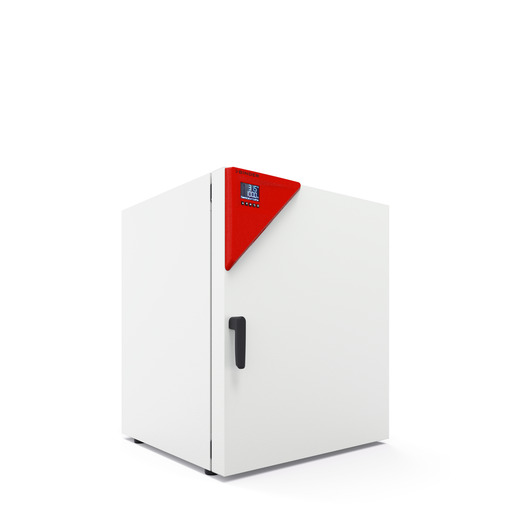
BINDER FP 260
BINDER FP 260 — Drying ovens with Temperature 10…300 °C.
The BINDER FP 260 is a forced-convection drying and heating oven with a 259 L interior, operating from 10 to 300 °C. As the mid-large member of the FP series, it balances the 115 L chamber and the 720 L unit, offering 40 kg per rack and 270 kg total load. It serves processes requiring uniform heat treatment, such as drying, aging, or thermal testing, with 1.7 K uniformity and 0.4 K fluctuation.
BINDER FP Series — Model Comparison & Selection
Full specifications
| Temperature | 10...300 °C |
| Air change rate | 9 x/h |
| Heating time to 150°C | 19 min |
| Interior volume | 259 L |
| Load per rack | 40 kg (FP260-230V / FP260UL-240V) |
| Nominal power | 2.5 kW |
| Permitted load | 270 kg (FP260-230V / FP260UL-240V) |
| Temperature fluctuation | 0.4 K |
| Temperature uniformity | 1.7 K |
| Rear wall clearance | 160 mm (FP260-230V / FP260UL-240V) |
| Side wall clearance | 100 mm (FP260-230V / FP260UL-240V) |
| Article Number mfr | 9010 |
| Recovery time after door was opened for 30 s at 150°C mfr | 6 min |
| Depth | 786 mm (FP260-230V / FP260UL-240V) |
| Height | 962 mm (FP260-230V / FP260UL-240V) |
| Width | 810 mm (FP260-230V / FP260UL-240V) |
| Net weight of the unit (empty) mfr | 82 kg |
| Power frequency | 50 Hz |
| Rated voltage | 230 V |
| Unit fuse | 16.0 A |
| Phase (Nominal voltage) mfr | 1 |
Description
Construction and Series Positioning
The FP 260 (E3.1) is a forced-convection chamber with a stainless steel interior of 259 L (net dimensions 810 × 962 × 786 mm W×H×D). It is positioned between the FP 115 and FP 720 in the Avantgarde.Line series, sharing the 10–300 °C range with the smaller models but offering greater load capacity: 40 kg per rack and 270 kg total. Unlike the FP 720, which has a rear main power switch, the FP 260 uses a standard front-panel on/off switch. The chamber is designed for indoor use only and requires specific wall clearances (160 mm rear, 100 mm side) for heat dissipation.
Thermal Behavior and Load
Heating from ambient to 150 °C takes 19 minutes, with a recovery time of 6 minutes after a 30-second door opening at 150 °C. Temperature uniformity is 1.7 K and fluctuation 0.4 K, supported by an air-change rate of 9 x/h. The RD4 controller manages set-points for temperature, fan speed, and air flap position, allowing adaptation to different load densities. The chamber is not suitable for materials that may form explosive mixtures or contain corrosive substances that attack stainless steel, aluminum, or copper.
Installation and Control
Electrical supply requires 230 V 1~ 50 Hz (nominal power 2.5 kW, unit fuse 16 A) for the standard variant; the UL variant uses 240 V 3~ 60 Hz. The rear panel provides a SUB-D socket for zero-voltage alarm/switch contacts and an optional analog output. Ethernet and USB interfaces enable data logging and remote monitoring, but connected devices must comply with EN 61010-1 or EN 60950-1. The RD4 controller includes password-protected access levels, program start/stop functions, and a data recorder. Annual maintenance by authorized personnel is mandatory to preserve warranty.
Integration & Operating Notes
The chamber requires a minimum of 160 mm clearance at the rear and 100 mm at the sides to ensure adequate heat dissipation. Installing it in an unventilated recess or closer to walls can cause the unit to overheat, potentially damaging components and affecting temperature control. These distances must be verified before installation.
The FP 260 standard variant requires 230 V 1~ 50 Hz with a tolerance of ±10%. Out-of-tolerance supply can impair temperature performance and safety. The unit draws 2.5 kW and requires a 16 A fuse. For the UL variant, a 240 V 3~ 60 Hz supply is needed. Verify the local power grid stability before connection.
Only connect devices to the Ethernet and USB interfaces that comply with EN 61010-1:2010 or EN 60950-1:2006 mod. Non-compliant equipment can compromise the safety of the entire system. This applies to PCs, USB sticks, and network hardware used for data transfer or remote control.
The chamber has no explosion protection. Operating temperature must remain below the flash point or sublimation point of the charge, and no explosive mixture with air may form. Additionally, corrosive substances such as acids and halides can damage stainless steel, aluminum, and copper components; such damage is excluded from liability.
Maintenance must be performed at least once a year by licensed electricians or BINDER-authorized experts; otherwise, the warranty becomes void. The controller displays a 'Service due!' message after one year of operation, recurring weekly until confirmed. An annual electrical repeat inspection per EN 50678/VDE 0701 and EN 50699/VDE 0702 is also required.
Selection & Integration Q&A
Choose the FP 260 when you need 259 L capacity and up to 270 kg total load, with 40 kg per rack. The FP 115 offers only 115 L, while the FP 720 provides 720 L but requires a 400 V connection and has a rear main switch. The FP 260 runs on 230 V single-phase, making it suitable for standard laboratory power.
Use the SUB-D socket 'ALARM / SWITCH CONTACT' for zero-voltage switching contacts. For analog temperature output, the optional 'ANALOG OUTPUT' SUB-D socket is required. Ensure any connected device complies with EN 61010-1:2010 or EN 60950-1:2006 mod. The Ethernet and USB interfaces allow data transfer and network integration.
The chamber is for indoor use only and must not be installed in unventilated recesses. Maintain 160 mm rear and 100 mm side clearances. Ambient conditions per chap. 3.4 apply. The IP20 rating means it is not protected against water; do not spray or immerse. Operating temperature range is 10–300 °C, but charge materials must not form explosive mixtures or contain corrosives.
Annual maintenance by BINDER-authorized personnel is mandatory to keep warranty. An annual electrical safety inspection per EN 50678/VDE 0701 and EN 50699/VDE 0702 is required. Base delivery excludes options like APT-COM 4 software, Pt100 object sensor, analog output, HEPA filter, gas-tight version, and inert gas connection. These must be ordered separately.