
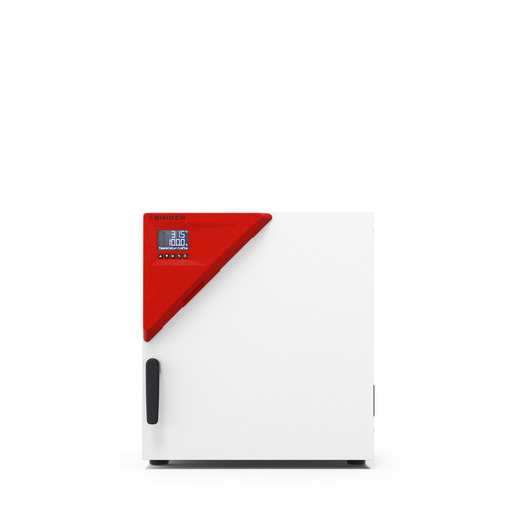
BINDER FP 56
BINDER FP 56 — Drying ovens with Temperature 10…300 °C.
The BINDER FP 56 is a 60 L forced-convection drying and heating chamber with a +10 to 300 °C working range, 1.2 kW single-phase heating, and an 80 h⁻¹ air-change rate. As the smallest standard FP variant, it delivers 0.4 K fluctuation and 1.4 K uniformity at 150 °C with a 4-minute recovery after a 30-second door opening. It is intended for reproducible drying, heating, and thermal conditioning of non-explosive, non-corrosive loads in laboratory and industrial process chains.
BINDER FP Series — Model Comparison & Selection
Full specifications
| Temperature | 10...300 °C |
| Air change rate | 80 x/h |
| Heating time to 150°C | 15 min |
| Interior volume | 60 L |
| Load per rack | 30 kg (FP056-230V / FP056UL-120V) |
| Nominal power | 1.2 kW |
| Permitted load | 70 kg (FP056-230V / FP056UL-120V) |
| Temperature fluctuation | 0.4 K |
| Temperature uniformity | 1.4 K |
| Rear wall clearance | 160 mm (FP056-230V / FP056UL-120V) |
| Side wall clearance | 100 mm (FP056-230V / FP056UL-120V) |
| Article Number mfr | 9010 |
| Recovery time after door was opened for 30 s at 150°C mfr | 4 min |
| Depth | 596 mm (FP056-230V / FP056UL-120V) |
| Height | 622 mm (FP056-230V / FP056UL-120V) |
| Width | 560 mm (FP056-230V / FP056UL-120V) |
| Net weight of the unit (empty) mfr | 41 kg |
| Power frequency | 50 Hz |
| Rated voltage | 230 V |
| Unit fuse | 10.0 A |
| Phase (Nominal voltage) mfr | 1 |
Description
Construction and series positioning
- The FP 56 (E3.1) is the 60 L member of the BINDER Avantgarde.Line FP series, using forced convection and the RD4 microprocessor controller. Its 560 × 622 × 596 mm net envelope and 41 kg empty weight make it the most compact standard FP model; siblings FP 115, FP 260, and FP 720 scale interior volume upward, with FP 720 moving to a 400 V supply and a rear main power switch.
- The FP 56 is supplied in two electrical variants: FP056-230V (Art. 9010-0363, 230 V 1~ 50 Hz, CEE 7/7 plug) and FP056UL-120V (Art. 9010-0367, 120 V 1~ 60 Hz, NEMA 5-20 plug). The 230 V unit draws 1.2 kW with a 10.0 A unit fuse.
- Interior volume is 60 L with a permitted total load of 70 kg and a maximum of 30 kg per rack, so rack placement and load distribution directly bound the usable thermal capacity.
Thermal behavior under load and door cycling
- The chamber holds +10 to 300 °C with 0.4 K temperature fluctuation and 1.4 K uniformity, and reaches 150 °C in 15 minutes. After a 30-second door opening at 150 °C, recovery takes 4 minutes, which sets the practical minimum interval between loading steps if the setpoint is to be maintained.
- Air-change rate is 80 h⁻¹, and the air flap position is a controller setpoint alongside temperature and fan speed. These three settings define the thermal and airflow conditions, so drying recipes must record all three, not temperature alone.
- Overtemperature protection is selectable per DIN 12880 class 2 (temperature limiter) or class 3.1 (safety controller), with distinct alarm and reset behavior. The choice must be fixed before commissioning because it changes how the chamber responds to a fault.
Installation, control, and operation
- The RD4 controller provides setpoint entry for temperature, fan speed, and air flap; tolerance-range alarms with a settable delay; program start/stop functions; an Ethernet interface; a USB port for data transfer; and a data recorder with configurable storage rate. A zero-voltage alarm/switch contact is available on the rear SUB-D socket, and an analog output is optional.
- Installation requires 160 mm rear clearance and 100 mm side clearance, indoor use only, and no unventilated recess. The chamber is IP 20 and must not be sprayed or operated wet. Supply voltage must stay within ±10% of nominal at the indicated frequency.
- Annual maintenance by authorized personnel and annual electrical repeat inspection per EN 50678/VDE 0701 and EN 50699/VDE 0702 are required; the controller displays a recurring 'Service due!' reminder after one year of operation.
Integration & Operating Notes
The chamber dissipates heat through the rear and sides; installing it in a recess or closer than the prescribed distances prevents adequate ventilation and can cause overheating damage. Verify clearance before positioning, especially when the unit is placed under a shelf or beside another heat source.
The 230 V variant is rated 1.2 kW at 230 V 1~ 50 Hz with a 10.0 A unit fuse. Out-of-tolerance voltage or the wrong frequency affects temperature performance and safety; size the branch circuit for the full unit fuse rating and confirm the supply frequency before connection.
The chamber has no explosion protection. Operating temperature must lie below the flash point or sublimation point of the charging material, and no explosive mixture with air may form. Verify solvent and material properties before loading; corrosive acids and halides that attack stainless steel, aluminum, or copper are also excluded.
The temperature safety device per DIN 12880 can be configured as a class 2 temperature limiter or a class 3.1 safety controller. The selection changes alarm behavior and reset requirements, so it must be agreed with the process owner and set before the chamber is released to production.
A zero-voltage switching contact is available on the rear SUB-D 'ALARM / SWITCH CONTACT' socket for external monitoring. An analog temperature output requires the optional SUB-D 'ANALOG OUTPUT' socket. Only connect external devices compliant with EN 61010-1:2010 or EN 60950-1:2006 mod.
Maintenance must be performed at least once a year by licensed electricians or BINDER-authorized experts; warranty is void if non-authorized personnel perform it. An electrical repeat inspection per EN 50678/VDE 0701 and EN 50699/VDE 0702 is required at commissioning, after service, and annually. The controller shows 'Service due!' after one year.
Hot gasket replacement can damage the gasket and the door seal seat. Allow the chamber to cool and disconnect power before service. Never remove the rear panel or allow water to penetrate the chamber during cleaning or maintenance.
Selection & Integration Q&A
Pick the FP 56 when 60 L and 70 kg total load cover the batch and the 560 mm width fits the bench or floor slot. Move to FP 115 or FP 260 only when larger batches or more rack area are required; all three share the +10 to 300 °C range and forced convection, so the choice is volumetric, not thermal.
The 230 V variant needs 230 V 1~ 50 Hz within ±10%, sized for the 10.0 A unit fuse. External alarm wiring uses the zero-voltage SUB-D 'ALARM / SWITCH CONTACT'; analog temperature output requires the optional 'ANALOG OUTPUT' socket. Ethernet and USB devices must comply with EN 61010-1:2010 or EN 60950-1:2006 mod.
Install indoors only, with 160 mm rear and 100 mm side clearance, and never in an unventilated recess. The chamber is IP 20 and must not be sprayed or operated wet. Loads must stay below the flash or sublimation point, and total load must not exceed 70 kg with no more than 30 kg per rack.
Annual maintenance by authorized personnel and annual electrical repeat inspection per EN 50678/VDE 0701 and EN 50699/VDE 0702 are required; the controller shows 'Service due!' after one year. Optional accessories include APT-COM 4 software, flexible Pt100 object sensor, analog output, HEPA fresh air filter, and inert gas connection; these are not part of the standard scope.