
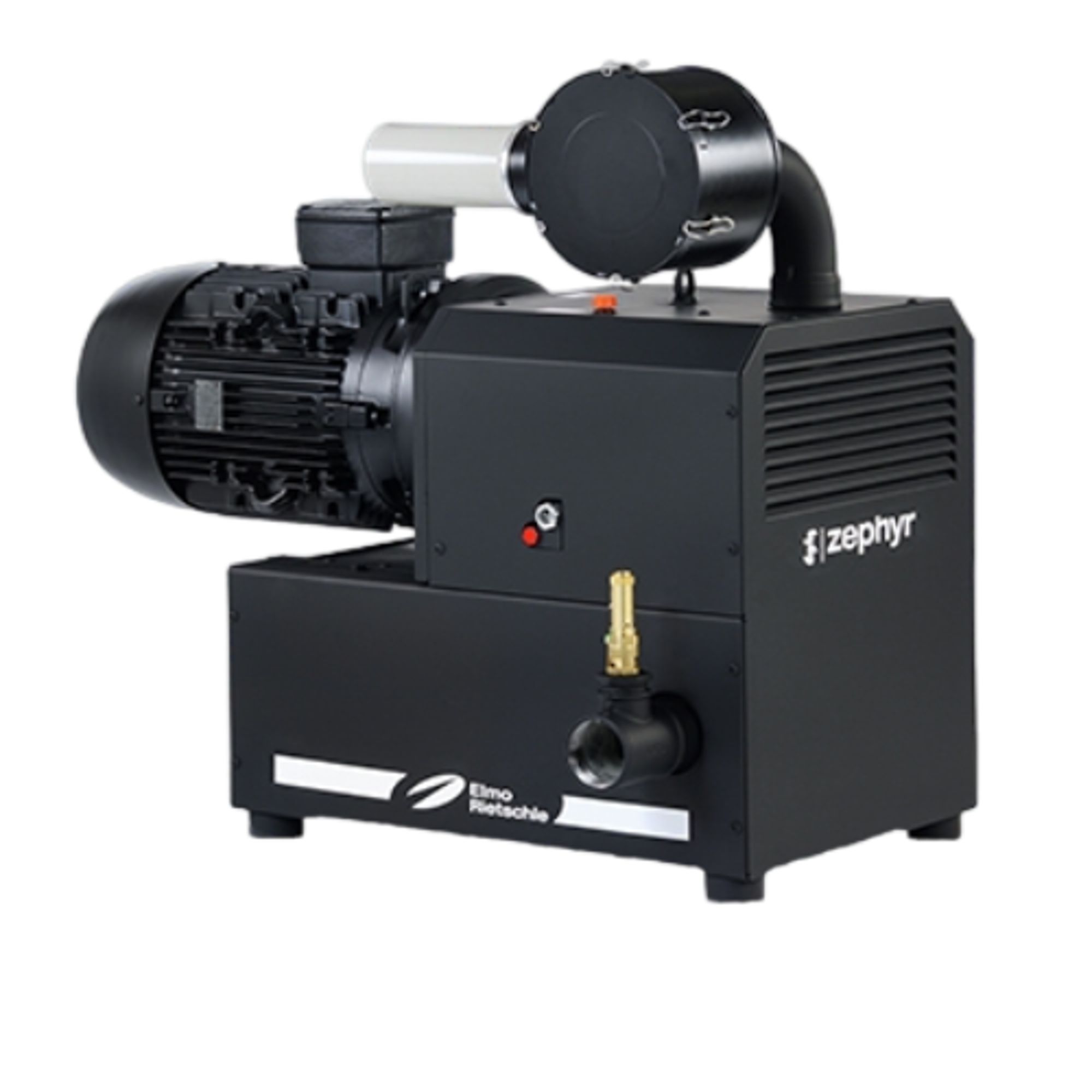
Elmo Rietschle C-DLR 100
Elmo Rietschle C-DLR 100 — Claw Vacuum Pumps.
The C-DLR 100 is a contact-free, dry-running claw compressor in ATEX execution (IIB, T2/T3) for explosive atmospheres. As the smallest frame in the C-DLR 100–500 series, it is distinguished by a 0.02 mbar·l/s leakage limit and ~12 starts/h, versus larger siblings up to 270 m³/h. It serves as a dry, oil-free pressure source for process gas at atmospheric inlet ±80 mbar(g).
Elmo Rietschle C-DLR Series — Model Comparison & Selection
Full specifications
| Lubrication type | dry |
| Operating principle | Claw |
| Operating temperature | >70 °C |
Description
Construction and series positioning
The C-DLR 100 is a double-shaft rotary piston (claw) compressor. Its rotors run contact-free and dry, synchronised by an oil-lubricated gear pair; the feed chamber contains no sealants or lubricants. Cooling is by a drum fan drawing fresh air between the compressor and the insulation hood; the air is discharged from the enclosure. Within the C-DLR 100–500 ATEX family, the 100 is the smallest frame: it shares the IIB T2/T3 ATEX concept but has the tightest leakage limit (0.02 mbar·l/s) and the highest permitted start frequency (~12/h). Larger siblings such as the C-DLR 301 reach 270 m³/h at 22 kW; the 100 is selected where low flow and frequent cycling dominate.
Behaviour under load and media limits
Operation is intended only with inlet pressure at atmosphere ±80 mbar(g); the PZ01 transmitter must be set to −80/+80 mbar(g) to prevent vacuum or overpressure. Maximum excess pressure is 2.0 bar(g) but is temperature-class dependent: T3 allows +0.8 bar with TZ01 at 130 °C; T2 allows +1.6/+1.8 bar at 195 °C and +2.0 bar at 210 °C. With the optional frequency converter (25–50 Hz), configure TZ01 for 210 °C and limit pressure to 2.0 bar. The machine is not technically tight: design for 0.02 mbar·l/s leakage and corresponding ventilation. Ambient and suction temperature must stay within +5 to +40 °C; above 1000 m altitude output derating is noticeable.
Installation, control and operation
The compressor must be mounted horizontally with max. 8° inclination in all directions on a plane, even, load-bearing floor. Cooling-air inlets/outlets need ≥30 cm to walls and ≥40 cm maintenance clearance. An external start sieve of 0.05 mm mesh is mandatory; clean pipelines of pollution and welding residues before connection. The control PLC is supplied by the user and must implement PZ01 pressure limits and TZ01 excess-temperature shutdown; the safety valve SV opens at 10 % above max. operating pressure and must not be adjusted. The compressor has no own Emergency Stop/Off and must be integrated into the plant protection concept. Flushing pressure must not exceed 0.5 bar(g).
Integration & Operating Notes
PZ01 min./max. limits must be configured to atmospheric pressure −80 mbar(g) and +80 mbar(g). Exceeding either side risks vacuum generation or excessive inlet pressure, invalidating intended use and potentially damaging the compressor.
For T3 set TZ01 to 130 °C with max. +0.8 bar; for T2 use 195 °C at +1.6/+1.8 bar or 210 °C at +2.0 bar. With the frequency-converter option (25–50 Hz), configure TZ01 for 210 °C and limit pressure to 2.0 bar. Mismatch defeats the excess-temperature protection.
Install on a plane, even, load-bearing floor. Greater inclination can cause damage and oil distribution problems. Provide at least 30 cm clearance at cooling-air inlets/outlets and 40 cm around the compressor for maintenance access.
An external start sieve with effective mesh size 0.05 mm must be fitted to prevent foreign bodies being sucked in. Clean pipelines of pollution and welding residues before connection; the compressor is not technically tight (0.02 mbar·l/s leakage for DLR 100/150).
The maintenance table covers oil level check, oil change, cleaning, motor and coupling, bearing lubrication, fan check and functional test of the safety valve. Inspection is due after 10,000 h and revision after 17,500 h to maintain operational safety.
The compressor has no own Emergency Stop or Emergency Off. The operating company must integrate it into the plant's protection concept, e.g. via a higher-level emergency stop, and test protective functions as at first commissioning.
When flushing with nitrogen before maintenance or commissioning, keep pressure at or below 0.5 bar(g). Higher flushing pressure exceeds the allowed limit and may damage the compressor or invalidate ATEX conformity.
Installation room and process gas must be kept within this range; outside it, operation is not intended use. Above 1000 m altitude, output reduction is noticeable and must be accounted for in system design. Storage: 0–80 % RH, −10 to +60 °C, max. 6 months.
Selection & Integration Q&A
Pick the 100 for low flow with frequent cycling: it allows ~12 starts/h and 0.02 mbar·l/s leakage. Choose the 301 when you need up to 270 m³/h at 22 kW; the 100 is the smallest ATEX frame.
The PLC is supplied by the user and must implement PZ01 inlet limits at −80/+80 mbar(g) and TZ01 excess-temperature shutdown set to the temperature class (130 °C for T3, 195/210 °C for T2). The safety valve SV opens at 10 % above max. operating pressure and must not be adjusted.
Plan inspection at 10,000 h and revision at 17,500 h; routine tasks include oil level/change, cleaning, bearing lubrication, fan check and safety-valve functional test. The external 0.05 mm start sieve, inlet filtration, PLC and emergency-stop integration are not part of the compressor and must be provided by the user.