
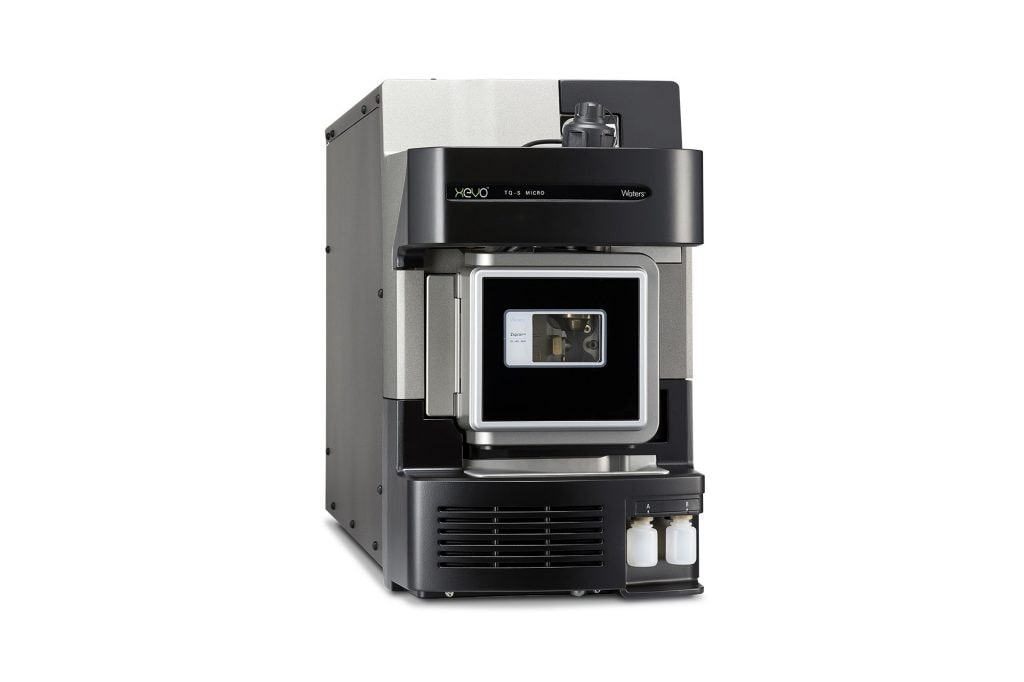
Waters Xevo TQ-S micro
Waters Xevo TQ-S micro — Mass spectrometers.
The Xevo TQ-S micro is a benchtop tandem quadrupole mass spectrometer with two high-resolution quadrupole analyzers and a T-Wave collision cell, covering 2–2048 m/z. It is distinguished within the series by its compact 60×35.6×93 cm frame and standard tool-free ESI/APCI/ESCi multi-mode source. It serves as the MS/MS detector in quantitative LC-MS workflows, delivering up to 555 MRM transitions per second.
Direct drop-in replacements
Full specifications
| Detector types | Low noise, off axis, long life photomultiplier detector |
| Ion source | High performance ZSpray dual-orthogonal API sources: Multi-mode source – tool-free ESI/APCI/ESCi (standard); UniSpray ion source (optional); Tool-free APCI probe (optional); nanoFlow ESI source (optional); ASAP (optional); APGC ion source (optional); ionK |
| Collision cell mfr | T-Wave enabled |
| Vacuum system mfr | One split-flow air-cooled vacuum turbomolecular |
| Regulatory approvals/marks mfr | CE, CB, NRTL (CAN/US), RCM |
| MRM speed mfr | 555 MRM/sec |
| Software mfr | waters_connect and MassLynx version 4.2 or later |
| Mass range | 2 to 2048 m/z |
| Height | 60.0 cm |
| Length | 93 cm |
| Width | 35.6 cm |
| Depth mfr | 93 cm (36.6 in) |
| Mass analyzer mfr | Two high resolution, high stability quadrupole a |
Description
Construction and positioning
The Xevo TQ-S micro is a tandem quadrupole (MS/MS) instrument built around two high-resolution, high-stability quadrupole analyzers (MS1 and MS2) with pre-filters and a T-Wave-enabled collision cell. The vacuum system uses one split-flow air-cooled turbomolecular pump backed by one vacuum backing pump. Its 60 cm height, 35.6 cm width and 93 cm depth make it the compact member of the TQ-S family; the standard ion source is a tool-free ZSpray dual-orthogonal multi-mode ESI/APCI/ESCi source, with UniSpray, APCI probe, nanoFlow ESI, ASAP, APGC and ionKey sources listed as optional. Detection is by a low-noise, off-axis, long-life photomultiplier. ### Behavior under load
- Mass range 2–2048 m/z covers small-molecule and peptide MRM work. - MRM speed of 555 transitions per second supports high-density acquisition methods without compromising dwell time per transition. - The T-Wave collision cell and dual pre-filters maintain ion transmission and reduce background before MS2 selection. - The off-axis photomultiplier geometry lowers neutral noise, which matters at low analyte concentrations. ### Installation, control and operation
- The instrument is controlled by waters_connect or MassLynx version 4.2 or later; both software packages must be installed on the workstation before commissioning. - Source exchange is tool-free for the standard ESI/APCI/ESCi multi-mode source, so switching ionization modes does not require tools or venting. - Regulatory marks: CE, CB, NRTL (CAN/US) and RCM. - The air-cooled split-flow turbomolecular pump requires adequate bench ventilation; the backing pump is a separate floor or bench-level unit.
Integration & Operating Notes
The instrument will not operate with earlier software revisions. The workstation must have MassLynx version 4.2 or later, or waters_connect, installed and licensed before the system can be tuned or run; plan the software installation and PC specification as part of the instrument order, not after delivery.
The 60 × 35.6 × 93 cm frame plus the split-flow air-cooled turbomolecular pump and separate backing pump require a bench with rear clearance for pump exhaust and airflow. Restricting rear ventilation raises pump temperature and can trigger vacuum faults; allow free space behind the instrument and route the backing pump exhaust away from the source intake.
The tool-free ZSpray dual-orthogonal multi-mode source supports ESI, APCI and combined ESCi operation. UniSpray, APCI probe, nanoFlow ESI, ASAP, APGC and ionKey are optional and must be ordered separately; confirm the ionization mode required by the application before specifying the configuration, because the optional sources are not part of the base delivery.
The tool-free source design allows the probe and source housing to be removed for cleaning without tools. Pre-filter and source cleaning frequency is set by sample matrix and throughput; high-matrix samples require more frequent cleaning to preserve sensitivity. Establish a cleaning schedule from observed response drop rather than a fixed calendar interval.
Selection & Integration Q&A
Choose the micro when bench space is the constraint: 60 × 35.6 × 93 cm and 555 MRM/s cover routine quantitative LC-MS/MS. Larger TQ-S variants are warranted only when higher sensitivity or source options beyond the standard tool-free ESI/APCI/ESCi are required.
MassLynx 4.2 or later, or waters_connect, must be installed and licensed on the control PC. The bench must provide 93 cm depth plus rear clearance for the air-cooled split-flow turbomolecular pump and a location for the separate backing pump.
Yes. The standard ZSpray dual-orthogonal multi-mode source is tool-free for ESI, APCI and ESCi. UniSpray, nanoFlow ESI, ASAP, APGC and ionKey are optional sources ordered separately and are not included in the base configuration.
Optional ion sources (UniSpray, APCI probe, nanoFlow ESI, ASAP, APGC, ionKey) and the control workstation with MassLynx 4.2 or waters_connect are not part of the base instrument. Source and pre-filter cleaning consumables must be planned separately.
Dimensional Drawings & Technical Documentation
Dimensional drawings
Click drawing to inspect vector dimensions