
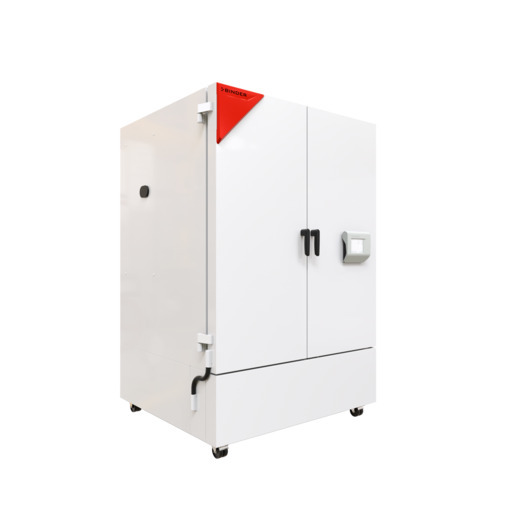
BINDER KBF 1060
BINDER KBF 1060 — Climate chambers with Temperature 0…70 °C.
The KBF 1060 is a 1,070 L constant climate chamber with a 0–70 °C range and 10–80 % RH humidity control, housed in a 1,285 × 1,951 × 1,175 mm cabinet. It is the largest standard KBF model, distinguished from smaller siblings by its 40 kg-per-rack load capacity and 640 W heat compensation. It serves as a high-volume test platform for reproducible temperature and humidity conditioning of bulk samples or large assemblies.
BINDER KBF Series — Model Comparison & Selection
Full specifications
| Temperature | 0...70 °C |
| Interior volume | 1070 L (KBF1060-230V) |
| Load per rack | 40 kg (KBF1060-230V) |
| Maximum heat compensation | 640 W |
| Nominal power | 1.6 kW (KBF1060-230V) |
| Temperature fluctuation | 0.1 K |
| Temperature uniformity | 0.3 K |
| Article Number mfr | 9020 |
| Recovery time after door was opened for 30 s at 25°C and 60% RH mfr | 2 min |
| Recovery time after door was opened for 30 s at 40°C and 75% RH mfr | 6 min |
| Depth | 1175 mm (KBF1060-230V) |
| Height | 1951 mm (KBF1060-230V) |
| Width | 1285 mm (KBF1060-230V) |
| Power frequency | 50/60 Hz (KBF1060-230V) |
| Rated voltage | 220...240 V |
| Unit fuse | 16.0 A (KBF1060-230V) |
| Humidity fluctuation | 1.5 % RH |
| Humidity range | 10...80 % RH |
Description
Construction and series positioning
- The KBF 1060 (model 1060-230, Art. No. 9020-0482) is the largest chamber in the KBF series, which also includes the 130, 260, 470, and 1600 models. All share the 0–70 °C base range, but the 1060 offers 1,070 L interior volume and a 40 kg per-rack load rating.
- Unlike the smaller 130 and 260, which use a triangular instrument panel, the 1060 uses a signal triangle and an ergonomically adjustable control terminal. A wall spacer is required from size 260 upward, so the 1060 must be installed with the specified rear clearance.
- The chamber is rated IP 20 and uses R600A refrigerant; refrigeration work is restricted to certified personnel.
Behavior under load and in different media
- Temperature fluctuation is 0.1 K and uniformity 0.3 K, supporting stable conditioning across the 1,070 L workspace. Humidity fluctuation is 1.5 % RH over the 10–80 % RH range.
- Recovery after a 30 s door opening is 2 min at 25 °C/60 % RH and 6 min at 40 °C/75 % RH, indicating faster humidity recovery at lower load conditions.
- With humidity active, the temperature range narrows to 10–70 °C. The 640 W maximum heat compensation and 1.6 kW nominal power define the load the chamber can offset during humidified operation.
Installation, connection and control
- The 230 V variant requires a 220–240 V, 1~, 50/60 Hz supply with a 16 A unit fuse and CEE 7/7 plug; a 120 V UL variant (Art. No. 9020-0498) exists with NEMA 5-20 plug.
- The MB2 controller provides fixed-value, time-program, and week-program modes, plus a chart-recorder display and USB/Ethernet data transfer. Humidity control can be switched on or off at start-up.
- Water connections for humidification and wastewater/condensate handling differ by serial number (up to 20250000010225 vs. from 20250000010226), so the correct connection scheme must be confirmed before installation.
Integration & Operating Notes
The KBF 1060 requires the specified wall distance using the spacer to ensure adequate air circulation around the condenser and refrigeration components. Insufficient clearance can reduce cooling performance and trigger high-pressure faults.
The 230 V variant draws 1.6 kW nominal and requires a 16 A unit fuse. Verify site voltage and frequency (50/60 Hz) before connection; use overcurrent protection rated for the chamber. The 120 V UL variant uses a NEMA 5-20 plug and must not be connected to 230 V.
When humidity is active, the chamber cannot operate below 10 °C. Plan test profiles that require both low temperature and humidity accordingly, or switch humidity off for sub-10 °C runs. The humidity sensor tolerates only limited concentrations of solvents and gases; observe the published threshold limits.
Regular maintenance must be performed at least once a year, including steam humidifier service. Condensers should be cleaned at least twice a year by a qualified technician; in dusty environments, clean more frequently by suction. The maintenance reminder appears after 8760 operating hours or two years and recurs every two weeks until reset by BINDER Service.
The humidification system requires freshwater of specified quality; operating behavior and maintenance intervals depend on water quality and steam output. Wastewater/condensate handling differs between chambers up to serial number 20250000010225 and from 20250000010226, so confirm the correct connection method before commissioning.
The chamber is equipped with an overtemperature safety controller per DIN 12880 class 2/3.3, selectable as temperature limiter or temperature protection. Set limit and offset values appropriate to the test material; the undertemperature protection class 3.2 also requires configuration. Verify the configured class before running unattended programs.
Selection & Integration Q&A
Choose the 1060 when you need 1,070 L interior volume and 40 kg per-rack load capacity. The 470 is smaller; the 1600 offers more volume but may exceed space or power constraints. The 1060 balances capacity with a 1.6 kW, 230 V single-phase supply.
The 230 V variant needs 220–240 V, 1~, 50/60 Hz with a 16 A fuse and CEE 7/7 plug. Humidification requires a freshwater connection and wastewater drain; connection details depend on serial number (up to or from 20250000010225).
A wall spacer is required from size 260 upward, so the 1060 must maintain the specified rear clearance. The chamber is IP 20 and must not be sprayed with water. Ambient dust increases condenser cleaning frequency beyond the standard twice-yearly interval.
Annual maintenance including steam humidifier service and twice-yearly condenser cleaning are required. Optional accessories include APT-COM 4 software, analog outputs, zero-voltage alarm contacts, internal LED light, door lock, Pt 100 object sensor, and external freshwater/wastewater cans.