
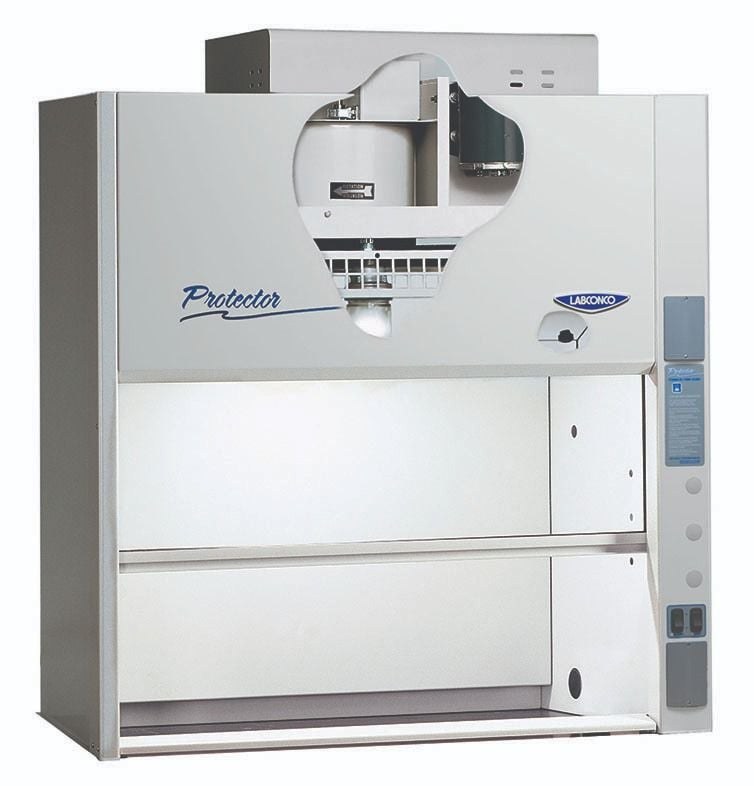
Labconco Basic Laboratory Hoods
Labconco Basic Laboratory Hoods — Fume hoods.
The Protector Basic 47 is a 4-foot (47-inch) low-profile fume hood with 25-inch depth, epoxy-coated steel construction, and by-pass airflow rated at 785 CFM. It is the narrowest of the Basic series (47 and 70 inch), available assembled or unassembled, with or without blower, in 115 V/60 Hz or 220 V/50 Hz. It serves as a general-purpose containment enclosure for routine laboratory work where a 10-inch exhaust duct and 18-inch sash stop are acceptable.
Full specifications
| Airflow | 785 CFM |
| Width | 4 ft |
| Sash stop height mfr | 18.0 in |
| Work surface depth mfr | 1.25 in |
| Overall width (A) mfr | 72.0 in |
| Dimension B mfr | 67.5 in |
| Dimension C mfr | 32.5 in |
| Dimension D mfr | 36.0 in |
| Electrical requirements mfr | 208 A |
Description
Construction and series positioning
- The Basic 47 is the 4-foot member of the Protector Basic line; the 6-foot Basic 70 is the only larger sibling. Both share the 25-inch low-profile epoxy-coated steel body and by-pass airflow design that maintains containment as the sash is raised.
- Unlike the ClassMate series (4, 5, 6 ft with vertical-rising or combination sashes), the Basic 47 is offered only with a vertical-rising tempered-glass sash and a fixed 18-inch sash stop height.
- Catalog variants span assembled/unassembled, with/without built-in blower, and standard vapor-proof incandescent light versus explosion-proof blower/light. Electrical variants are 115 V/60 Hz or 220 V/50 Hz; explosion-proof models are not internally wired.
Airflow and containment behavior
- Rated airflow is 785 CFM (1334 m³/h) through a 10-inch diameter exhaust connection; the 6-foot Basic 70 requires 12-inch duct. Face velocity is not fixed but set by regulating airflow across the sash opening, verified by velocity readings per Industrial Ventilation.
- The by-pass design admits room air as the sash closes, limiting face-velocity rise; the adjustable baffle behind the work surface tunes airflow distribution. Sash stop at 18 inches defines the maximum working opening.
- Work surface depth is 1.25 inches; the lower airfoil must sit flush with or up to 1 inch in front of the work-surface front edge, never behind it.
Installation, control and operation
- No integrated controller: blower, if supplied, is wired to the building circuit; electrical service is 115 V single-phase 60 Hz or 220 V 50 Hz. Explosion-proof variants require licensed field wiring with conduit and grounding.
- Exhaust duct is under positive pressure; all joints must be sealed and the duct supported independently of the hood and blower housing. Sash weight shipping ties must be cut and cables attached before use.
- Operating practice: two-minute unobstructed purge after start-up, one-minute purge after loading, two-minute undisturbed run before closing sash. Materials kept at least 6 inches inside the sash and 2 inches from side walls. Perchloric acid and radioisotopes are not recommended; flammable materials only with explosion-proof components.
Integration & Operating Notes
The exhaust ductwork must be supported independently by hangers or brackets attached to the building structure. Allowing duct weight to rest on the blower scroll or hood panels can distort the housing, misalign the blower, and compromise containment. Verify support before connecting the 10-inch duct.
The manual explicitly states perchloric acid should not be used and radioisotope materials are not recommended. Flammable or explosive materials are permitted only when the hood is equipped with explosion-proof components. Selecting this standard model for those applications would violate the manufacturer's operating limits.
Service fixtures require 1/4-inch OD copper (brass for gas) tubing with an accessible shut-off valve. Recommended operating pressure is 40 PSI; maximum allowable is 200 PSI. If building supply exceeds 40 PSI, install a pressure regulator upstream to protect fixtures and maintain consistent flow.
The exhaust blower motor is factory-lubricated for two years. Thereafter apply 20 to 30 drops of SAE 20 automotive oil annually. Check belt tension at the same interval: approximately 5 pounds pressure should deflect the belt 1/2 inch from its normal position. These actions extend motor and belt life and maintain rated airflow.
During shipment the sash weight is secured with two plastic wire ties. Before operation, cut the ties, remove cardboard packing, slide the weight up, and attach the sash cables into their slots. Operating with the weight still tied will prevent proper sash balance and may damage the cable system.
The sash foil is not directly attached to the hood body and will detach if used as a lifting point. Rig or lift the hood only by its sides and back panel to avoid damaging the foil or cabinet structure during placement.