
Shimadzu GPC
Shimadzu GPC — Chromatographs.
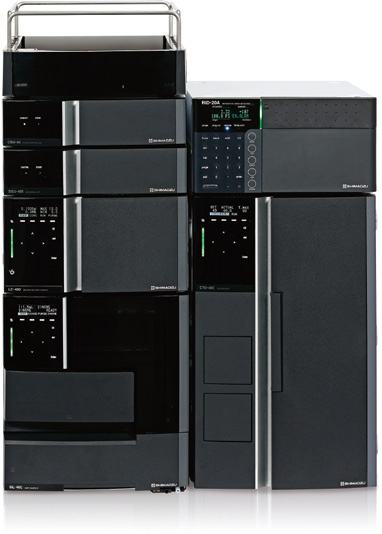
The Shimadzu GPC is a modular gel permeation chromatography system built around the RID-20A refractive index detector, available in integrated Prominence-i or modular Nexera configurations. It delivers retention time reproducibility of 0.025–0.066 %RSD over five days for polystyrene, with flow rate precision ≤0.06 %RSD. The system is used for polymer molecular weight distribution analysis, with LabSolutions GPC software supporting multiple calibration curve approximations.
Direct drop-in replacements
Full specifications
| Detector types | Refractive Index Detector (RID-20A), Photodiode Array Detector (PDA) (Prominence-i GPC System) |
| Retention time reproducibility mfr | 0.066 %RSD (n=10) (Day 1, polystyrene) |
| Retention time reproducibility mfr | 0.034 %RSD (n=10) (Day 2, polystyrene) |
| Retention time reproducibility mfr | 0.065 %RSD (n=10) (Day 3, polystyrene) |
| Retention time reproducibility mfr | 0.025 %RSD (n=10) (Day 4, polystyrene) |
| Retention time reproducibility mfr | 0.057 %RSD (n=10) (Day 5, polystyrene) |
| Retention time mfr | 7.427 min (Day 1, polystyrene) |
| Retention time mfr | 7.444 min (Day 2, polystyrene) |
| Retention time mfr | 7.455 min (Day 3, polystyrene) |
| Retention time mfr | 7.418 min (Day 4, polystyrene) |
| Retention time mfr | 7.434 min (Day 5, polystyrene) |
| System configuration mfr | Modular (Nexera GPC System standard) |
| Detector cell volume mfr | 9 μL (RID-20A detector) |
| Calibration curve approximation formulae mfr | Linear, 3rd-order, 3rd-order + hyperbolic curve, (LabSolutions GPC Software) |
| Data output method mfr | ASCII format (LabSolutions GPC Software) |
| Solvent usage savings mfr | 30 % (RID-20A GPC analysis) |
| Stabilization time mfr | After 30 Minutes (Power ON, RID-20A) |
| Mobile phase flow rate accuracy mfr | No more than 1% or 2 μL/min, whichever is greate (Nexera GPC System standard) |
| Mobile phase flow rate precision mfr | No more than 0.06% RSD or 0.02 min SD, whichever (Nexera GPC System standard) |
| Mobile phase containers monitored mfr | up to twelve containers (1-liter containers; up to 4 with 2- to 5-liter containers) |
Description
Construction and positioning
- The GPC system is a modular platform: the Nexera standard configuration comprises CBM-40 system controller, LC-40D solvent delivery unit, DGU-403 degassing unit, SIL-40C autosampler, CTO-40C column oven, RID-20A refractive index detector, and LabSolutions workstation with GPC software. The Prominence-i variant integrates the HPLC with a PDA detector and RID-20A.
- This model is distinguished by its detector flexibility: it supports both RID-20A and PDA detectors, allowing concentration and compositional analysis. No sibling models are listed, so positioning is within the GPC series as a conventional-scale, multi-detector system.
Performance under load
- Retention time reproducibility for polystyrene over five days ranged from 0.025 to 0.066 %RSD (n=10), with retention times between 7.418 and 7.455 min. This indicates stable flow and temperature control.
- Mobile phase flow rate accuracy is within 1% or 2 µL/min (0.01–2 mL/min), and precision is ≤0.06% RSD or 0.02 min SD. The RID-20A detector cell has a 9 µL volume and temperature control from 30 to 60 °C, with stabilization after 30 minutes.
Installation and operation
- The system is controlled via LabSolutions workstation, which supports calibration curve approximations: linear, 3rd-order, 3rd-order + hyperbolic, 5th-order, and 5th-order + hyperbolic. Data output is in ASCII format.
- Mobile phase containers monitored: up to twelve 1-liter containers, or up to four 2- to 5-liter containers. Solvent usage savings of 30% are reported for RID-20A GPC analysis.
Integration & Operating Notes
Operating outside this range compromises flow accuracy (specified as ≤1% or 2 µL/min) and may affect retention time reproducibility. Ensure the LC-40D solvent delivery unit is calibrated for the intended flow rate before running samples.
The refractive index detector requires a 30-minute warm-up to reach stable operating conditions. Starting analysis before stabilization can cause baseline drift and invalidate retention time reproducibility. Incorporate this delay into the startup sequence.
The system can monitor up to twelve 1-liter containers or four 2- to 5-liter containers. Low solvent levels can lead to cavitation and flow interruptions. Set appropriate alerts in LabSolutions and refill containers before they run dry.
Selection & Integration Q&A
Choose Prominence-i for a compact, integrated HPLC with PDA and RID-20A, ideal for routine GPC with compositional analysis. Choose Nexera for modular flexibility, higher throughput, and independent component upgrades.
The RID-20A requires mobile phase flow from the LC-40D pump, with flow rate within 0.01–2 mL/min and precision ≤0.06% RSD. Ensure proper tubing connections and temperature control (30–60 °C) for stable baseline.
Regular maintenance includes replacing mobile phase filters, checking for leaks, and calibrating the detector. Consumables like columns (Shim-pack GPC series), vials, and solvents are not included. Refer to the manual for service intervals.