
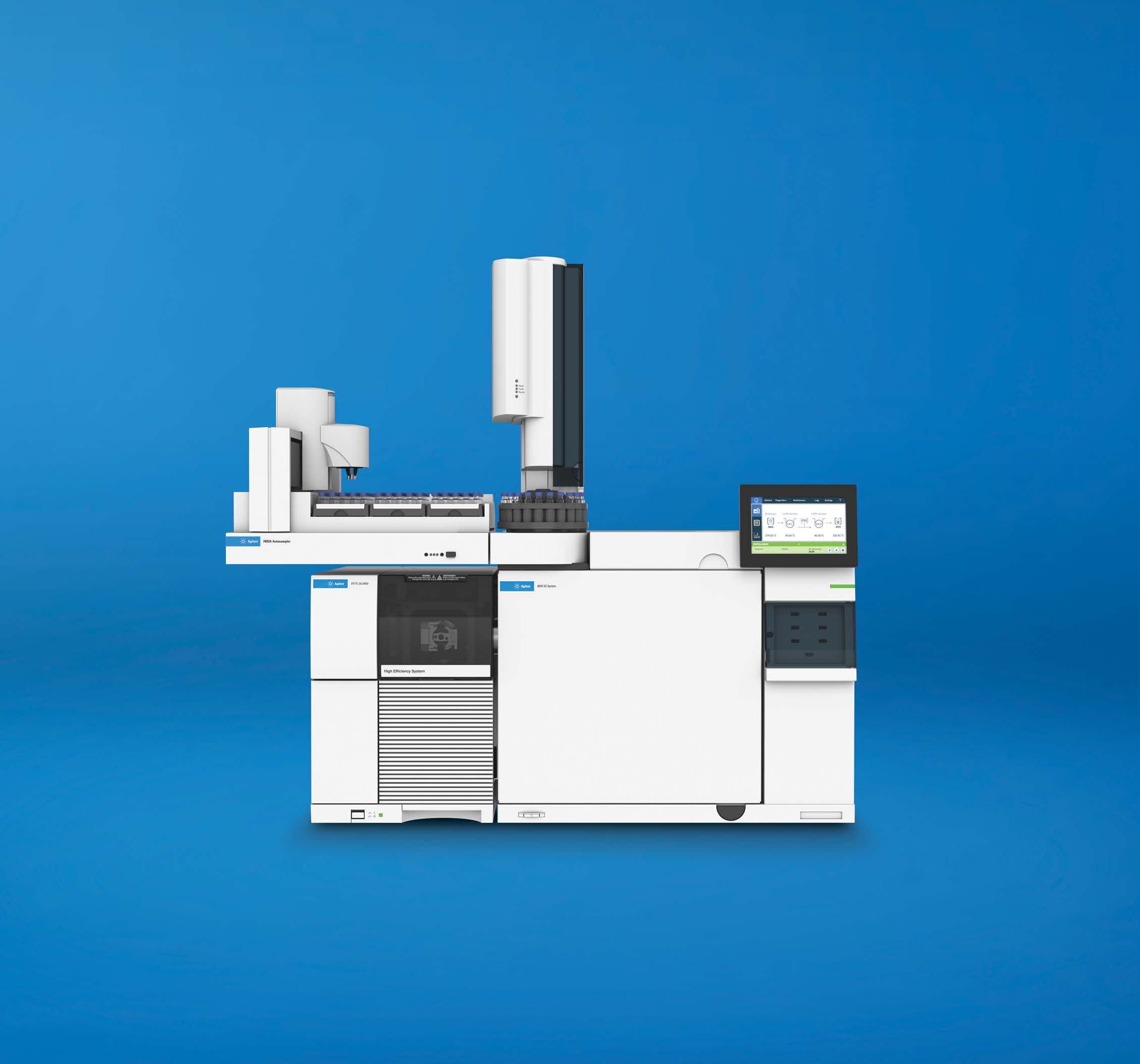
Agilent Technologies GC/MS Ion Sources, GC Inlets
Agilent Technologies GC/MS Ion Sources, GC Inlets — Gas chromatography mass spectrometry gc ms.
The Agilent HydroInert ion source is a dedicated electron-ionization source for GC/MSD and GC/TQ systems operated with hydrogen carrier gas, available as a complete assembly (G7078-67930) or as upgrade kits for the 5977B Inert Plus MSD and 7000D/E Inert Plus triple quadrupole. It extends the series' 1050 m/z mass range to H2 carrier operation, where standard EI sources suffer from chemical background and reduced sensitivity.
Agilent Technologies GC/MS Series — Model Comparison & Selection
| Model | Mass range | Detection limit | Sensitivity | Carrier gas | Ion source | Peak area rsd, % |
|---|---|---|---|---|---|---|
| GC/MS Ion Sources, GC Inlets Current | 1050 | — | 100 | 2 | — | — |
| GC/MS Instruments, GC/MS Systems, GC/MS Analysis | 1050 | attogram-level | — | — | 2.0 | 5 |
Full specifications
| Sensitivity | 100 S/N |
| Carrier gas | 2 |
| Pentachlorophenol Concentration Range Start | 500 pg/µL |
| Recommended Flow Rate | The HydroInert source is an easy |
| Retention Time | 13.04 min |
| Number of compounds in MRM database mfr | 1100 compounds |
| Number of eMethods mfr | 7500 eMethods |
| Maximum allowable injection volume (GC/MS/MS) mfr | 4 fg |
| Number of OFN injections per data set mfr | 12 injections |
| Number of data sets mfr | 4 sets |
| Extractor lens diameter mfr | 9 mm |
| Library match score, DDT mfr | 85 |
| Library match score, DDD mfr | 79 |
| Peak tailing factor range mfr | 0.6...0.9 |
| Number of compounds in EPA 8270 list mfr | 200 compounds |
| Calibration range mfr | 0.8...100 ng/μL |
| Starting concentration for selected compounds mfr | 200 pg/μL |
| Peak tailing factor mfr | 0.6...0.9 |
| Maximum allowable injection mfr | 4 fg |
| IDL evaluation injections mfr | 12 injections |
| Aniline mfr | 98.6 |
| Nitrobenzene mfr | 95.7 |
| Benzoic acid mfr | 93.3 |
| Naphthalene-d8 mfr | 96.9 |
| Acenaphthene-d10 mfr | 98.3 |
| Phenanthrene-d10 mfr | 97.7 |
| Musk ambrette mfr | 86.6 |
| Fenitrothion mfr | 95.6 |
| Musk ketone mfr | 95.8 |
| Benzidine mfr | 92.6 |
| Chrysene-d12 mfr | 96.0 |
| Benzo[b]fluoranthene mfr | 97.8 |
| Benzo[k]fluoranthene mfr | 97.8 |
| Perylene-d12 mfr | 94.4 |
| Nitro Compounds mfr | Nitrobenzene, fenitrothion, ethalfluralin ethalf |
| Heavily Chlorinated Compounds mfr | DDT, Endrin, heptachlor, BHC compounds, pentachl |
| PAHs mfr | Benzo fluoranthene, benzo[g,h,i]perylene, fluora |
| Alkanes >C24 mfr | Tetracosane , octatriacontane octatriacontane |
| Pesticides mfr | Deltamethrin, fipronil, permethrin, captan capta |
| Fragrance/Flavor Compounds mfr | Musk ketone, musk ambrette, linalool linalool |
| VOCs mfr | 1.4 dichloromethane |
| Extractor mfr | 13.04 DDD |
| HydroInert mfr | 13.04 DDT |
| Trichloromethane mfr | 2.107 |
| Bromodichloromethane mfr | 2.792 |
| Dibromochloromethane mfr | 3.526 |
| Tribromomethane mfr | 4.267 |
| Optimal carrier gas flow rate mfr | 0.5...1.0 mL/min |
| Maximum recommended flow rate for turbo pump mfr | 2.0 mL/min |
| Maximum allowable instrument detection limit (IDL) for GC/MS/MS mfr | 4 fg |
| Average OFN IDL with HydroInert and H2 mfr | 2.9 fg |
| OFN test concentration mfr | 10 fg/μL |
| DFTPP test concentration mfr | 25 ng/μL |
| Lower concentration level achievable with GC/MS/MS mfr | 20 pg/μL |
| Nitrobenzene linear range mfr | 0.1...100 ng/μL |
| Average RF RSD for H2 with HydroInert mfr | 6.59 % RSD |
| EPA 8270 test concentration for 68 analytes mfr | 50 ng/μL |
| Pesticide mixture dilution mfr | 10 ng/μL |
| Mass range | 1050 m/z |
| Mass 51 abundance criterion mfr | 10...80 |
| Mass 68 abundance criterion mfr | 2 |
| Mass 70 abundance criterion mfr | 2 |
| Mass 199 abundance criterion mfr | 5...9 |
| Mass 275 abundance criterion mfr | 10...60 |
| Mass 365 abundance criterion mfr | 1 |
| Mass 443 abundance criterion mfr | 15...24 |
| Mass 442 abundance mfr | 100 |
| Mass spectral library match score mfr | 79 |
| Mass 197 abundance criterion mfr | 2 |
| Standard concentration mfr | 50 ppm |
Description
Construction and series positioning
- The HydroInert source is a variant of the Agilent Inert Plus EI source family, not a standalone instrument; it is installed in the 5977B Inert Plus GC/MSD or the 7000D/E Inert Plus GC/TQ.
- It is supplied either as a complete source assembly (G7078-67930) or as an upgrade kit: 5505-0083 for GC/MSD and 5505-0084 for GC/TQ.
- Sibling models in the series are the general-purpose GC/MS instruments and systems (attogram detection limits, 1050 m/z) and the spectra-library/application packages; the HydroInert source is the modification selected specifically for hydrogen carrier gas.
Behavior in hydrogen carrier operation
- The source is engineered to suppress the background ions that hydrogen carrier gas generates in a conventional EI source, preserving sensitivity (100 S/N, as stated in the verified performance data) across the 1050 m/z mass range.
- The extractor lens diameter is 9 mm; this is the only mechanical dimension given for the source itself.
- No digitized response curves are available for this source, so no load-dependent behavior beyond the stated sensitivity and mass range is asserted here.
Installation, control and operation
- The source is a field-installed assembly/upgrade; the technical overview covers the HydroInert source for the 5977B Inert Plus GC/MSD and 7000D/E Inert Plus GC/TQ and the two upgrade kits.
- The attached document digests contain no sections or actionable installation facts, so no tuning, temperature or gas-flow setpoints are stated in this card.
Integration & Operating Notes
The HydroInert source is the H2-carrier variant of the Inert Plus source; for helium carrier gas the standard Inert Plus EI source of the 5977B or 7000D/E is the appropriate configuration. Mixing the two source types with the wrong carrier gas negates the background-suppression design intent.
Two distinct kits exist: 5505-0083 for the 5977B Inert Plus GC/MSD and 5505-0084 for the 7000D/E Inert Plus GC/TQ. The complete source assembly is G7078-67930. Ordering the wrong kit leaves the source incompatible with the instrument's source housing and vacuum interface.
Because the HydroInert source is delivered as an upgrade kit or complete assembly, installation involves replacing the ion source in the MSD or GC/TQ vacuum housing. Plan venting, source cleaning and re-tuning of the instrument as part of the upgrade; the attached digests provide no step-by-step procedure, so the instrument's own service documentation must be followed.
Selection & Integration Q&A
Choose HydroInert when the method runs hydrogen carrier gas; it is the H2-specific variant of the Inert Plus source. For helium carrier, the standard Inert Plus EI source is the correct configuration. The source is ordered as kit 5505-0083 (GC/MSD) or 5505-0084 (GC/TQ), or as assembly G7078-67930.
The host must be a 5977B Inert Plus GC/MSD or a 7000D/E Inert Plus GC/TQ, since the upgrade kits are platform-specific (5505-0083 and 5505-0084). The instrument's vacuum housing, source heater and lens stack are reused; the 9 mm extractor lens is part of the source itself. No separate controller or drive is listed.
The verified facts give no explicit duty-cycle, temperature or pressure limit for the source. The only mechanical datum is the 9 mm extractor lens diameter. Because hydrogen carrier operation is the source's design purpose, follow the host instrument's own hydrogen-safety and vacuum interlocks; the attached digests contain no additional limits.
Delivery is either the complete source assembly G7078-67930 or the platform-specific upgrade kit (5505-0083 for GC/MSD, 5505-0084 for GC/TQ). The digests list no cables, filaments, gaskets or tuning standards as included, and no service interval; plan source cleaning and re-tuning per the host instrument's service documentation.