
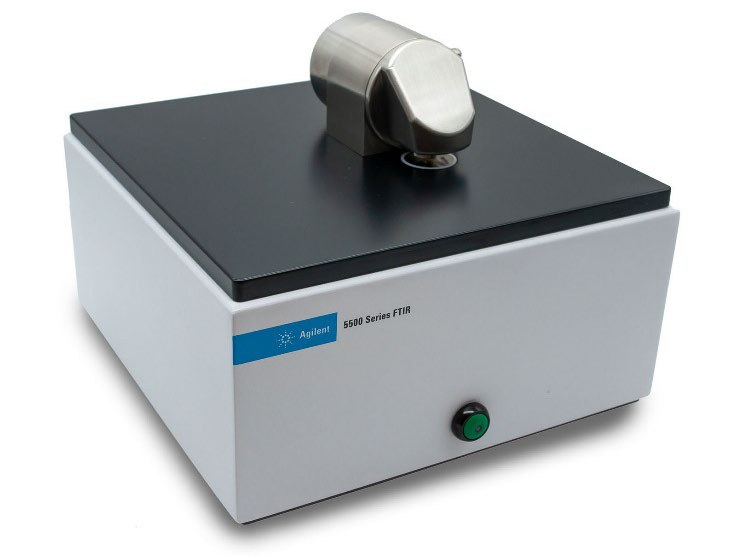
Agilent Technologies 5500 Series FTIR
Agilent Technologies 5500 Series FTIR — Molecular spectroscopy.
The Agilent 5500 Series FTIR is a compact 20.3 × 20.3 × 11.4 cm, 3.6 kg spectrometer platform configured with one of three sampling accessories: TumblIR liquid transmission (5500t), diamond ATR (5500a), or DialPath variable-pathlength transmission. This card covers the series as a whole; the specific accessory determines sample compatibility, pathlength, and pH limits. It is intended for onsite lubricant analysis and general mid-IR sample identification in non-hazardous, indoor environments.
Full specifications
| Atr Sample Press Force | 15 pounds |
| Dimensions | 20.3 cm |
| Single Reflection Atr Active Area | 200 µm |
| Single Reflection Atr Sampling Surface Diameter | 1 mm |
| Triple Reflection Atr Active Area | 200 µm |
| Triple Reflection Atr Sampling Surface Diameter | 2 mm |
| Tumblir Bottom Window Diameter | 2 mm |
| Tumblir Pathlength | 100 micrometers |
| ATR window thickness mfr | 0.5 less |
| ATR sample press sample thickness assumption mfr | 0.03 inch |
| DialPath pathlengths mfr | three factory-set pathlengths pathlengths |
| Warmup period before analysis mfr | 5 minutes |
| Warmup period before performance validation tests mfr | 30 minutes |
| Stability test regions mfr | 3000 |
| Stability test sample interval mfr | one sample every minute minute |
| Diagnostic value Energy (centerburst) optimal mfr | 26000...21,000 |
| Diagnostic value Energy (centerburst) marginal mfr | 30000 |
| Diagnostic value Energy (centerburst) critical mfr | 31000 |
| Diagnostic value Laser signal optimal mfr | 15000...3,000 |
| Diagnostic value Laser signal marginal mfr | 15000 |
| Diagnostic value Laser signal critical mfr | 17000 |
| Energy (centerburst) optimal mfr | 26000...21,000 |
| Energy (centerburst) marginal mfr | 30000 |
| Energy (centerburst) critical mfr | 31000 |
| Laser signal optimal mfr | 15000...3,000 |
| Laser signal marginal mfr | 15000 |
| Laser signal critical mfr | 17000 |
| System OFF mfr | Red Red |
| System startup mfr | Red/green Red/green |
| System ON mfr | Red/green Red/green |
| Firmware update mfr | Red/green Red/green |
| ATR sample press assumed sample thickness mfr | 0.03 inch |
| Single Reflection Atr Depth Of Penetration | 2 micron |
| Triple Reflection Atr Effective Penetration Depth | 6 micron |
| Weight | 3.6 kg |
| Laser frequency calibration reference mfr | 1921 film |
| Diagnostic value Battery life optimal mfr | 30 min |
| Diagnostic value Battery life marginal mfr | 30...5 min |
| Diagnostic value Battery life critical mfr | 5 min |
| Diagnostic value Source optimal mfr | 1.9 A |
| Diagnostic value Source marginal mfr | 2.2 A |
| Diagnostic value Source critical mfr | 2.5 A |
| Battery life optimal mfr | 30 min |
| Battery life marginal mfr | 30...5 min |
| Battery life critical mfr | 5 min |
| Source optimal mfr | 1.9 A |
| Source marginal mfr | 2.2 A |
| Source critical mfr | 2.5 A |
| Low battery mfr | Green Green |
| Critically low battery mfr | Red Red |
| Dead battery mfr | No LED illumination illumination |
| Signal-to-noise test regions mfr | 2500 |
| Signal-to-noise test resolution mfr | 4 |
| Signal-to-noise test collection time mfr | one-minute minutes minutes |
| Signal-to-noise test duration mfr | 2 test |
| Signal-to-noise minimum number of tests mfr | 10 tests |
| Minimum number of signal-to-noise tests mfr | 10 tests |
Description
Construction and series positioning
- The 5500 Series is a single spectrometer chassis (20.3 × 20.3 × 11.4 cm, 3.6 kg) that ships in three factory-configured variants distinguished only by the installed sampling accessory:
- **5500t** with TumblIR: fixed 100 µm liquid transmission, ZnSe windows, pH 4–9, liquids only.
- **5500a** with ATR: type IIa diamond crystal on ZnSe substrate, pH 1–14; single-reflection (1 mm surface, 200 µm active area, ~2 µm penetration at 1700 cm⁻¹, spring-loaded press at 15 lb force assuming 0.03 in sample thickness) or triple-reflection (2 mm surface, 200 µm active area, ~6 µm effective penetration, flush-mounted, no press, liquids/pastes only).
- **5500 DialPath**: TumblIR-based transmission with three factory-set pathlengths, 2 mm bottom window diameter.
- No sibling models exist outside these three accessory configurations; selection is driven entirely by sample type and pH.
Behavior under load and in different modes
- TumblIR and DialPath operate in two physical modes: sample loading/cleaning (window facing up) and sample analysis (window facing down, arm rotated to the detent). The DialPath background must be collected at the same pathlength as the sample; changing pathlength between background and sample invalidates the baseline.
- The single-reflection ATR press is set to 15 lb force; the diamond window is 0.5 mm or less thick and can crack on sharp or pointed samples. The triple-reflection ATR is flush-mounted and accepts only liquid or paste samples.
- The instrument will not collect data if diagnostic values are grossly out of specification; energy, battery life, source current, laser signal, detector temperature, and CPU temperature are classified Optimal/Marginal/Critical and should be checked daily or weekly.
Installation, control, and operation
- Power connects at the lower left rear via a blue threaded cap (finger-tight); a UL-approved surge protection strip is mandatory between the outlet and the system cord, and the cord must be connected to the spectrometer first.
- USB connects at the upper left rear to a PC running MicroLab PC; first logon is Admin/admin (case-sensitive). A 5-minute warmup is required before analysis; performance validation tests require at least 30 minutes of warmup.
- The power button is a momentary switch to prevent accidental power-off; the two-color LED indicates startup, system on, low battery, critically low battery, dead battery, and firmware update states.
- Performance validation comprises signal-to-noise (2500 and 1000 cm⁻¹, 4 cm⁻¹ resolution, one-minute collection, 2 minutes per test, at least 10 tests), stability (one sample every minute), and laser frequency calibration (NIST SRM 1921 polystyrene film, only after consultation with Agilent support).
Integration & Operating Notes
Connect the power cord to the spectrometer first, then to the AC outlet, with a UL-approved surge protection strip in between. Reversing the order or omitting the strip exposes the instrument to power startup damage and surge events; the blue cap must be threaded clockwise until finger tight.
TumblIR and DialPath use ZnSe windows that tolerate only pH 4–9 and must not see solid or powder samples such as tablets or hard graphite lubricant. Solids damage the windows or alter the fixed 100 µm pathlength; route extreme-pH or solid samples to the diamond ATR instead.
The single-reflection ATR diamond is 0.5 mm or less thick; the spring-loaded press applies 15 lb force assuming 0.03 in sample thickness. Avoid using the press on sharp or pointed samples, and do not leave extremely acidic samples on the metal mounting plate for extended periods even though the diamond accepts pH 1–14.
If diagnostic values (energy, source current, laser signal, detector temperature, CPU temperature, battery life) are grossly out of specification, the instrument will not collect data. Check the diagnostic page daily or weekly; a yellow or red status circle requires contacting Agilent technical support before critical measurements.
Laser frequency calibration uses NIST SRM 1921 polystyrene film and should only be set after consultation with an Agilent technical support engineer. Independent adjustment affects the frequency (X-axis) accuracy of all spectra and cannot be corrected by routine performance tests.
The system is not intrinsically safe and must only be used in atmospheres tested for flammable materials. It is intended for indoor use; allow the shipment to reach room ambient temperature for several hours before opening to avoid condensation.
Selection & Integration Q&A
Pick single-reflection ATR for solids, powders, rubber, polymers, paints, fibers, or extreme-pH samples (diamond accepts pH 1–14) and limited sample amounts; its ~2 µm penetration suits higher-absorbing materials. Choose TumblIR for pH 4–9 liquids needing a fixed 100 µm transmission path; choose triple-reflection ATR for lower-absorbing liquids/pastes only (no press, ~6 µm penetration).
A PC with MicroLab PC software, the supplied USB cable to the upper-left rear USB port, and the supplied power cord to the lower-left rear connector with a UL-approved surge protection strip between the outlet and the cord. Connect the cord to the spectrometer first, then the outlet. First logon is Admin/admin (case-sensitive).
Indoor use only; not intrinsically safe, so only in atmospheres tested for flammable materials. Allow the shipment to reach room temperature for several hours before opening. A 5-minute warmup precedes analysis; validation tests need 30 minutes warmup. Detector temperature optimal 35–44 (critical <30 or >48) and CPU temperature optimal 10–75 (critical >80) constrain ambient conditions and ventilation.
Check diagnostic values daily or weekly; run the performance test initially and validation tests (signal-to-noise, stability, laser frequency calibration) as needed. Laser calibration requires NIST SRM 1921 polystyrene film and Agilent consultation. Base delivery includes spectrometer, accessory, manual, power cord, USB cable, installation disk; options not included: laptop, surfactant kit, extra cords, single-bounce ATR with sample press, multi-bounce ATR.