
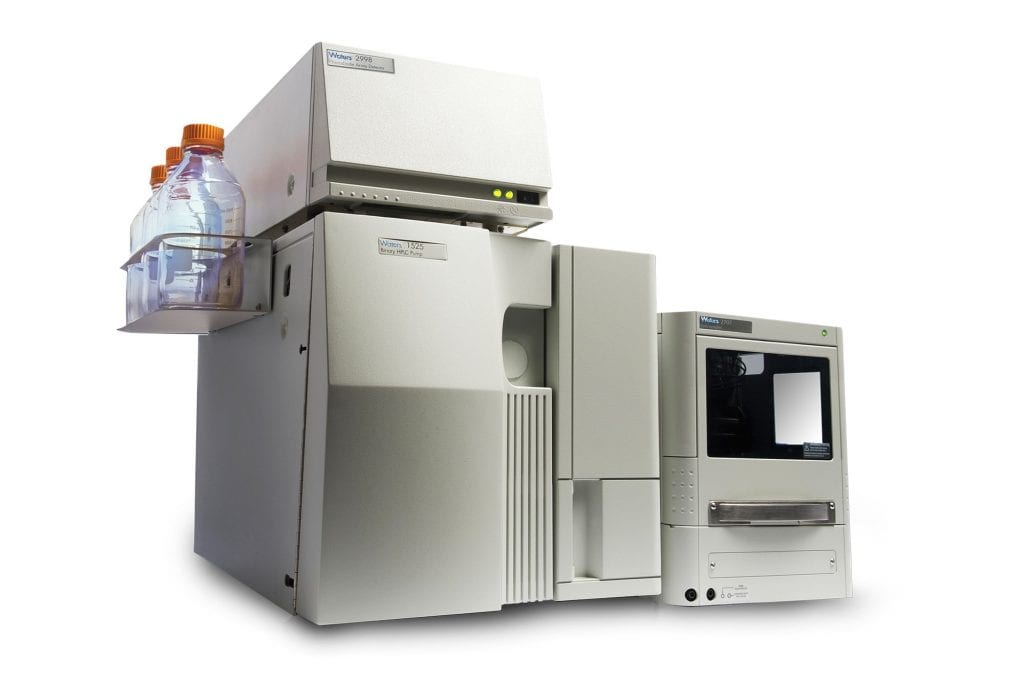
Waters Breeze QS HPLC System: Cost Effective Solution
Waters Breeze QS HPLC System: Cost Effective Solution — Chromatographs.
The Breeze QS HPLC System is a modular chromatography platform configured from Waters 1500-series pumps, a choice of detectors, and manual or automated injection. It is distinguished by its cost-effective, flexible architecture that supports isocratic or binary gradient operation and multiple detection modes. The system serves routine analytical HPLC in quality control and research laboratories, where users assemble a configuration tailored to their specific separation and detection needs.
Direct drop-in replacements
Full specifications
| Pumps mfr | Waters 1525 Binary Pump; Waters 1515 Isocratic P |
| Detectors mfr | 2489 UV/Visible (UV/Vis) Detector; 2998 Photodio |
| Injectors mfr | Manual injectors, and/or 2707 Autosampler; 2707 |
| Optional Component mfr | 1500 Series Column Heaters; Extended Temperature |
Description
System Architecture and Positioning
The Breeze QS HPLC System is not a single fixed instrument but a configurable set of modules. The core is a Waters 1500-series pump: the 1515 Isocratic Pump for single-solvent operation, or the 1525 Binary Pump for gradient work (including 1525µ and 1525EF variants). Detection is provided by one of five detectors: 2489 UV/Vis, 2998 PDA, 2414 RI, 2475 FLR, or 2424 ELS. Sample introduction is via manual injectors or the 2707 Autosampler, with an optional cooled version. This modularity allows the system to be tailored to specific analytical requirements, from simple isocratic UV detection to advanced gradient separations with multiple detection techniques. ### Behavior and Configuration Flexibility
Because the system is assembled from discrete modules, its performance envelope depends on the selected pump and detector. The binary pump enables gradient elution for complex mixtures, while the isocratic pump suits single-mobile-phase methods. The wide detector range covers UV/Vis absorbance, photodiode array spectral analysis, refractive index for universal detection, fluorescence for trace analysis, and evaporative light scattering for semi-volatile compounds. Optional column heaters (standard or extended temperature range) and vacuum degassers further adapt the system to specific separation conditions. The eSAT/IN interface allows integration of third-party detectors, expanding compatibility. ### Installation and Operation
Installation requires standard laboratory infrastructure: solvent lines, waste containers, and a suitable bench space. The modular design means each component has its own power and communication connections; the system is typically controlled via Waters chromatography software (not specified in the provided facts). Manual injectors require operator intervention for each sample, while the 2707 Autosampler enables automated sequences. Column heaters require additional power and control connections. The system should be installed in a stable environment free from excessive vibration and temperature fluctuations, as is typical for HPLC equipment.
Integration & Operating Notes
The modular nature means multiple stacked or adjacent modules; plan for sufficient bench depth and height, and provide secondary containment for mobile-phase solvents and waste. Ensure the bench can support the combined weight of pump, detector, autosampler, and column heater.
Pump, detector, autosampler, column heater, and degasser are separate units with individual power cords. Verify that the laboratory power distribution can accommodate the total load and that outlets are grounded. Consider an uninterruptible power supply for the pump and detector to prevent data loss during transient outages.
The system requires a control computer and chromatography data software (e.g., Waters Empower) to integrate the modules. Communication cables between pump, autosampler, detector, and computer are typically supplied separately. The eSAT/IN interface is needed to connect third-party detectors, and its configuration must be planned during installation.
Particulates and dissolved gases can damage pump seals and cause baseline noise. Use the optional 1500 Series Vacuum Degasser or sparge solvents with helium. Filter all solvents and samples through appropriate membranes (e.g., 0.45 µm) before use to prevent column blockage and detector cell contamination.
Pump seals and check valves are wear items; replace according to the pump manual (typically every 3–6 months of continuous use). Detector lamps have finite lifetimes (e.g., deuterium lamps ~2000 hours) and should be replaced when energy drops. Autosampler needles and injection valves also require periodic inspection and replacement.
Selection & Integration Q&A
Choose the 1515 Isocratic Pump for simple, single-mobile-phase methods with fixed composition, where cost and simplicity are priorities. Select the 1525 Binary Pump when method development or complex separations require gradient elution, such as for samples with a wide polarity range.
An eSAT/IN interface is required to integrate a third-party detector. This module converts the detector's analog signal to a format the Waters software can acquire. Ensure the detector's output is compatible (e.g., 0–1 V or 4–20 mA) and that the eSAT/IN is configured in the software.
Base delivery typically includes the selected modules but not the control computer, software, column, solvent filters, tubing, or fittings. Consumables such as pump seals, check valves, detector lamps, autosampler vials and caps, and column heaters are optional or separate. A vacuum degasser and eSAT/IN interface are also optional.