
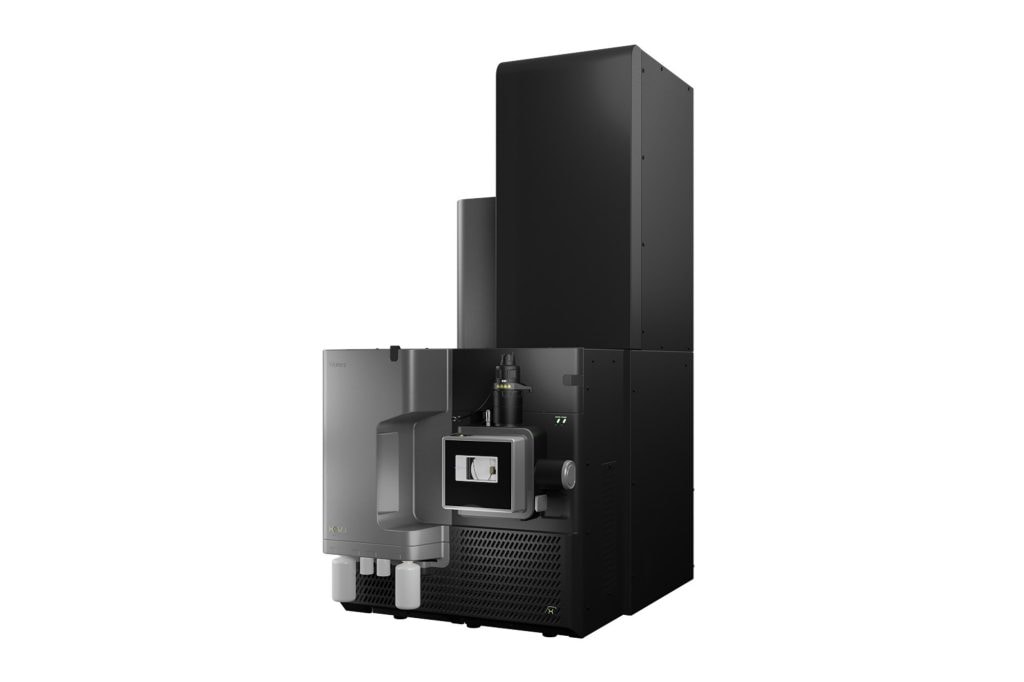
Waters Xevo G3 QTof
Waters Xevo G3 QTof — Mass spectrometers.
The Waters Xevo G3 QTof is a benchtop quadrupole time-of-flight mass spectrometer for accurate mass measurement and high-resolution LC-MS applications. As the third-generation Xevo QTof platform, it is positioned for demanding qualitative and quantitative workflows requiring high mass accuracy and sensitivity. It serves as the detector in UPLC/MS systems for pharmaceutical, environmental, and clinical research.
Direct drop-in replacements
Full specifications
Description
Construction and Architecture
The Xevo G3 QTof is a benchtop instrument combining a quadrupole mass filter with a time-of-flight analyzer. It is designed for integration with Waters UPLC systems and features an electrospray ionization (ESI) source as standard, with options for APCI and other ionization modes. The instrument includes a lock mass sprayer for continuous mass calibration and a dual-stage reflectron TOF analyzer for high resolution. ### Behavior Under Load
The Xevo G3 QTof operates in both MS and MS/MS modes, with a mass range of m/z 20–100,000 and resolution up to 100,000 FWHM. It provides accurate mass measurements typically within 1 ppm mass error using lock mass correction. The instrument supports data-dependent acquisition (DDA) and data-independent acquisition (DIA) methods, such as MSE and HDMSE, for comprehensive sample profiling. ### Installation, Connection, and Control
The system requires a laboratory environment with stable temperature (18–28 °C) and humidity (20–80% non-condensing). It connects to a PC running Waters MassLynx software via Ethernet. The instrument requires a nitrogen supply for the source and a dry nitrogen supply for the TOF analyzer. Power requirements are 100–240 V AC, 50/60 Hz, with a typical consumption of 1.5 kVA. The instrument is controlled through MassLynx, which also handles data processing and reporting.
Integration & Operating Notes
The instrument must be placed on a sturdy laboratory bench capable of supporting its weight (approximately 150 kg) and free from excessive vibration. Ensure adequate clearance for ventilation and service access.
Connect to a grounded, dedicated electrical outlet rated for 100–240 V AC, 50/60 Hz, with a minimum capacity of 1.5 kVA. Avoid sharing the circuit with high-power equipment to prevent electrical noise.
Provide dry nitrogen (≥99.999% purity) at 90–110 psi for the source and dry nitrogen at 60–80 psi for the TOF analyzer. Contaminated or wet nitrogen can degrade performance and damage components.
MassLynx software includes interlocks that prevent the instrument from operating if nitrogen pressure is insufficient. Ensure nitrogen supply is stable before starting acquisition.
Clean the ion source weekly or as needed based on sample load. Perform mass calibration daily using the lock mass sprayer. Replace the source filter and check vacuum pump oil every three months.
Selection & Integration Q&A
Choose the Xevo G3 QTof for high-resolution accurate mass analysis with superior sensitivity and dynamic range. It is ideal for complex mixture analysis, metabolite identification, and quantitative workflows requiring high mass accuracy. For simpler applications or lower resolution needs, consider the Xevo TQD or other single-quadrupole instruments.
The Xevo G3 QTof connects to a Waters UPLC system via a standard chromatographic interface. Ensure the UPLC system is equipped with a compatible column manager and that the plumbing is configured for the low flow rates typical of UPLC (e.g., 0.2–0.6 mL/min). Use PEEK tubing and fittings rated for high pressure.
Dimensional Drawings & Technical Documentation
Dimensional drawings
Click drawing to inspect vector dimensions