
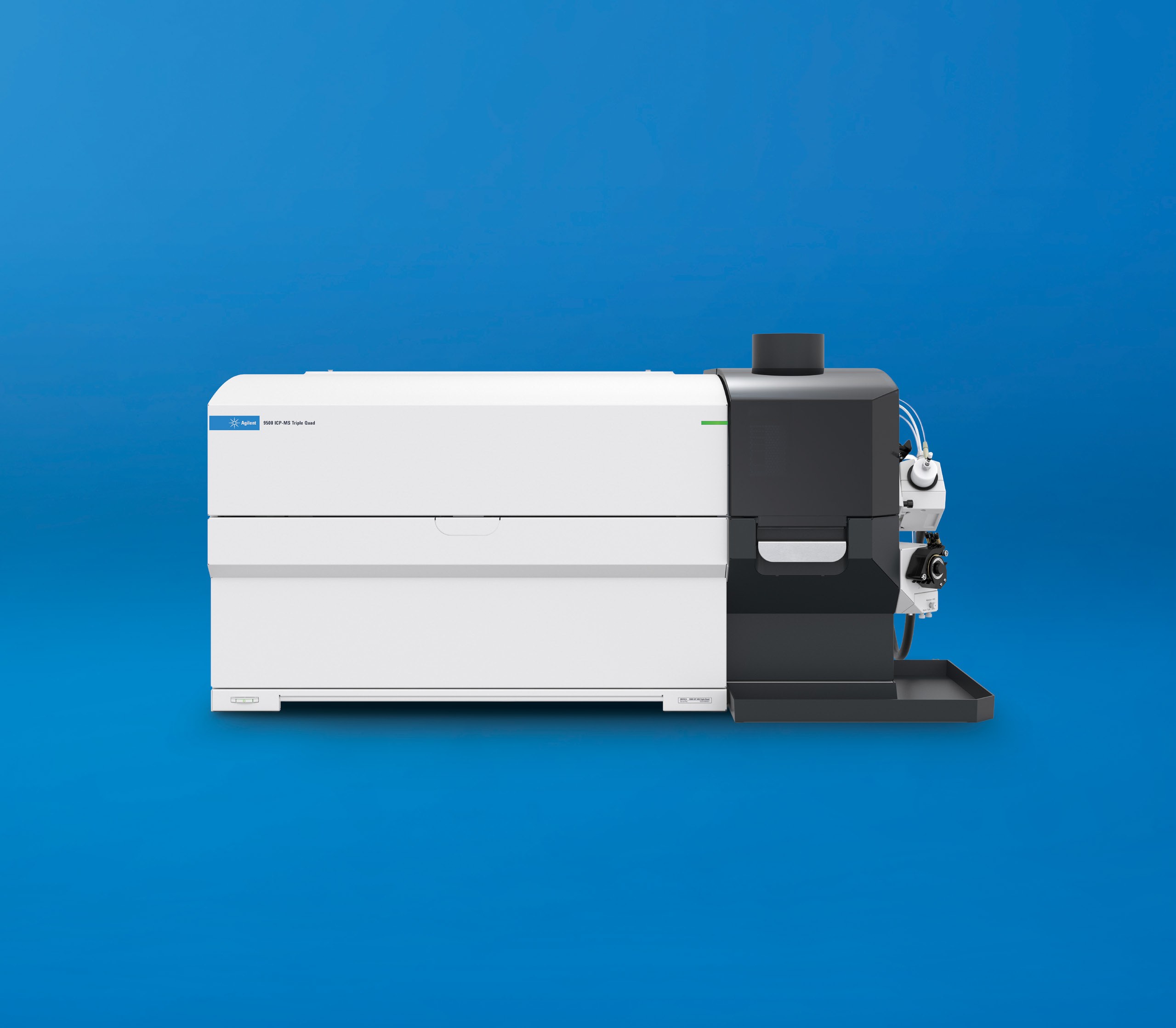
Agilent Technologies 9500-triple-quadrupole-icp-ms
Agilent Technologies 9500-triple-quadrupole-icp-ms — Atomic spectroscopy.
The Agilent 9500 Triple Quadrupole ICP-MS (ICP-QQQ) is a benchtop tandem mass spectrometer with a dual-cell system (DCS) for interference removal. It delivers 20-fold sensitivity improvement for low-mass elements (Be, B) and 2-fold for mid-to-high mass elements, with 3-minute analysis time. It is used for trace elemental analysis in complex matrices.
Agilent Technologies ICP MS Instruments Series — Model Comparison & Selection
| Model | Sensitivity | Minimum dwell time, ms | Analysis time, min | Data repeatability, % | Instrument depth, mm | Instrument height, mm |
|---|---|---|---|---|---|---|
| 9500-triple-quadrupole-icp-ms Current | 10000 | 0.05 | 3 | 5.54 | 600 | 530 |
| 7900-icp-ms | 109 | — | — | — | — | — |
| 8900-triple-quadrupole-icp-ms | 700 | 0.1 | — | — | — | — |
Full specifications
| Sensitivity | 10000 cps/ppb |
| Analysis time | 3 min |
| Data Repeatability | 5.54 % |
| Minimum Dwell Time | 0.05 ms |
| Stabilization Time | 5 sec |
| Total Acquisition Time | 52.549 sec |
| Annual cost mfr | 13260 |
| Interference removal effectiveness mfr | 20 x |
| Sample remeasurement rate mfr | 15 |
| Data acquisition time reduction mfr | 33 |
| W mfr | 1060 mm |
| D mfr | 600 mm |
| H mfr | 530 mm |
| exhaust flow reduction mfr | 50 |
| acquisition time reduction mfr | 33 |
| seawater analyses stability mfr | 130 analyses |
| method detection limit level mfr | ppt-level level |
| CRM/spike recovery mfr | 90...110 |
| analysis time per sample mfr | 140 s |
| He flow rate plateau mfr | 6 mL/min |
| IPA matrix concentration mfr | 15 |
| HCl matrix concentration mfr | 2 |
| Ca spike concentration mfr | 100 ppm |
| Ba matrix concentration mfr | 20 ppm |
| tantalum concentration in sample mfr | 0.5 ppm |
| gold m/z mfr | 197 |
| Instrument Depth | 600 mm |
| Instrument Height | 530 mm |
| Instrument Width | 1060 mm |
| Weight | 387 kg |
| Sensitivity improvement for low-mass elements (Be, B) mfr | 20 fold |
| Sensitivity improvement for mid-to-high mass elements mfr | 2 fold |
| Interference removal for low mass mfr | 20 x |
| Sensitivity improvement, low-mass elements (Be, B) mfr | 20 fold |
| Sensitivity improvement, mid-to-high mass elements mfr | 2 fold |
| Q2 mass range mfr | 300 m/z |
| low-mass sensitivity gain mfr | 20 x |
| Low-mass threshold mfr | 23 |
| Low-mass sensitivity improvement mfr | 20 fold |
| Mid-to-high mass sensitivity improvement mfr | 2 fold |
| power consumption reduction mfr | 20 |
| Nitrogen content of ambient air mfr | 78 |
| Oxygen content of ambient air mfr | 21 |
| Effective interference removal using ambient air mfr | 15 |
| ambient oxygen content mfr | 21 |
Description
Construction and positioning
- The 9500 is a triple quadrupole ICP-MS (ICP-QQQ) with a dual-cell system (DCS) that enables advanced helium mode (AHM) and air cell mode for interference reduction.
- It measures 1060 mm wide, 600 mm deep, and 530 mm high, weighing 387 kg.
- Within the Agilent AA series, sibling models (240FS AA, 240Z AA, 280FS AA, 280Z AA) are atomic absorption spectrometers, while the 9500 is an ICP-MS/MS instrument for trace elemental analysis.
Behavior and performance
- The DCS provides 20-fold sensitivity improvement for low-mass elements (Be, B) and 2-fold for mid-to-high mass elements.
- Interference removal effectiveness is 20x, and data acquisition time is reduced by 33%.
- Analysis time is 3 minutes, with data repeatability of 5.54%.
- Sample remeasurement rate is 15 (unit not specified).
Installation and operation
- The instrument requires ambient air (nitrogen 78%, oxygen 21%) for the air cell mode.
- Annual cost is 6670 (currency not specified).
- No certificates or applications are listed.
Integration & Operating Notes
The air cell mode uses ambient air with nitrogen content of 78% and oxygen content of 21%. Ensure the installation environment provides adequate air quality and supply; deviations may affect interference removal performance.
Selection & Integration Q&A
Choose the 9500 for trace multi-element analysis requiring interference removal via tandem MS and dual-cell system. The 240FS/280FS are flame AA for higher concentrations; 240Z/280Z are graphite furnace AA for ultratrace single-element analysis. The 9500 offers ICP-MS/MS sensitivity and speed (3 min analysis).
The 9500 uses a dual-cell system with helium mode and air cell mode. For air cell mode, ambient air (78% N2, 21% O2) is required. Ensure appropriate gas supplies and sample introduction compatible with ICP-MS. No specific fittings are listed in the provided facts.
Annual cost is estimated at 6670 (currency unspecified), covering typical consumables and service. Base delivery does not include gases, sample introduction kits, or air supply systems. Refer to Agilent for specific maintenance schedules and accessory lists.