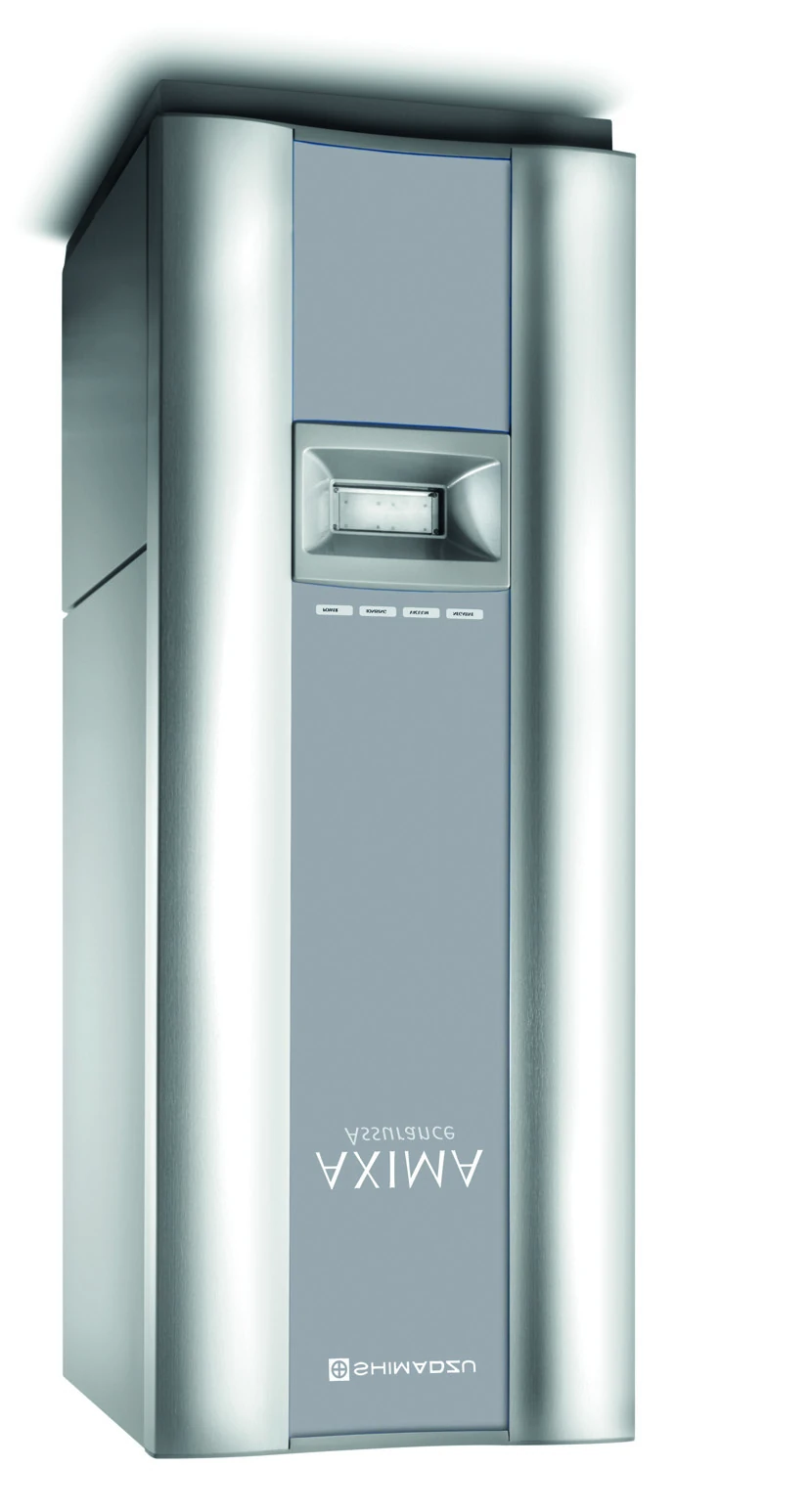
Shimadzu Axima Assurance
Shimadzu Axima Assurance — Mass spectrometers.
The AXIMA Assurance is a MALDI time-of-flight mass spectrometer with a 1.2 m linear flight tube, a fixed-focus 337 nm nitrogen laser (3 ns pulse, 100 µJ nominal, up to 50 Hz), and pulsed ion extraction up to +25 kV/-20 kV. It is distinguished within the AXIMA series by its 50 Hz laser and standard positive/negative ion operation with a patented beam blanker for low-mass ion removal. It serves intact biomolecule and polymer analysis across the 1–500 kDa range, typically in linear mode with >6000 FWHM resolution.
Direct drop-in replacements
Full specifications
| Detector types | Electron multiplier (multiple dynode) |
| Ion source | variable repetition rate 50Hz N2 laser |
| Operating system | Launchpad suite; Polymer Analysis |
| Resolution (linear mode, ACTH 18-39) mfr | >6000 FWHM (linear mode, ACTH 18-39) |
| Sample target formats mfr | 96 or 384 well microtitre plate; FlexiMass micro |
| Beam blanker mfr | patented, optionally removes unwanted low mass i |
| Ion optics (alt) mfr | near-axis laser irradiation and advanced ion opt |
| Extraction mfr | pulsed extraction |
| Operation (alt) mfr | manual or fully automated |
| Ionization source (alt) mfr | Matrix assisted laser desorption ionization |
| Laser wavelength (nitrogen laser, fixed focus) mfr | 337 nm (nitrogen laser, fixed focus) |
| Laser energy (nominal, per laser shot) mfr | 100 μJ (nominal, per laser shot) |
| Maximum pulse rate (50 laser shots per second) mfr | 50 Hz (50 laser shots per second) |
| Turbomolecular pump pumping speed (nominal, two pumps with rotary backing) mfr | 250 l/s (nominal, two pumps with rotary backing) |
| Transient recorder (16 bit accumulator) mfr | 2 GHz, 8 bit (16 bit accumulator) |
| Camera magnification (monochrome CCD camera) mfr | 25x (monochrome CCD camera) |
| Target thickness (plain, 96 and 384 sample targets) mfr | 2 mm (plain, 96 and 384 sample targets) |
| Maximum target thickness (with optional adaptor) mfr | 10 mm (with optional adaptor) |
| RAM (control PC) mfr | 16 GB (control PC) |
| HDD storage (control PC) mfr | 256 GB (control PC) |
| SSD storage (control PC) mfr | 1 TB (control PC) |
| Monitor size (control PC) mfr | 24 " (control PC) |
| Operating system (alt) mfr | Microsoft Windows 10 64-bit |
| Mass range | 1 - 500 kDa |
| Mass range (typical oligonucleotide spectrum) mfr | 2000-12000 m/z (typical oligonucleotide spectrum) |
| Laser pulse width mfr | 3 ns |
| Flight tube drift length (linear flight tube) mfr | 1.2 m (linear flight tube) |
| XY stage step (microtiter plate footprint MALDI target) mfr | 10 μm (microtiter plate footprint MALDI target) |
| XY stage repeatability (microtiter plate footprint MALDI target) mfr | 10 μm (microtiter plate footprint MALDI target) |
| Ion extraction energy (software controlled) mfr | up to +25 kV/-20 kV kV (software controlled) |
| Ion modes (standard) mfr | positive and negative (standard) |
| Ion polarity (standard, software selection) mfr | Positive and negative ion operation (standard, software selection) |
Description
Construction and positioning
- Linear TOF architecture with a 1.2 m drift tube, multiple-dynode electron multiplier detector, and two turbomolecular pumps (250 L/s nominal each) backed by rotary pumps.
- Near-axis laser irradiation and advanced ion optics; pulsed extraction is software-controlled up to +25 kV (positive) and -20 kV (negative).
- Sample handling supports 96- or 384-well microtitre plates and FlexiMass microscope slides (plain or 48-well); an optional adaptor raises maximum target thickness from 2 mm to 10 mm.
- A monochrome CCD camera with 25× magnification and a 10 µm-step XY stage (10 µm repeatability) enable automated target viewing and positioning.
Behavior under load and in different modes
- Standard positive and negative ion modes are software-selected; the patented beam blanker optionally removes unwanted low-mass ions.
- In linear mode, resolution exceeds 6000 FWHM (ACTH 18–39); typical oligonucleotide spectra span m/z 2000–12000, while the specified mass range covers 1–500 kDa.
- The 2 GHz, 8-bit transient recorder with 16-bit accumulator captures fast transient signals; the 50 Hz laser repetition rate supports rapid spectral accumulation.
Installation, connection and operation
- The system is controlled from a PC (16 GB RAM, 256 GB HDD, 1 TB SSD, 24-inch monitor) running the Launchpad suite and Polymer Analysis software.
- Operation can be manual or fully automated, with the XY stage and camera enabling automated plate/slide scanning.
- The vacuum system requires two turbomolecular pumps with rotary backing; target loading must respect the 2 mm standard thickness limit unless the optional adaptor is fitted.
Integration & Operating Notes
Standard plain, 96- and 384-well targets are 2 mm thick; thicker or unconventional targets require the optional adaptor, which raises the maximum to 10 mm. Exceeding the limit without the adaptor risks collision with the ion source and invalid results.
The fixed-focus nitrogen laser delivers a nominal 100 µJ per 3 ns pulse at 337 nm. Since laser energy is not user-variable, control of ion yield and fragmentation must be achieved through pulsed extraction settings, beam blanker use, and sample preparation.
Ion extraction energy (up to +25 kV/-20 kV) and polarity (positive/negative) are software-controlled. Ensure the control software sequences polarity and extraction voltage before laser firing to avoid discharging the source or damaging the detector.
Selection & Integration Q&A
Choose the Assurance for linear-mode intact biomolecule analysis (1–500 kDa) with standard positive/negative ion modes and a 50 Hz laser. Other AXIMA variants may offer reflectron or MS/MS capabilities; the Assurance is optimized for high-throughput linear work with the beam blanker for low-mass ion removal.
The instrument uses two turbomolecular pumps (250 L/s nominal each) with rotary backing pumps. Ensure the laboratory provides adequate exhaust and ventilation for the rotary pumps, and that the foreline plumbing meets the manual's specifications for conductance and pressure.
The manual specifies laboratory conditions (temperature and humidity) for stable operation. The 50 Hz laser can be fired continuously for rapid accumulation, but duty cycle may be limited by target heating and detector saturation; follow the manual's recommended acquisition parameters.
The base system includes the instrument, control PC, and standard targets. Optional adaptors for thick targets (up to 10 mm), additional FlexiMass slides, and consumables such as MALDI matrices and calibration standards are not included. Scheduled maintenance kits for the turbomolecular pumps are also separate.