
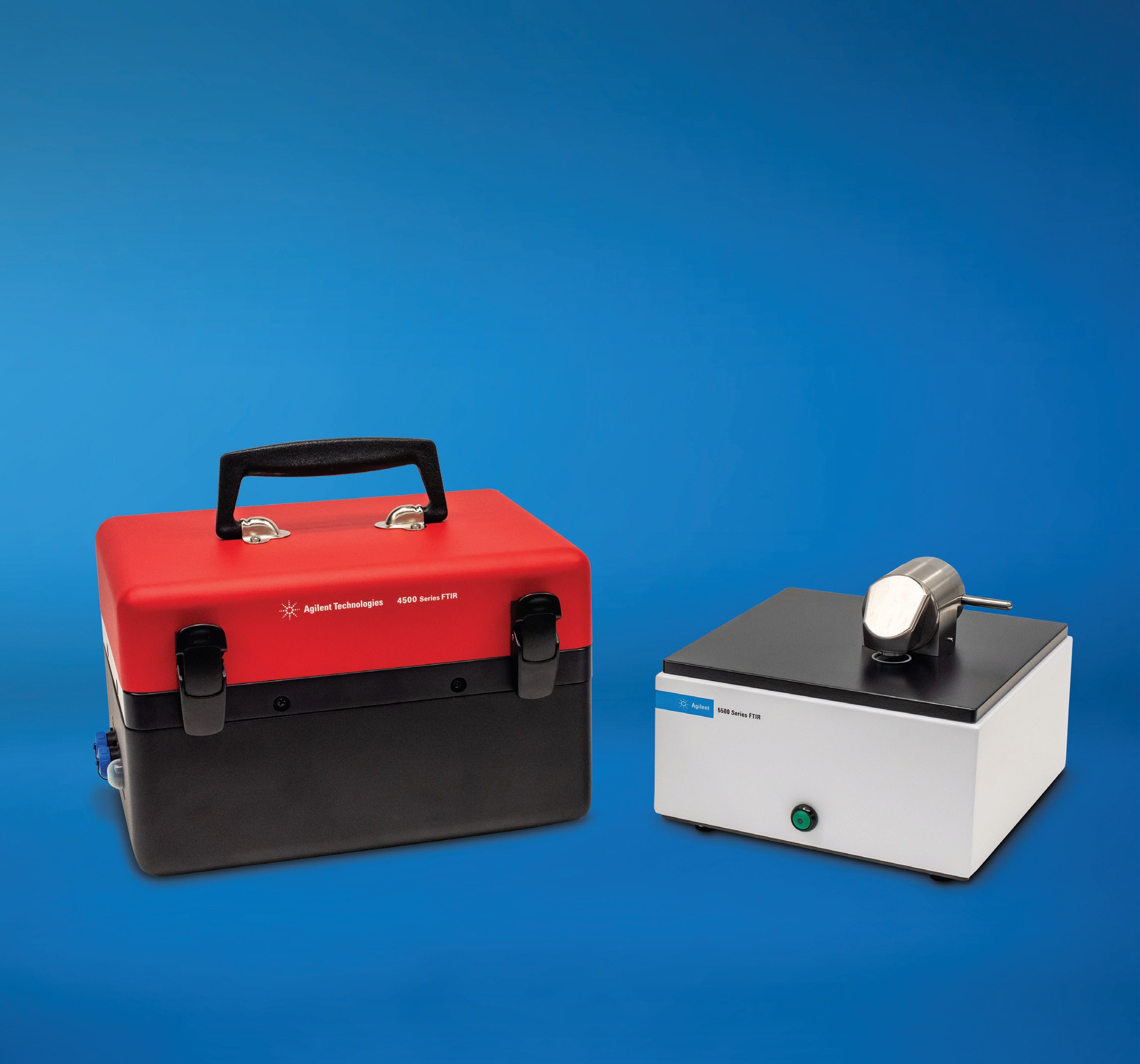
Agilent Technologies 4500 Portable FTIR Spectrometer, Rugged Non-Lab Analyzer
Agilent Technologies 4500 Portable FTIR Spectrometer, Rugged Non-Lab Analyzer — Molecular spectroscopy.
The Agilent 4500 is a rugged, portable FTIR spectrometer in an IP54 housing with an internal four-hour battery, designed for field analysis. It delivers results in under two minutes and connects via USB or Bluetooth. This modification is distinguished from the 5500 Series by its battery operation and sealed enclosure, making it suitable for on-site mid-IR measurements where lab access is limited.
Agilent Technologies FTIR Compact Portable Systems Series — Model Comparison & Selection
| Model | Wavelength range | Weight, kg | Analysis time, min | Dimensions, mm | Power supply | Protection rating |
|---|---|---|---|---|---|---|
| 4500 Portable FTIR Spectrometer, Rugged Non-Lab Analyzer Current | — | 3.6 | less than two minutes | 203 | battery or mains | 54 |
| 4200 FlexScan | 4000...650 | — | — | — | — | — |
| Compact FTIR Spectrometer, At-side FTIR Analyzer | — | 3.6 | less than two minutes | 203 | battery or mains | 54 |
| Handheld FTIR, Mobile Nondestructive Testing | — | 2.27 | — | — | — | — |
Full specifications
| Analysis time | less than two minutes |
| Dimensions | 20.3 cm |
| Computer connection mfr | USB or Bluetooth Bluetooth |
| Weight | 3.6 kg |
| Footprint mfr | 4 paper |
| Power supply | battery or mains |
| Battery operating time mfr | four-hour h h |
| Protection rating | 54 |
Description
Construction and positioning
- The 4500 is a mid-IR spectrometer built into a sealed IP54-rated housing, weighing 3.6 kg and measuring 20.3 cm in one dimension (footprint 4 paper units).
- It is the field-portable variant of the 4500/5500 series; the 5500 Series targets lab, QA/QC, and field use, while the 4500 is specifically ruggedized with an internal battery.
- Sibling models include the 4200 FlexScan, an at-side FTIR analyzer, and a handheld FTIR for mobile nondestructive testing; the 4500 occupies the portable, non-handheld segment.
Behavior and operation
- Analysis time is less than two minutes, enabling rapid on-site screening.
- Power is supplied by either battery or mains; the internal battery provides four hours of operating time, allowing untethered use.
- No spectral curve points or performance ranges are provided in the verified facts; refer to the instrument manual for detailed optical specifications.
Installation and control
- The instrument connects to a computer via USB or Bluetooth, supporting both wired and wireless control.
- The IP54 protection rating allows operation in dusty and splash-prone environments, but not immersion.
- The document digest for the 4500/5500 series manual contains no actionable engineering facts; consult the full manual for installation, connection, and control specifics.
Integration & Operating Notes
The instrument can run from mains or its internal battery, which lasts four hours. For extended field sessions, ensure access to mains power or spare battery capacity; battery recharge time and procedure are not specified in the verified facts and should be confirmed in the manual.
Data transfer and control are via USB or Bluetooth. Bluetooth pairing may require specific adapter or software configuration; verify compatibility with the host computer and software version before deployment.
The IP54 rating protects against dust and water splashes, making the instrument suitable for field use. However, it should not be submerged or exposed to heavy rain without additional protection. Mounting or placement should avoid excessive vibration and shock.
Selection & Integration Q&A
Choose the 4500 for field use where portability and battery operation are essential; it is rugged (IP54) and runs four hours on battery. The 5500 Series suits lab or QA/QC with mains power. The 4200 FlexScan is an at-side analyzer for fixed installations, not handheld.
The 4500 connects via USB or Bluetooth. For USB, a standard USB cable and compatible driver are required. For Bluetooth, the host computer must support Bluetooth and be paired with the instrument. Ensure the control software is installed and licensed.
The IP54 housing allows operation in dusty and splash-prone environments but not immersion. Operating temperature and humidity limits are not specified in the verified facts; consult the manual. The four-hour battery limits continuous field use; plan for recharging or mains access.
Maintenance schedule and consumables (e.g., desiccant, calibration standards) are not detailed in the verified facts. The base delivery includes the instrument and battery; USB cable, Bluetooth adapter, and software may be optional. Refer to the manual for service intervals.