
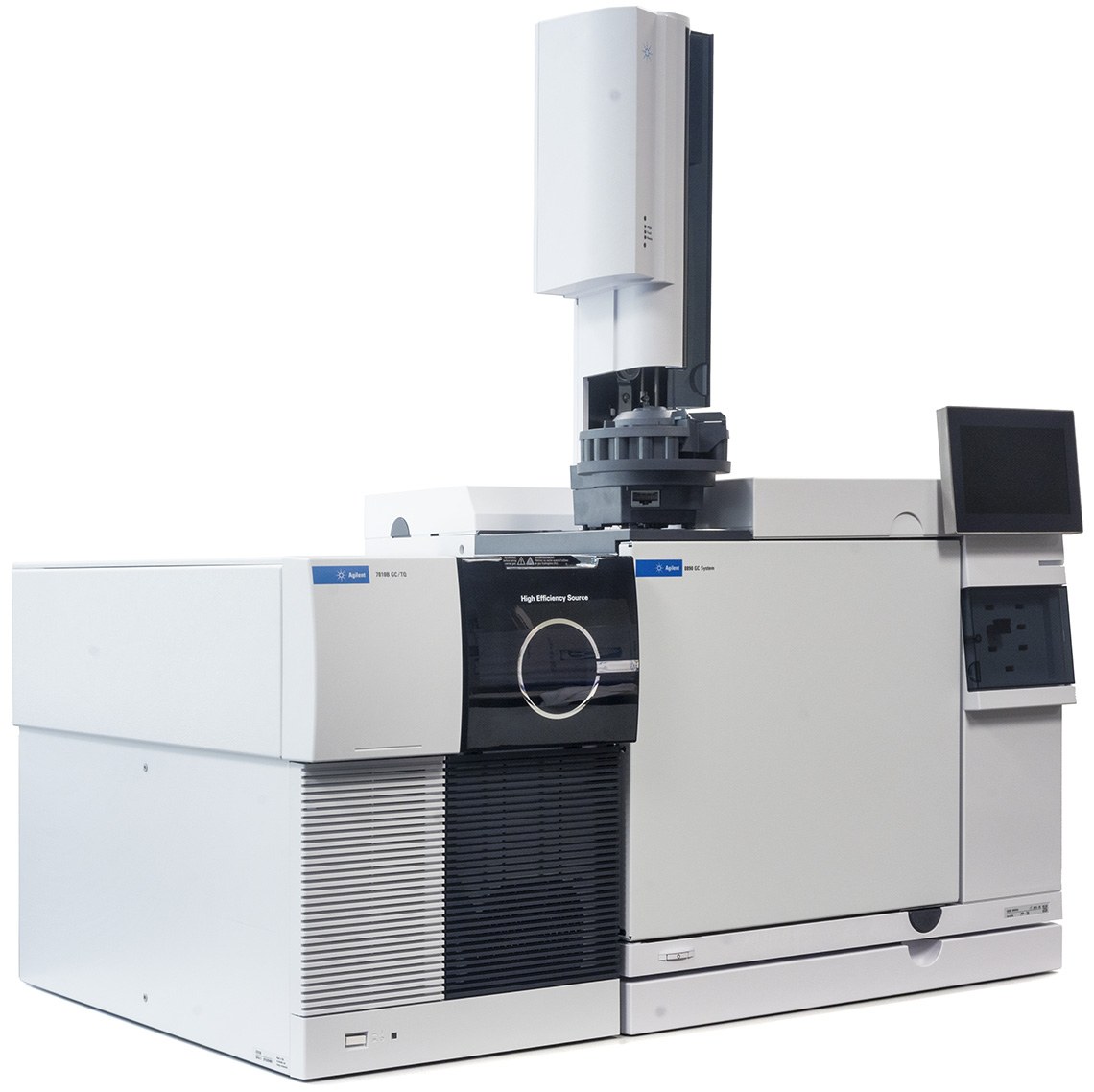
Agilent Technologies 7010D GCMS
Agilent Technologies 7010D GCMS — Gas chromatography mass spectrometry gc ms.
The Agilent 7010D is a triple quadrupole GC/MS system built around an 8890 GC and a HydroInert EI source, with two independently heated hyperbolic quadrupoles and a hexapole collision cell. It targets femtogram-level MRM quantitation in complex matrices, distinguishing it from the single-quadrupole 5977C and the 7000E triple quad.
Agilent Technologies GC MS Instruments Series — Model Comparison & Selection
| Model | Pumping speed, m³/h | Carrier gas | Transfer line temperature, °C | Sample volume, milliliter | Ion source temperature, °C | Analysis time, min |
|---|---|---|---|---|---|---|
| 7010D GCMS Current | — | Helium | 300 | 0.002 | 280 | — |
| 5977C GC/MSD | 1 | Hydrogen | 230 | 3×10⁻⁴ | 230 | 7.5 |
| 7000E GC/TQ | 6×10⁻⁵ | Helium | 300 | 0.002 | 280 | 10 |
| Quadrupole Time-of-Flight GC/MS, Mass Screening GC/Q-TOF | — | 1.5 | 280 | — | — | — |
Full specifications
| Carrier gas | Helium |
| Centrifugation Speed | 5000 rpm |
| Collision Gas (nitrogen) | 1.5 mL/min |
| Column Flow | 1.2 mL/min |
| Electron Energy | 70 eV |
| Ion source | HydroInert source |
| Purge Flow To Split Vent | 50 mL/min |
| Quench Gas (helium) | 2.25 mL/min |
| Sample volume | 1.5 µL |
| Switching Time | 4.9 min |
| GC system mfr | 8890 autosampler |
| SPME fiber type mfr | PDMS PDMS |
| Inlet mfr | S/SL inlet inlet |
| Backflush time mfr | 4 min |
| Ionization mode mfr | EI EI |
| Carrier gas and flow rate mfr | 1 flow |
| Tune mfr | Etune: atunes.eiex.tune.xml s.eiex.tune.xml |
| Cleaning interval mfr | 350...400 injections |
| Analytical column mfr | Agilent J&W DB-VRX VRX |
| Injection mode mfr | Pulsed split split |
| Injection program mfr | 90 min |
| Oven program mfr | 40 min |
| MRM transition EtO mfr | 44 |
| Calibration standards mfr | 2.0 |
| Software revision applicability mfr | 03.00 higher |
| Sensitivity specification mfr | femtogram to sub-femtogram levels levels |
| Ion source to quadrupole region pressure (single quadrupole reference) mfr | 10...20 Torr |
| Atmospheric pressure reference mfr | 760 Torr |
| OFN MRM demonstration mfr | 100 fg |
| PCB congener injection amount mfr | 400 column |
| HCB in diesel fuel S/N mfr | 86 |
| PCB congeners in mussel extract mfr | 2 column |
| Cyanophos in garlic spike level mfr | 0.5 ppb |
| MRM precursor selection example mfr | 210 m/z |
| autotune time mfr | 8 minutes |
| single quadrupole inter-quadrupole pressure mfr | 10...20 Torr |
| atmospheric pressure mfr | 760 Torr |
| Mass spectrometer mfr | 7010 system |
| Ion Source Temperature | 280 °C |
| Ms Quadrupole Temperature | 150 °C |
| Transfer Line Temperature | 300 °C |
| MRM transition 2-CE mfr | 80 |
| Stock standard concentration (EtO and 2-CE) mfr | 1 mg/mL |
| Working standard concentration (EtO and 2-CE) mfr | 10 μg/ml |
Description
Construction and series positioning
- The 7010D pairs an Agilent 8890 GC with a triple quadrupole mass spectrometer: a HydroInert EI source, two independently MS-heated hyperbolic gold-plated quartz quadrupoles, a single hexapole collision cell, and a high-energy dynode (HED) off-axis detector.
- Within the series, the 5977C is a single-quadrupole MSD for routine SIM/scan work; the 7000E is the other triple quad; the Q-TOF covers 50–950 m/z for accurate-mass screening. The 7010D is the high-sensitivity MRM quantitation member, specified at femtogram to sub-femtogram levels depending on compound.
- Vacuum is maintained by a split-flow turbomolecular pump backed by a rotary vane or optional dry scroll foreline pump.
Behavior under load and in different modes
- The most sensitive mode is SRM/MRM: Q1 is fixed to a precursor, the hexapole fragments it with nitrogen and helium, and Q3 is fixed to a product ion. Full-scan and SIM modes are available but carry lower duty cycle per m/z.
- The collision cell uses linear axial acceleration across six resistively coated rods, which suppresses crosstalk even at very low dwell times, so fast MRM lists can be run without carryover between transitions.
- The HED detector's off-axis geometry pulls ions away from neutrals, and gain-normalized tuning keeps response consistent as the multiplier ages.
- The EI source has dual filaments that can be tuned separately, so analysis continues on the second filament while the first is cleaned or replaced.
Installation, connection and control
- The MS is compatible with Agilent 8890, 9000 and 7890 GCs; the 7010D configuration here uses the 8890 with an S/SL inlet and a DB-VRX column.
- Both nitrogen and helium must be supplied to the collision cell; helium acts as quench gas.
- MassHunter Workstation Instrument Control (B.03.00 or higher) downloads settings to GC and MS from one window, runs Autotune with report printing, and supports time-segmented scan types.
- Backflush on the Agilent GC removes late eluters, reducing column bleed and ghost peaks reaching the MS.
Integration & Operating Notes
The hexapole collision cell is filled with a nitrogen/helium mixture, with helium as quench gas. Installation must provide both gases at controlled flows; losing either degrades fragmentation and neutral-noise suppression, so gas supply and purity should be treated as a hard prerequisite, not an accessory.
EI sources carry two independently tunable filaments. When one filament's tune degrades, select the other filament in the method and continue running; clean or replace the idle filament offline. This avoids a full source vent and recalibration cycle for a single filament failure.
Instrument Control software (B.03.00 or higher) pushes GC and MS parameters together and supports time-segmented scan types, so scan mode and MRM transitions can change mid-run. Method validation should confirm that each time segment's parameters are accepted before acquisition starts.
A rotary vane or optional dry scroll foreline pump can be fitted. The choice affects oil handling, maintenance intervals and lab housekeeping; it should be decided before installation because the pump and its exhaust routing are fixed at commissioning.
Selection & Integration Q&A
Pick the 7010D when quantitation must reach femtogram to sub-femtogram levels by MRM in complex matrices. The 5977C single quad suits routine SIM/scan work without MS/MS; the 7000E is the other triple quad in the series. The Q-TOF is for accurate-mass screening over 50–950 m/z, not targeted MRM.
The collision cell needs both nitrogen and helium, with helium as quench gas. The MS must be paired with an Agilent 8890, 9000 or 7890 GC; this configuration uses an 8890 with an S/SL inlet and a DB-VRX column. Backflush on the GC is recommended to keep late eluters off the column.
Collision gases (nitrogen and helium), foreline pump oil for the rotary vane option, replacement filaments, and the DB-VRX column are supplied separately. Filament cleaning or replacement is scheduled by tune performance, and gain-normalized tuning should be run to track multiplier aging.