BINDER VDL 23
BINDER VDL 23 — Drying ovens with Temperature 9…110 °C.
The BINDER VDL 23 is a 24-litre vacuum drying chamber built for drying flammable solvents under vacuum, with an ATEX EX II 2/3/- G IIB T3 Gb/Gc/- X classification. Its 9–110 °C working range and 0.1 K fluctuation distinguish it as the smallest chamber in the VDL series, suited to small-batch solvent removal where space and solvent volume are limited.
BINDER VDL Series — Model Comparison & Selection
Full specifications
| Temperature | 9...110 °C |
| Heating time to 100°C | 110 min |
| Interior volume | 24 L (VDL 23) |
| Leak rate | 0.01 bar/h |
| Load per rack | 20 kg (VDL 23) |
| Nominal power | 0.9 kW |
| Permitted load | 50 kg (VDL 23) |
| Pressure fluctuation over time | 1 mbar |
| Temperature fluctuation | 0.1 K |
| Temperature uniformity | 1.0 K |
| Rear wall clearance | 100 mm (VDL 23) |
| Side wall clearance | 70 mm (VDL 23) |
| Article Number mfr | 9630 |
| Pressure fluctuation over time at 400 mbar mfr | 70 mbar |
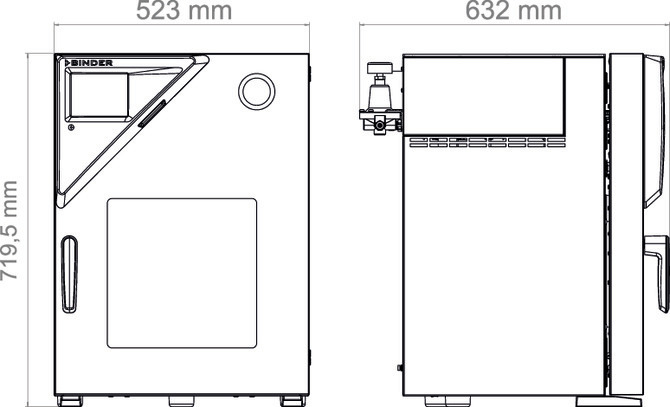
| Depth | 413 mm (VDL 23) |
| Height | 698 mm (VDL 23) |
| Width | 523 mm (VDL 23) |
| Power frequency | 50 Hz |
| Rated voltage | 200...230 V |
| Unit fuse | 6.3 A |
| Phase (Nominal voltage) mfr | 1 |
| Vacuum connection with small flange mfr | 16 mm |
Description
Construction and series positioning
- The VDL 23 is the smallest of three VDL vacuum drying chambers (24 L interior; siblings VDL 56 and VDL 115 share the same 9–110 °C range).
- It is a vacuum-tight chamber with a 16 mm small-flange vacuum connection and a leak rate of 0.01 bar/h, intended for operation with an ATEX-compliant vacuum pump drawing from Zone 0 or 1.
- The chamber is not rated for installation in Zone 0 or Zone 1; it must sit in a non-hazardous or appropriately classified area per the site explosion protection document.
- Two voltage variants exist: 200–230 V 1~ 50/60 Hz with CEE 7/7 plug (Art. 9630-0009) and 100–120 V 1~ 50/60 Hz with NEMA 5-15 plug (Art. 9630-0013).
Behaviour under load and process conditions
- Heating to 100 °C takes 110 min; temperature uniformity is 1.0 K and fluctuation 0.1 K across the 9–110 °C range.
- The heater is interlocked: no heating occurs until the chamber pressure falls below 100 mbar, so evacuation must precede any temperature ramp.
- Pressure stability is specified as 1 mbar fluctuation over time and 70 mbar at 400 mbar, relevant when holding a vacuum setpoint during solvent drying.
- Maximum load is 50 kg total, with 20 kg per rack; the chamber is not intended for dense, high-thermal-mass loads that would exceed the heating-up time budget.
Installation, control and operation
- The MB2 microprocessor program controller provides setpoint entry, timer and week programs, ramp/step modes, alarm and tolerance settings, and Ethernet/USB data interfaces.
- Compressed air flushing for the electrical equipment area requires a regulated 2 bar inlet; technical ventilation must cover both the chamber and the vacuum pump installation area before commissioning.
- Wall clearances are 100 mm at the rear and 70 mm at the sides; equipotential bonding must follow the grounding concept.
- Explosion protection testing is mandatory before initial commissioning and before restart after maintenance or repair.
Integration & Operating Notes
The controller will not release the heater until the pressure threshold of 100 mbar is reached. If a process recipe calls for heating at higher pressure, the chamber will not follow the temperature setpoint; evacuate first, then ramp temperature.
The VDL 23 is classified EX II 2/3/- G IIB T3 Gb/Gc/- X and is not permitted in potentially explosive areas of Zone 1 or Zone 0. Site it in a non-hazardous area or one classified for the chamber's equipment group and category.
The compressed air supply for flushing the electrical equipment area must deliver 2 bar at the chamber inlet. Undersized or unregulated supply will impair flushing and the associated explosion protection measure.
Only a vacuum pump compliant with Directive 2014/34/EU and suitable for suction from Zone 0 or Zone 1 may be connected. The VP5 EX accessory is limited to a 40 °C maximum gas inlet temperature; confirm the pump's temperature class against the solvent.
The VDL 23 exists as a 200–230 V 1~ 50/60 Hz unit (Art. 9630-0009, CEE 7/7) and a 100–120 V 1~ 50/60 Hz unit (Art. 9630-0013, NEMA 5-15). The unit fuse is 6.3 A; connecting the wrong variant will prevent operation and may damage the controller.
If the inner chamber temperature reaches the safety controller value, the controller raises a 'Safety controller' alarm. Check that the safety controller value is set above the process setpoint with adequate margin; the TL class 2 limiter separately cuts the heater on overtemperature.
If the chamber does not heat, verify door closure and gasket condition, check the 6.3 A unit fuse, and confirm the supply voltage matches the variant. Defective Pt 100 sensor, heating element or semiconductor relay require BINDER service; do not attempt repair.
Selection & Integration Q&A
Pick the VDL 23 for small solvent batches that fit a 24 L interior and stay within 50 kg total load (20 kg per rack). The VDL 56 and VDL 115 share the same 9–110 °C range but offer larger interiors; choose them when batch size or rack count exceeds the VDL 23's capacity.
The pump must be ATEX Directive 2014/34/EU compliant and suitable for suction from Zone 0 or Zone 1; the VP5 EX accessory is limited to 40 °C gas inlet. Compressed air flushing needs a regulated 2 bar inlet at the chamber. The vacuum port is a 16 mm small flange.
Install only outside Zone 0 or Zone 1, with 100 mm rear and 70 mm side clearance. Technical ventilation must cover both the chamber and the vacuum pump area and be running before commissioning. Equipotential bonding per the grounding concept is required.
Plan annual electrical testing (EN 50678/VDE 0701, EN 50699/VDE 0702) and explosion protection tests before commissioning and after repairs. The base delivery excludes the vacuum pump, pump module, connection kits, APT-COM 4 software, analog outputs and flexible Pt 100 sensor; order these separately as needed.