
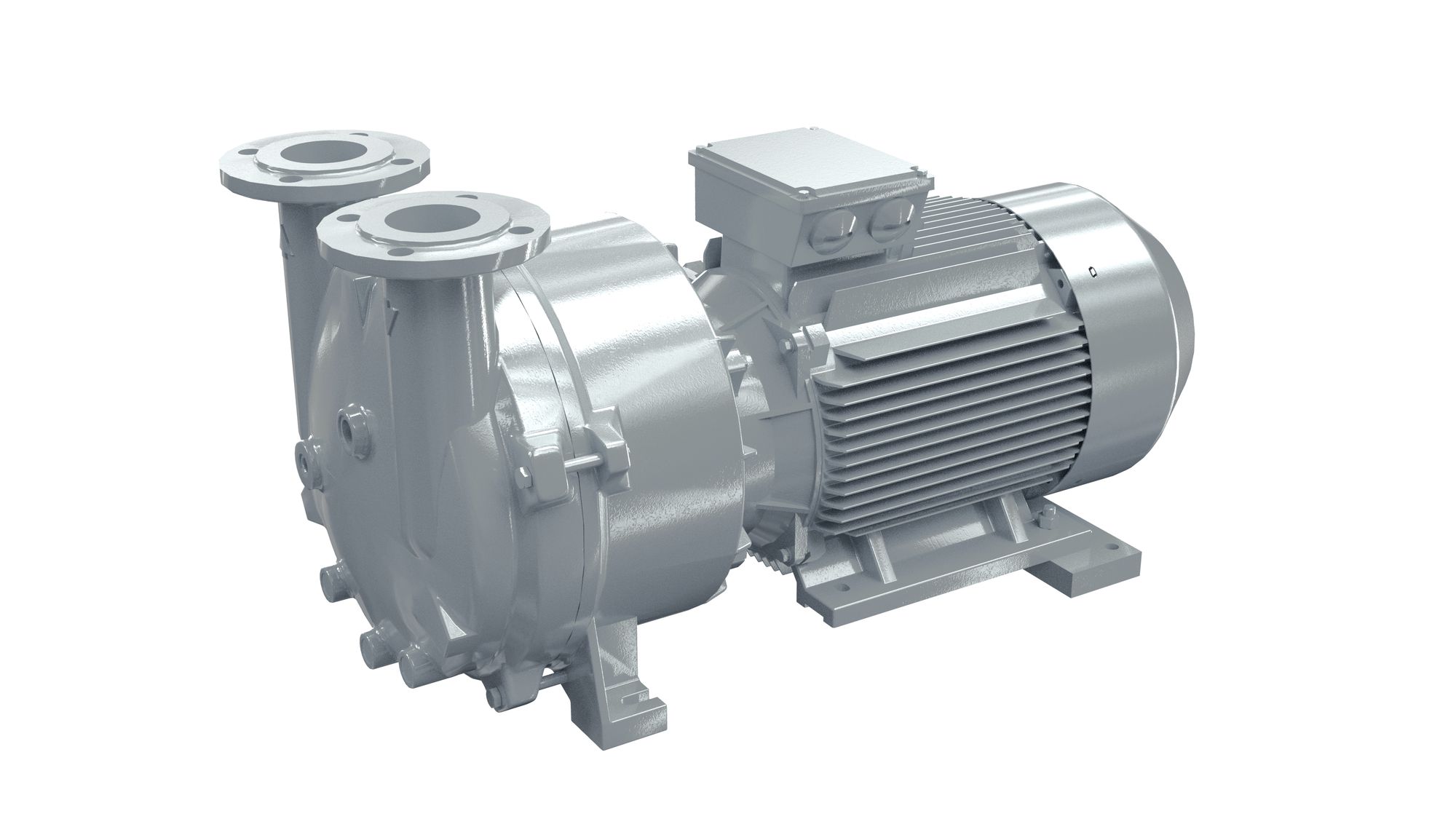
Elmo Rietschle L-2BV 7060
Elmo Rietschle L-2BV 7060 — Liquid Ring Vacuum Pumps with Max inlet pressure 200 kPa.
The L-2BV 7060 is a liquid-ring vacuum pump/compressor with an eccentrically arranged impeller in a cylindrical housing, using an operating liquid to form a rotating ring. As the mid-size 2BV7060 variant, it handles inlet pressures up to 1.3 bar abs. (vacuum) or 2.0/2.4 bar abs. (compressor, 50/60 Hz), distinguishing it from smaller 2BV3151 siblings. It serves as a robust vacuum source or low-pressure compressor in systems where the pumped gas may contain vapor or particles.
Elmo Rietschle L-2BV Series — Model Comparison & Selection
| Model | Max inlet pressure, kPa | Operating principle | Weight, kg | Noise level, dB | Operating temperature, °C | Pumping speed, m³/h |
|---|---|---|---|---|---|---|
| L-2BV 7060 Current | 130 | liquid-ring | 25 | 70 | 80 | — |
| 2BV3151 | — | Liquid ring vacuum pump | 9 | 70 | — | — |
| L-2BV 3151 | 3.3 | — | 9 | 70 | 110 | 39 |
Full specifications
| Max inlet pressure | 1.3 bar 50 Hz: 2 bar · 60 Hz: 2.4 bar |
| Operating principle | liquid-ring |
| Minimum distance from fan guard to adjacent surface mfr | 1.34 in |
| Max. discharge pressure during vacuum-pump operation (alt var) mfr | 18.8 psi |
| Max. permissible pressure in pump-motor unit (alt var) mfr | 116 psi |
| Max. discharge pressure p2 max during compressor operation (alt 50 Hz) mfr | 29.0 psi (50 Hz) |
| Max. discharge pressure p2 max during compressor operation (alt 60 Hz) mfr | 34.8 psi (60 Hz) |
| Weight | 20 kg (2BV7060-2) 2BV7060-3: 25 kg |
| Weight 2BV7060-2 (alt 2BV7060-2) mfr | 44 lb (2BV7060-2) |
| Weight 2BV7060-3 (alt 2BV7060-3) mfr | 55 lb (2BV7060-3) |
| Noise level | 70 dB (50 Hz) 60 Hz: 70 dB |
| Operating temperature | 80 °C |
| Ambient temperature limit | 40 °C |
Description
Construction and series positioning
- The L-2BV 7060 belongs to the L-BV7N series (types 2BV7060, 2BV7061, 2BV7070, 2BV7071). Within this series, the 2BV7060 is the mid-range model: its compressor discharge limit (2.0 bar abs. at 50 Hz, 2.4 bar abs. at 60 Hz) sits between the 2BV7061 (1.9 bar abs.) and the larger 2BV7070/7071 (up to 3.5 bar abs.).
- Two weight variants exist: 2BV7060-2 (20 kg) and 2BV7060-3 (25 kg). The -2 and -3 suffixes denote different motor or material configurations; the operating instructions list both for this model.
- The liquid-ring principle uses an eccentrically mounted impeller; the operating liquid (typically water) is thrown outward to form a rotating ring, creating sealed cells that draw in, compress and discharge gas through fixed inlet and discharge ports.
Behavior under load and in different modes
- In vacuum-pump operation, maximum discharge pressure is 1.3 bar abs. (18.8 psia). The maximum permissible pressure anywhere in the pump-motor unit is 8 bar abs. (116 psia); higher system pressures require protective devices.
- In compressor operation at inlet pressure p1 = 1 bar abs., maximum discharge pressure is 2.0 bar abs. at 50 Hz and 2.4 bar abs. at 60 Hz. These limits are type- and frequency-dependent and must not be exceeded.
- The unit can run self-priming or with operating-liquid feed. Self-priming requires a vacuum of at least 900 mbar abs. in the inlet pipe at switch-on and a liquid level in the feed pipe/reservoir at the same height as the shaft center. During self-priming, the reservoir level may not drop more than about 1 m below the shaft center.
- With operating-liquid feed, the pre-pressure in the feed pipe must be set about 1 bar above the inlet pressure. Nominal operating-liquid flow rate for the 2BV7060 is 0.20 m³/h (dry air, water at 15 °C).
- Operating-liquid temperature limits: +5 °C min., +15 °C nominal, +80 °C max. Pumped gas/vapor temperature max. +80 °C. Ambient temperature +5 °C to +40 °C.
Installation, connection and operation
- The pump-motor unit must be mounted on a stable surface able to carry its weight and absorb vibration; total vibration velocity must not exceed 4.5 mm/s. The fan guard requires a minimum clearance of 34 mm to adjacent surfaces for heat dissipation.
- Feet are bolted with 4 × M8-6.8 fasteners. Pipe connections on intake and discharge must not be tightened beyond 100 Nm.
- Electrical connection is made in the terminal box; terminal screws must be tightened to 0.8–1.2 Nm (M4) or 1.8–2.5 Nm (M5), and a minimum clearance of 5.5 mm between bare live parts and to ground must be maintained. Supply voltage and frequency may deviate by ±5 % and ±2 % respectively without performance loss.
- Before commissioning, the working space is primed with 0.40 l of operating liquid. Direction of rotation must be checked at start-up. Installation height is limited to 1000 m above sea level; higher altitudes require consultation.
Integration & Operating Notes
In vacuum-pump operation the maximum discharge pressure is 1.3 bar abs. (18.8 psia). If the downstream system can generate higher back-pressure, install a relief device or interlock to prevent exceeding this limit, which could overload the pump and damage the liquid-ring assembly.
The maximum permissible pressure in the pump-motor unit is 8 bar abs. (116 psia). System designs that could subject the pump to higher pressures—for example, blocked discharge or external pressure sources—must include protective devices such as relief valves or pressure switches to avoid mechanical failure.
For self-priming operation, the inlet pipe must be evacuated to at least 900 mbar abs. before start-up, and the liquid level in the feed pipe or reservoir must be at the same height as the shaft center. During operation the reservoir level may not drop more than about 1 m below the shaft center; otherwise the liquid ring collapses and the pump loses suction.
When running with operating-liquid feed, set the pre-pressure in the feed pipe to approximately 1 bar above the inlet pressure. This ensures a stable liquid ring and prevents either flooding or starvation of the working space. Use the nominal flow rate of 0.20 m³/h for the 2BV7060 as a baseline for sizing the feed circuit.
In the terminal box, bare live parts must have at least 5.5 mm clearance to each other and to ground. Tighten M4 terminals to 0.8–1.2 Nm and M5 terminals to 1.8–2.5 Nm. Loose strands or insufficient clearance can lead to arcing or short circuits, especially under vibration.
The motor can tolerate supply deviations of ±5 % voltage and ±2 % frequency without a reduction in performance. Outside these limits, consult the factory; operation may lead to overheating or reduced starting torque.
When connecting intake and discharge pipes, the tightening torque must not exceed 100 Nm (73.8 ft lbs). Over-tightening can crack the pump casing or distort the ports, leading to leaks and misalignment. Use appropriate sealing methods and support the piping independently.
Before commissioning, fill the working space with 0.40 l of operating liquid (water or specified medium). This initial charge is essential to establish the liquid ring and avoid dry running, which can damage the impeller and casing. Check the direction of rotation immediately after start-up.
Selection & Integration Q&A
Choose the 2BV7060 when your vacuum duty requires inlet pressures up to 1.3 bar abs. and compressor duty up to 2.4 bar abs. at 60 Hz. The 2BV3151 is smaller and limited to lower pumping speeds, while the 2BV7070 offers higher discharge pressures (up to 3.5 bar abs.) but is physically larger and heavier. The 7060 balances capacity and footprint for mid-range applications.
Provide an operating-liquid feed with a pre-pressure approximately 1 bar above the inlet pressure. The nominal flow rate for the 2BV7060 is 0.20 m³/h with water at 15 °C. Ensure the liquid temperature stays between +5 °C and +80 °C (nominal +15 °C). For self-priming mode, the feed pipe or reservoir must maintain a liquid level at the shaft center at start-up and not drop more than 1 m below during operation.
The base delivery does not include operating liquid, piping, or electrical cables. Before first start, prime with 0.40 l of operating liquid. Regularly check the liquid ring and bearings; the manual provides a fault table for troubleshooting. No specific maintenance intervals are given in the digest, but vibration and temperature monitoring are recommended. Refer to the operating instructions for detailed service procedures.