
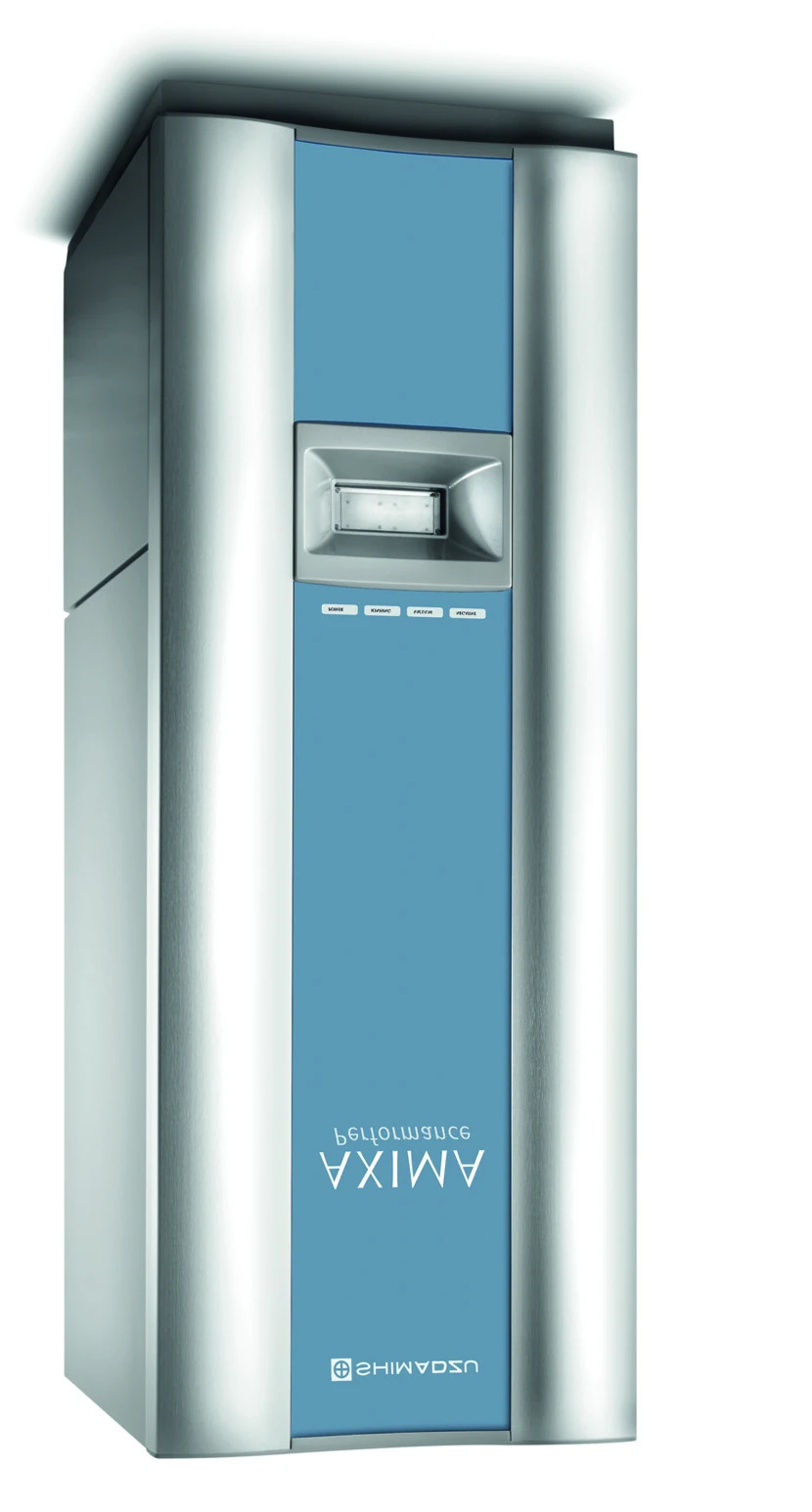
Shimadzu Axima Performance
Shimadzu Axima Performance — Mass spectrometers.
The AXIMA Performance is a MALDI-TOF-TOF mass spectrometer with near-axis laser irradiation and a monoPULSE™ ion gate for precursor selection, operating in reflectron mode for MS and high-energy CID at 20 keV for MS/MS. It supports manual or fully automated operation, distinguishing it within the series by its tandem capability and variable repetition rate laser. It is used for detailed structural characterization of biomolecules and synthetic polymers in analytical laboratories.
Direct drop-in replacements
Full specifications
| Type | MALDI-TOF-TOF |
| Ion source | Near-axis laser irradiation |
| Operating system | Manual or fully automated |
| Collision energy (laboratory frame) (CID) mfr | 20 keV (CID) |
| Laser mfr | Variable repetition rate |
| MS mode mfr | Reflectron mode |
| Precursor ion selection mfr | monoPULSETM ion gate |
Description
Construction and Architecture
The AXIMA Performance is a tandem time-of-flight (TOF-TOF) mass spectrometer configured for matrix-assisted laser desorption/ionization (MALDI). It employs near-axis laser irradiation and a variable repetition rate laser for sample ionization. The instrument operates in reflectron mode for MS analysis, providing high resolution and mass accuracy. For MS/MS experiments, a monoPULSE™ ion gate selects precursor ions, which are then fragmented in a collision cell at 20 keV collision energy (laboratory frame) using high-energy CID. The system can be operated manually or fully automated, with software options including Intellimarque™ and LC-MALDI, and optional Mascot® database searching.
Behavior and Modes
The AXIMA Performance distinguishes itself within the series by its TOF-TOF configuration, enabling both MS and MS/MS analyses. In MS mode, the reflectron geometry enhances resolution. In MS/MS mode, the monoPULSE™ ion gate provides precise precursor selection, and the 20 keV CID energy facilitates extensive fragmentation for structural elucidation. The variable repetition rate laser allows optimization of acquisition speed and signal intensity. The system supports automated operation for high-throughput workflows, while manual control offers flexibility for method development.
Installation and Operation
Installation requires a suitable laboratory environment with stable power and climate control. The instrument is controlled via software that integrates with the automation features. Connection to LC systems is possible via the LC-MALDI option. The PDF digest does not provide specific installation, connection, or control details beyond the manual/automated operation and software options.
Integration & Operating Notes
Collision-induced dissociation is performed at 20 keV (laboratory frame). This high energy yields extensive fragmentation, suitable for de novo sequencing and structural analysis. Ensure that the collision cell and detector can handle the resulting fragment ion currents.
Selection & Integration Q&A
Choose the AXIMA Performance when MS/MS capability with high-energy CID (20 keV) and precursor selection via monoPULSE™ ion gate are needed for structural characterization. For routine MS only, a single-stage TOF may suffice.
Integration with LC requires the LC-MALDI software option, which enables automated spotter operation. Ensure the LC system's flow rate and solvent compatibility match the MALDI matrix deposition requirements.
Dimensional Drawings & Technical Documentation
Dimensional drawings
Click drawing to inspect vector dimensions