
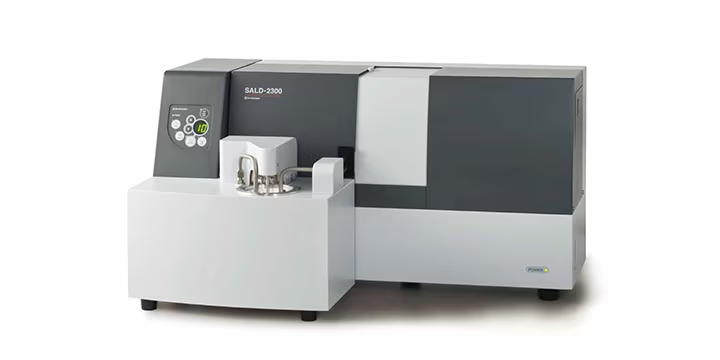
Shimadzu SALD-2300
Shimadzu SALD-2300 — Particle size analyzers.
The Sald 2300 is a laser diffraction particle size analyzer from Shimadzu, configured for measurement ranges from 17 nm to 2500 μm depending on the optical system in use. It is distinguished within the SALD series by its multiple selectable ranges, enabling sub‑micron to millimeter particle characterization. It serves as a core instrument for particle size distribution analysis in quality control and research laboratories.
Direct drop-in replacements
Full specifications
Description
Construction and positioning
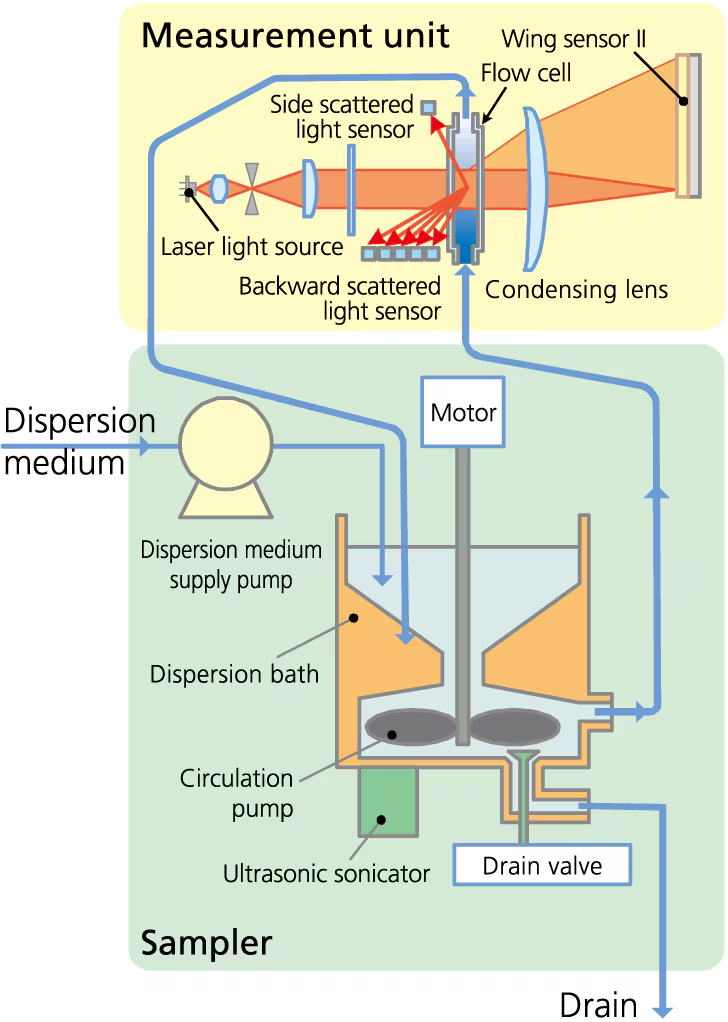
The Sald 2300 employs the laser diffraction method, where particle size is derived from the angular intensity of scattered light. The instrument supports four distinct measurement ranges: 17 nm–2500 μm, 17 nm–400 μm, 30 nm–280 μm, and 300 nm–2500 μm. These ranges correspond to different optical configurations or measurement modes, allowing the user to select the appropriate range for the sample at hand. ### Behavior under load and media
No curve points or dynamic behavior data are available. Therefore, details on electrical supply, interfaces, control software, and installation requirements cannot be included. The instrument is intended for laboratory use, and typical integration would involve a PC for data acquisition and analysis, but this is not confirmed by the provided facts.
Integration & Operating Notes
The instrument offers four distinct ranges; using a range outside the sample's expected size distribution may lead to inaccurate results or detector saturation. Ensure the chosen range covers the full particle size span of the sample, and verify that the dispersion method is compatible with the selected optics.
Laser diffraction instruments require clean optical surfaces to maintain signal integrity. Establish a cleaning interval based on sample throughput and material characteristics.
Selection & Integration Q&A
The Sald 2300 is suitable when your samples span from sub‑20 nm to 2.5 mm and you require the flexibility of multiple selectable ranges. Without sibling data, compare specific range needs and optical configurations with other models.
The base delivery typically includes the analyzer and basic software, but consumables like sample cells, dispersion fluids, and calibration standards are usually separate. A maintenance kit and replacement optical components may be needed; consult the accessory list.
Dimensional Drawings & Technical Documentation
Dimensional drawings
Click drawing to inspect vector dimensions