
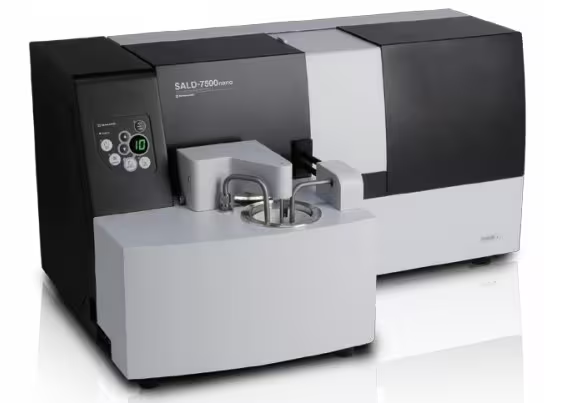
Shimadzu SALD-7500nano
Shimadzu SALD-7500nano — Particle size analyzers.
The SALD-7500nano is a nanoparticle size analyzer from Shimadzu that uses dynamic light scattering (DLS) to measure particle size distributions in the submicron range. It is positioned as a high-sensitivity instrument for dilute suspensions and emulsions. Its primary purpose is to provide rapid, reproducible size analysis for quality control and research in materials, pharmaceuticals, and chemicals.
Direct drop-in replacements
Full specifications
| Measurement range mfr | 7 nm to 800 μm nm to μm (SALD-7500nano) |
| Measurable concentration range mfr | 0.1 ppm to 20 % (SALD-7500nano) |
| Forward-scattered light capture angle (SLIT optical system) mfr | up to 60 ° (SLIT optical system) |
| Wing sensor II elements (forward diffracted/scattered light) mfr | 78 elements (forward diffracted/scattered light) |
| Side scattered light sensor elements mfr | 1 element (SALD-7500nano) |
| Back scattered light sensor elements mfr | 5 elements (SALD-7500nano) |
| Total sensor elements mfr | 84 elements (SALD-7500nano) |
| Light source mfr | semiconductor laser (SALD-7500nano) |
| Glass sample plate thickness mfr | 0.3 mm (P/N 346-62295-03) |
| Glass sample plate thickness mfr | 0.5 mm (P/N 346-62295-05) |
| Glass sample plate thickness mfr | 0.05 mm (P/N 346-62295-06) |
| Sample volume mfr | 0.09 cm3 (P/N 346-62295-03) |
| Sample volume mfr | 0.15 cm3 (P/N 346-62295-05) |
| Sample volume mfr | 0.015 cm3 (P/N 346-62295-06) |
| Particle concentration (glass sample plate) mfr | A few hundred ppm (glass sample plate) |
| Note2 mfr | Only applicable for liquid pump. Not applicable |
| Note3 mfr | Ultrasonic cleaning instruments are needed for t |
| Installation space width (measurement unit SALD-7500nano) mfr | 820 or more mm (measurement unit SALD-7500nano) |
| Installation space depth (measurement unit SALD-7500nano) mfr | about 400 mm (measurement unit SALD-7500nano) |
| Minimum serial measurement time mfr | 1 s (SALD-7500nano) |
Description
Construction and positioning
The SALD-7500nano is a benchtop DLS-based particle size analyzer. Unlike laser diffraction models in the SALD series, it employs a solid-state laser and avalanche photodiode detector to capture fluctuations in scattered light intensity. This configuration enables measurement of particles down to the nanometer scale, complementing the larger-particle capabilities of sibling models. The instrument includes a temperature-controlled sample cell holder to stabilize measurements against thermal drift. ### Behavior under load and media
Typical operation involves loading a dilute sample into a disposable cuvette or flow cell. The instrument's software computes the autocorrelation function of scattered light and derives the size distribution via regularization algorithms. Measurement quality depends on sample concentration: too high leads to multiple scattering, too low reduces signal-to-noise. The system supports both batch and flow-through configurations, with optional solvent-resistant passageways (SALD-MS75) for compatibility with organic solvents, though resistance values are representative and not certified. ### Installation, connection, and control
The instrument requires a stable, vibration-free bench and a power supply of 100–240 V AC, 50/60 Hz. It connects to a PC via USB or Ethernet for control and data analysis using Shimadzu's dedicated software. The sample cell holder accepts standard cuvettes; for flow measurements, an external pump (not included) is required. Ultrasonic cleaning instruments are recommended for reference sample preparation to ensure dispersion.
Integration & Operating Notes
The DLS technique is highly sensitive to mechanical vibrations and temperature fluctuations. Install the instrument on a sturdy, level bench away from centrifuges, pumps, or other vibration sources. Allow sufficient clearance for ventilation and sample access. Avoid direct sunlight and drafts.
Connect the instrument to a properly grounded outlet rated for the supplied voltage (100–240 V AC). Use a power line separate from heavy equipment to prevent electrical noise. The instrument should be powered off before connecting or disconnecting cables.
For reliable results, dilute samples so that the scattering intensity is within the instrument's linear range. Excessive concentration causes multiple scattering and underestimates size; insufficient concentration yields poor signal-to-noise. Perform a preliminary count rate check and adjust dilution accordingly.
Residue from samples can contaminate the optical path and affect measurements. After each analysis, remove the cuvette and clean the holder with a lint-free swab and appropriate solvent. For flow systems, flush the tubing with clean solvent and dry thoroughly. Periodically check the laser window for dust or smudges.
Selection & Integration Q&A
Choose the SALD-7500nano for submicron and nanoparticle sizing using DLS. For larger particles (microns to millimeters), laser diffraction models like the SALD-2300 or SALD-7100 are more suitable. The nano model excels in dilute suspensions and emulsions requiring high sensitivity.
A flow-through cell and an external liquid pump (not included) are required. Ensure the pump delivers a stable, pulseless flow within the recommended rate (typically 1–10 mL/min). Use solvent-resistant tubing (e.g., PTFE) if analyzing organic solvents. The SALD-MS75 option provides solvent-resistant passageways, but resistance values are representative and not certified.
Operate at 15–30 °C and 20–80% RH (non-condensing). Avoid vibration, direct sunlight, and drafts. The instrument is designed for intermittent use; allow 30 minutes warm-up for stable laser output. Continuous operation beyond 8 hours may require additional cooling or breaks to prevent overheating.
Routine maintenance includes daily cleaning of the sample cell and cuvette holder, weekly inspection of the laser window, and annual service by Shimadzu. Not included: disposable cuvettes, external pump for flow mode, ultrasonic cleaner for sample preparation, and solvent-resistant tubing. These must be ordered separately.