
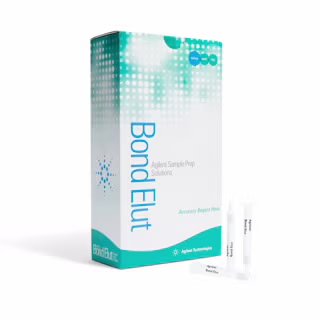
Agilent Technologies Bond Elut LMS | Large Molecule Size
Agilent Technologies Bond Elut LMS | Large Molecule Size — Sample preparation.
Bond Elut LMS is a 150 mg / 6 mL solid-phase extraction cartridge built for large-molecule sample cleanup. It sits in the Bond Elut series alongside Carbon S, ENV, Focus and HLB sorbents, and is applied upstream of LC/MS determination in methods such as EPA 1633 for PFAS in wastewater.
Agilent Technologies Bond Elut Series — Model Comparison & Selection
| Model | Pumping speed, m³/h | Sample volume, milliliter | Drying gas temperature, °C | Average recovery all compounds, % | Cartridge sorbent mass, mg | Centrifugation speed, rpm |
|---|---|---|---|---|---|---|
| Bond Elut LMS | Large Molecule Size Current | — | 0.005 | — | — | — | 2800 |
| Bond Elut Carbon S & Carbon S/NH2 | 0.024 | 0.005 | 230 | 99.2 | 150 | 1900 |
| Bond Elut HLB | SPE Sorbent | 1.8×10⁻⁵ | 0.002 | 40 | 73.4...118 | 500 | — |
| Bond Elut Lipid Extraction | 3...5 | — | 30 | — | — | — |
Full specifications
| Centrifugation Speed | 2800 rpm |
| Centrifugation Time | 10 minutes |
| Column temperature | 40 °C |
| Post Time | 2.0 min |
| Sample volume | 5 µL |
| Spe Cartridge Volume | 6 mL |
| LC gradient flow rate mfr | 0.4 mL/min |
| LC stop time mfr | 12.2 min |
| Number of PFAS analytes covered by EPA Method 1633 mfr | 40 |
| PFBA initial MDL (Bond Elut PFAS WAX) mfr | 0.38 ng/L |
| PFBA aqueous MDL mfr | 0.79 ng/L |
| PFOA initial MDL (Bond Elut PFAS WAX) mfr | 0.23 ng/L |
| PFOA aqueous MDL mfr | 0.54 ng/L |
| PFOS initial MDL (Bond Elut PFAS WAX) mfr | 0.39 ng/L |
| PFOS aqueous MDL mfr | 0.63 ng/L |
| PFHxS initial MDL (Bond Elut PFAS WAX) mfr | 0.26 ng/L |
| PFHxS aqueous MDL mfr | 0.54 ng/L |
| PFBA spiked concentration mfr | 50 ng/L |
| PFBA average recovery mfr | 91 |
| PFOA spiked concentration mfr | 12.5 ng/L |
| PFOA average recovery mfr | 96 |
| PFOS spiked concentration mfr | 12.5 ng/L |
| PFOS average recovery mfr | 97 |
| PFDoS average recovery mfr | 48 |
| 5:3 FTCA average recovery mfr | 153 |
| Gradient flow rate mfr | 0.4 mL/min |
| Stop time mfr | 12.2 min |
| Number of PFAS analytes covered mfr | 40 |
| MDL PFBA mfr | 0.38 ng/L |
| MDL PFHxA mfr | 0.09 ng/L |
| MDL PFOA mfr | 0.23 ng/L |
| MDL PFOS mfr | 0.39 ng/L |
| MDL PFHxS mfr | 0.26 ng/L |
| MDL HFPO-DA mfr | 0.60 ng/L |
| MDL 5:3 FTCA mfr | 3.77 ng/L |
| Average recovery PFBA mfr | 91 |
| Average recovery PFOA mfr | 96 |
| Average recovery PFOS mfr | 97 |
| Average recovery PFDoS mfr | 48 |
| Average recovery 5:3 FTCA mfr | 153 |
| Average recovery 7:3 FTCA mfr | 141 |
| Average recovery NFDHA mfr | 48 |
| Average recovery 3:3 FTCA mfr | 114 |
| UHPLC Guard Column mfr | 18 μm |
| Analytical Column mfr | 18 μm |
| Delay Column mfr | 4.6 mm |
| Gradient Flow Rate mfr | 0.4 mL/min |
| Stop Time mfr | 12.2 min |
| PFBA mfr | 0.38 |
| PFPeA mfr | 0.71 |
| PFHxA mfr | 0.09 |
| PFHpA mfr | 0.19 |
| PFOA mfr | 0.23 |
| PFNA mfr | 0.15 |
| PFDA mfr | 0.15 |
| PFUnA mfr | 0.13 |
| PFDoA mfr | 0.29 |
| PFTrDA mfr | 0.33 |
| PFTeDA mfr | 0.38 |
| PFBS mfr | 0.12 |
| PFPeS mfr | 0.15 |
| PFHxS mfr | 0.26 |
| PFHpS mfr | 0.21 |
| PFOS mfr | 0.39 |
| PFNS mfr | 0.15 |
| PFDS mfr | 0.23 |
| PFDoS mfr | 0.44 |
| PFOSA mfr | 0.20 |
| NMeFOSA mfr | 0.09 |
| NEtFOSA mfr | 0.17 |
| NMeFOSAA mfr | 0.27 |
| NEtFOSAA mfr | 0.34 |
| NMeFOSE mfr | 1.41 |
| NEtFOSE mfr | 1.97 |
| HFPO-DA mfr | 0.60 |
| ADONA mfr | 0.26 |
| PFMPA mfr | 0.36 |
| PFMBA mfr | 0.13 |
| NFDHA mfr | 0.38 |
| PFEESA mfr | 0.26 |
| Sample size mfr | 500 mL |
| SPE load flow rate mfr | 5 mL/min |
| SPE conditioning volume (methanolic ammonium hydroxide) mfr | 15 mL |
| SPE conditioning volume (formic acid) mfr | 5 mL |
| Acetic acid addition volume mfr | 25 μL |
| PFOS retention time mfr | 7.1 minutes |
| Spe Cartridge Sorbent Mass | 150 mg |
| Carbon S mass per sample mfr | 10 mg |
| Mobile Phase mfr | 2 Acetonitrile |
Description
Construction and series positioning
- Bond Elut LMS is a 150 mg sorbent bed in a 6 mL cartridge format, the standard SPE column geometry for gravity or vacuum-manifold processing of aqueous samples.
- Within the Bond Elut series it is the large-molecule size variant; sibling sorbents (Carbon S & Carbon S/NH2, ENV, Focus, HLB) cover different selectivity and cleanup roles, so LMS is selected when the target/analyte profile is macromolecular rather than for a generic reversed-phase retention.
Behavior and method context
- The attached application note documents a PFAS workflow using Bond Elut PFAS WAX (150 mg, 6 mL) with Carbon S cleanup, not LMS itself; its performance figures (e.g. PFOA 96%, PFOS 97%, PFBA 91% average recovery; PFDoS 48%; 5:3 FTCA 153%) belong to that WAX/Carbon S configuration and should not be transferred to LMS.
- The LC side of that method runs 0.4 mL/min with a 12.2 min stop time and covers 40 PFAS analytes under EPA Method 1633; these are downstream LC/MS conditions, not cartridge ratings.
Installation and operation
- No installation, connection or control facts specific to the LMS cartridge are present in the supplied digests; the cartridge is a passive consumable used on standard SPE vacuum manifolds, and operating details must come from the current Agilent Bond Elut method guide for the LMS sorbent.
Integration & Operating Notes
The only performance data supplied (recoveries, MDLs, LC gradient) were generated on Bond Elut PFAS WAX with Carbon S cleanup, a different sorbent configuration. Method validation for LMS must be established separately before use in a regulated PFAS workflow.
SPE cartridges are consumables and are not regenerated in routine practice. Confirm the 150 mg / 6 mL LMS lot and sorbent identity against the method before conditioning, since the supplied documents do not list regeneration or cleaning procedures for this sorbent.
The LMS cartridge has no powered or signal interface; flow control, vacuum and fraction collection are provided by the SPE manifold and the downstream LC/MS system. Electrical and I/O requirements therefore belong to the manifold and instrument, not to this part.
Selection & Integration Q&A
Pick LMS when the method targets large-molecule analytes and a 150 mg / 6 mL bed is appropriate. Choose Carbon S for cleanup of small polar interferences, ENV for environmental water matrices, or HLB for broad reversed-phase retention; the supplied facts give no cross-sorbent recovery comparison, so confirm by method trial.
The cartridge needs a standard SPE vacuum manifold or positive-pressure processor and a downstream LC/MS or LC-UV system. The supplied method context uses 0.4 mL/min LC flow and a 12.2 min stop time on a 1290 Infinity II LC with a 6470 triple quadrupole, but those are instrument settings, not cartridge requirements.
The supplied specification sheet and application digest contain no temperature, pressure, humidity or duty-cycle limits for the LMS cartridge. Operating limits must be taken from the current Agilent Bond Elut method guide for this sorbent; do not assume the PFAS WAX method conditions apply.
The cartridge is a single-use consumable; no regeneration schedule is given in the supplied documents. Manifold tubing, vacuum source, conditioning solvents, Carbon S cleanup cartridges and LC columns/MS consumables are separate items and are not part of the LMS cartridge delivery.