
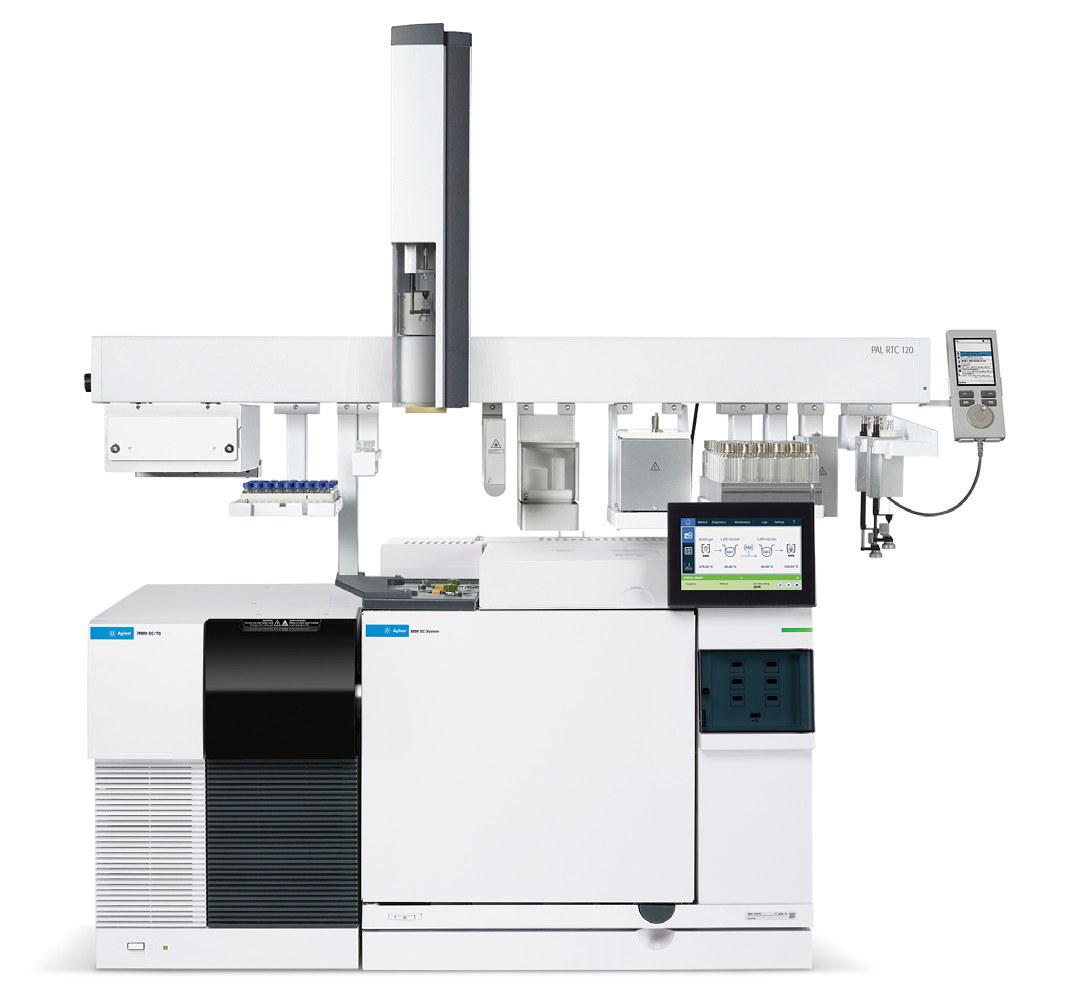
Agilent Technologies PAL3 autosampler, automated solid phase extraction
Agilent Technologies PAL3 autosampler, automated solid phase extraction — Gas chromatography.
The PAL3 autosampler is a robotic front-end for GC and GC/MS that automates solid-phase extraction and SPME sample preparation. It is distinguished within the series by its RTC (robotic tool change) configuration, which enables automated SPE and SPME workflows. It serves as the sample-introduction and preparation stage for trace analysis, including pesticides in durian and aldehydes in beer.
Agilent Technologies GC Sample Preparation Introduction Series — Model Comparison & Selection
| Model | Sample volume, milliliter | Analysis time, min | Bake flow, mL/min | Bake temperature, °C | Bake time, min | Calibration concentration, µg/ml |
|---|---|---|---|---|---|---|
| PAL3 autosampler, automated solid phase extraction Current | — | — | — | — | — | — |
| GC autosampler, GC sample injection | 0.001 | 80 | — | — | — | 100 |
| purge and trap, volatile organic compounds analysis | — | — | 200 | 280 | 2 | — |
| Reliable, consistent GC introduction of liquefied gases | — | — | — | — | — | — |
Full specifications
| Carrier gas | Helium |
| Carrier Gas Flow | 1.2 mL/min |
| Number of target pesticides mfr | 197 |
| Analytical system mfr | 3 GC/MSD |
| Sample matrix mfr | 1 ratio |
| Recovery criterion mfr | 70...120 |
| Precision criterion (RSD) mfr | 20 |
| Quantification limit range mfr | 3...100 ppb |
| MRM database size mfr | 1100 compounds |
| MRMs per compound mfr | 10 |
| Flavor threshold, hexanal mfr | 350 μg/L |
| Flavor threshold, furfural mfr | 15.157 mg/L |
| Flavor threshold, phenylacetaldehyde mfr | 105 μg/L |
| Flavor threshold, trans-2-nonenal mfr | 0.1 μg/L |
| Calibration range, hexanal mfr | 0.05...10 μg/L |
| Calibration range, furfural mfr | 5...1,000 μg/L |
| Calibration range, phenylacetaldehyde mfr | 0.1...50 μg/L |
| Calibration range, trans-2-nonenal mfr | 0.025...5 μg/L |
| Coefficient of determination R2, hexanal mfr | 0.999 |
| Coefficient of determination R2, furfural mfr | 0.998 |
| Coefficient of determination R2, phenylacetaldehyde mfr | 0.996 |
| Coefficient of determination R2, trans-2-nonenal mfr | 0.998 |
| Repeatability %RSD (n = 3), hexanal in beer mfr | 1.3...4.9 |
| Repeatability %RSD (n = 3), furfural in beer mfr | 1.3...2.8 |
| Repeatability %RSD (n = 3), phenylacetaldehyde in beer mfr | 0.9...3.7 |
| Repeatability %RSD (n = 3), trans-2-nonenal in beer mfr | 1.7...2.8 |
| Method detection limit, hexanal mfr | 0.0009 μg/L |
| Method detection limit, furfural mfr | 0.52 μg/L |
| Method detection limit, phenylacetaldehyde mfr | 0.015 μg/L |
| Method detection limit, trans-2-nonenal mfr | 0.003 μg/L |
| Inlet liner mfr | 5190 Ultra |
| Ion source drawout lens diameter mfr | 9 mm |
| Autotune algorithm mfr | etune etune |
| Software version mfr | 10.1 |
| Calibration range mfr | 0.01...0.5 μg/mL |
| LLOQ mfr | 0.02 μg/mL |
| Number of analytes tested mfr | 100 |
| Internal standard mfr | Chlorpyrifos- |
| Ion source drawout lens part number mfr | 3870 |
Description
Construction and positioning
- The PAL3 is a robotic autosampler platform for gas chromatography, configured here for automated solid-phase extraction (SPE) and SPME sample preparation.
- Within the series, sibling models cover basic GC automatic injection, GC sample injection, headspace sampling, and intelligent headspace sampling. This modification is the sample-preparation variant, adding robotic tool change (RTC) capability for multi-step extraction workflows.
- The system is used with GC/MSD analytical platforms, including the 7000E triple quadrupole and 5977C single quadrupole, as documented in application notes.
Behavior and analytical performance
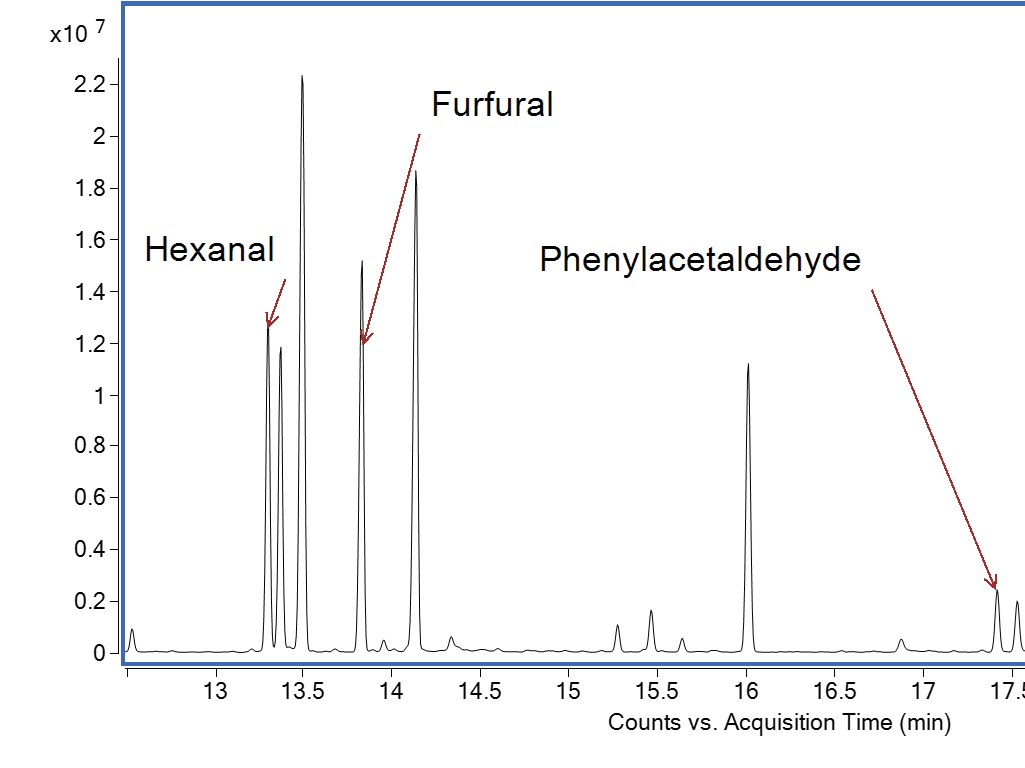
- Documented applications include 197 pesticides in durian (with recovery criterion 70–120% and precision RSD ≤20%) and four aldehydes in beer (hexanal, furfural, phenylacetaldehyde, trans-2-nonenal).
- For aldehydes in beer, calibration ranges span 0.05–10 µg/L (hexanal), 5–1,000 µg/L (furfural), 0.1–50 µg/L (phenylacetaldehyde), and 0.025–5 µg/L (trans-2-nonenal), with coefficients of determination R² ≥0.996.
- Repeatability %RSD (n=3) for these aldehydes ranges from 0.9% to 4.9%, and method detection limits are as low as 0.0009 µg/L (hexanal).
- The carrier gas is helium at 1.2 mL/min.
Installation and operation
- The system is controlled as part of the GC/MS workflow; application notes describe automated sample preparation sequences for SVOCs in water per EPA 8270E, pesticides in durian, and aldehydes in beer.
- No electrical, dimensional, or environmental specifications are provided in the verified facts; installation requirements must be obtained from the instrument manual.
Integration & Operating Notes
The PAL3 executes sample preparation steps (SPE, SPME) before injection. The GC/MS must be started only after the autosampler signals that the sample is ready; otherwise the injection may occur before extraction is complete, leading to low or erratic responses. Configure the start-signal handshake in the chromatography data system method.
For the pesticide method, recovery must fall within 70–120% and precision RSD must not exceed 20%. Results outside these limits indicate a problem in the sample preparation or analytical sequence and should trigger investigation before reporting data.
Selection & Integration Q&A
Choose this PAL3 configuration when the method requires automated solid-phase extraction or SPME sample preparation before GC injection, as in trace aldehyde or pesticide analysis. For simple liquid injection without preparation, a basic GC autosampler suffices; for volatile-only matrices, a headspace sampler is more appropriate.
The verified facts do not include environmental or duty-cycle specifications. Consult the instrument manual for operating temperature, humidity, and duty-cycle limits before installing the system in a laboratory environment.
The method specifies an Ultra inlet liner (part number beginning 5190) for the GC inlet. SPME fibers and SPE cartridges are also required for the preparation steps but are not listed in the verified facts; order them separately according to the application note.
Dimensional Drawings & Technical Documentation
Dimensional drawings
Click drawing to inspect vector dimensions